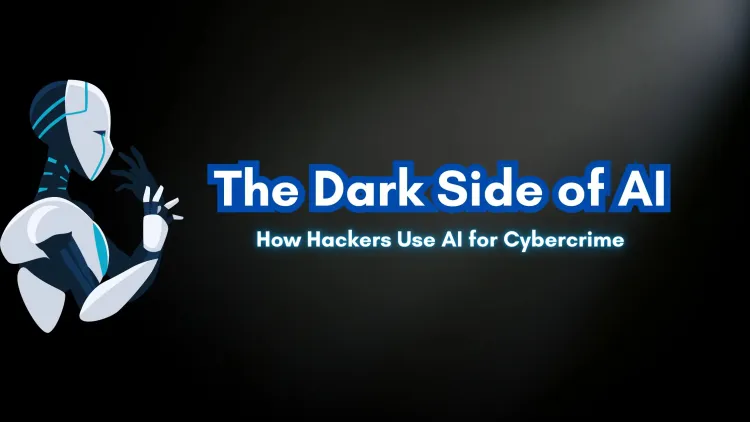
The Dark Side of AI | How Hackers Are Weaponizing Artificial Intelligence for Cybercrime
AI is changing cybersecurity, but it is also being weaponized by hackers to conduct more sophisticated cyberattacks. Cybercriminals are using AI-powered hacking tools to automate phishing scams, create deepfake frauds, crack passwords using AI-driven brute force, and develop self-learning malware that adapts to security defenses in real time. AI is also playing a major role in social engineering attacks, cyber espionage, and misinformation campaigns, making it a double-edged sword. This post covers how hackers are using AI to enhance cybercrime, real-world cases of AI-powered attacks, and the best strategies to defend against AI-driven cyber threats. With cybercriminals using AI for fraud, identity theft, and large-scale hacking operations, cybersecurity experts must use AI-based security tools to counteract these threats.
Quick answer: Hackers misuse AI to craft convincing phishing, produce deepfake audio and video, speed up reconnaissance and tweak malware to avoid detection. The best defence is layered: awareness training, multi-factor authentication, email and endpoint filtering, and a tested incident response plan, with AI tools used on the defending side too.
Key takeaways
- Voice cloning calls rely on urgency, so hang up and call back.
- Malware tweaked by AI can evade basic scanners.
- Layer email filtering, endpoint tools and training.
Table of Contents
- Introduction
- How Are Hackers Using AI for Cyber Attacks?
- What Are the Real-Life Cases of AI-Powered Cybercrime?
- How to Defend Against AI-Powered Cyber Threats?
- Conclusion
Introduction
Artificial Intelligence (AI) is changing industries, improving automation, and enhancing cybersecurity. However, just as AI is being used for defense, hackers and cybercriminals are weaponizing AI to launch sophisticated attacks. AI-powered cybercrime is becoming a major threat, as it enables hackers to automate attacks, bypass security systems, and exploit vulnerabilities faster than ever before.
From AI-driven phishing scams and deepfake frauds to AI-powered malware and automated hacking, cybercriminals are finding innovative ways to use AI for malicious purposes. Here is how hackers are using AI to attack individuals, businesses, and governments, and what can be done to counter these threats.
How Are Hackers Using AI for Cyber Attacks?
1. AI-Generated Phishing Scams
Phishing scams have always been a major cyber threat, but AI has made them far more dangerous. Cybercriminals use machine learning algorithms to analyze social media activity, email patterns, and online behaviors to craft highly personalized phishing emails. These emails are grammatically perfect and contextually relevant, making them almost impossible to distinguish from legitimate messages.
Example: Hackers used AI to generate realistic phishing emails that impersonated a CEO, tricking employees into transferring millions of dollars to fraudulent accounts.
2. Deepfake Technology for Fraud
Deepfake AI can create realistic audio and video impersonations, allowing hackers to impersonate executives, celebrities, or politicians for fraud and misinformation campaigns.
Example: In 2019, cybercriminals used deepfake AI to impersonate a CEO’s voice and tricked an employee into wiring $243,000 to a fraudulent account.
3. AI-Powered Malware & Ransomware
Hackers use AI to create self-learning malware that can evade detection, modify its attack strategy, and adapt to security defenses in real time. AI-powered ransomware encrypts data faster and more efficiently, making recovery even more difficult.
Example: AI-driven malware like Emotet and TrickBot use machine learning to analyze system defenses and adjust their attack methods accordingly.
4. Automated Brute-Force Attacks
Traditional brute-force attacks rely on guessing passwords through trial and error. AI-powered brute-force attacks use neural networks to analyze common password patterns, dramatically increasing the speed and efficiency of password cracking.
Example: AI tools like PassGAN (Password Generating Adversarial Network) can crack weak passwords in seconds.
5. AI in Social Engineering Attacks
Hackers use AI to analyze voice patterns, social media behavior, and communication styles to create more convincing scams. AI-driven chatbots can engage in real-time conversations to manipulate users into revealing sensitive information.
Example: AI-powered bots have been used to impersonate customer service representatives and trick users into providing bank details and login credentials.
6. AI for Cyber Espionage & Surveillance
AI-powered hacking tools help cybercriminals and state-sponsored hackers conduct automated reconnaissance, monitor targets, and extract sensitive data from governments, businesses, and individuals.
Example: APT groups (Advanced Persistent Threats) use AI-driven cyber espionage to steal classified government documents and conduct surveillance on high-profile individuals.
7. AI-Generated Fake News & Disinformation Campaigns
AI-generated fake news and misinformation campaigns have become a powerful tool for hackers and cybercriminals. AI can generate thousands of fake articles, social media posts, and videos to manipulate public opinion and disrupt economies.
Example: AI-driven bots have been used to spread fake news during elections, influencing voter decisions and destabilizing democracies.
What Are the Real-Life Cases of AI-Powered Cybercrime?
| Case | AI Technology Used | Impact |
|---|---|---|
| $243,000 CEO Voice Scam | Deepfake AI | Employee transferred money to fraudsters |
| PassGAN Password Cracking | AI-Powered Brute Force | Cracked passwords in seconds |
| AI-Generated Phishing Emails | Machine Learning | Bypassed traditional email filters |
| Automated Malware (Emotet, TrickBot) | AI-Based Malware | Infected thousands of devices worldwide |
| Deepfake Political Misinformation | AI-Generated Fake News | Manipulated election results |
How to Defend Against AI-Powered Cyber Threats?
While hackers are weaponizing AI, cybersecurity experts are also using AI-driven defense mechanisms to detect and prevent cyberattacks. Here are some strategies to protect against AI-powered threats:
1. AI-Based Cybersecurity Solutions
Deploy AI-powered security tools to detect anomalies, identify phishing attempts, and monitor network traffic in real time.
2. Multi-Factor Authentication (MFA)
Enable MFA on all accounts to prevent unauthorized access, even if passwords are compromised.
3. Deepfake Detection Tools
Use AI-based deepfake detection software to analyze suspicious videos and voice recordings for forgeries.
4. Employee Security Awareness Training
Train employees to recognize AI-driven phishing emails, social engineering tactics, and deepfake scams.
5. Strict Data Security Policies
Enforce strict password policies, access control measures, and data encryption to reduce security risks.
6. Regular Security Updates
Keep software and security systems up to date to protect against AI-powered malware and exploits.
Conclusion
AI is a double-edged sword in cybersecurity. While it is changing cyber defense, it is also being weaponized by hackers to automate attacks, create deceptive scams, and bypass security measures. As cybercriminals continue to use AI for malicious purposes, individuals and businesses must adopt AI-driven cybersecurity solutions, strict security protocols, and continuous awareness training to stay ahead of these evolving threats.
The future of cybersecurity will be an AI vs. AI battle, where ethical AI must outsmart malicious AI to protect digital assets and sensitive data.
To take this further with guided labs and an instructor, see our cyber security fundamentals programme.
Related reading
- How AI is Enabling a New Era of Cybercrime | A Threat to Digital Security
- AI in Cybercrime | How Artificial Intelligence is Powering Modern Cyber Threats
- Is AI Making Hacking Easier for Attackers? Exploring the Threats and Countermeasures
Reference
For the authoritative details, see CERT-In (India).
Frequently Asked Questions
What's Your Reaction?
 Like
0
 Dislike
0
 Love
0
 Funny
0
 Wow
0
 Sad
0
 Angry
0

Vaishnavi is a skilled tech professional at the Ethical Hacking Training Institute in Pune, responsible for managing and optimizing the technical infrastructure that supports advanced cybersecurity education. With deep expertise in network security, backend operations, and system performance, she ensures that practical labs, online modules, and assessments run smoothly and securely. Her behind-the-scenes contributions play a vital role in delivering a seamless and secure learning experience for aspiring ethical hackers.