Top AI Chatbots for Cybersecurity Professionals: Threat Detection, Incident Response, Pentesting
As cyber threats grow more complex, cybersecurity professionals need intelligent AI chatbots to assist in threat detection, penetration testing, incident response, and security automation. AI-powered security chatbots like IBM Watson, Darktrace AI, PentestGPT, OffensiveGPT, and Microsoft Security Copilot are transforming how security teams analyze threats, respond to incidents, and strengthen security postures. This blog explores the best AI chatbots for cybersecurity professionals, comparing their features, use cases, and benefits for modern security operations.
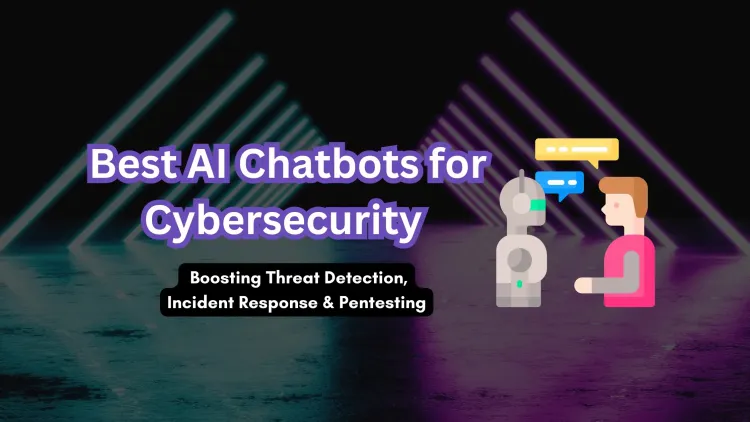
Quick answer: The AI chatbots cybersecurity professionals actually use in 2026 fall into three groups. SOC assistants built into security platforms, such as Microsoft Security Copilot, CrowdStrike Charlotte AI, SentinelOne Purple AI, Google's Gemini in Security Operations and Darktrace Cyber AI Analyst. Research tools for authorised testing, such as PentestGPT. And general assistants like ChatGPT, Claude and Gemini for scripting, analysis and reports.
Key takeaways
- Match the chatbot to the job: SIEM-embedded assistants such as Security Copilot for investigations, general assistants for explanations, and PentestGPT-type agents only for authorised testing.
- Treat every AI answer as a lead to verify against logs, because these tools can sound confident and still be wrong.
- Check data handling before use: confirm where queries and alerts are stored, who can see them and whether they train models.
"AI chatbot for security" now covers everything from a chat box inside your SIEM to an open-source research agent on GitHub. This guide sorts the main options by the job they do, what each is good at, and the limits and data risks you should weigh before trusting one with an investigation.
What do AI chatbots do for security teams?
Security chatbots let analysts ask questions in plain language and get answers drawn from their logs, alerts and threat intelligence. In practice they help with five jobs:
- Alert triage: summarise an alert or incident, pull related events and suggest whether it needs escalation.
- Investigation: turn a question such as "which hosts talked to this IP last week?" into a query for the SIEM or EDR.
- Script and query help: explain a suspicious PowerShell command, write a KQL or Splunk query, or draft a detection rule.
- Threat intelligence: summarise what is known about a malware family, vulnerability or threat actor.
- Reporting: draft incident summaries, executive briefings and penetration test findings.
What they don't do is replace analyst judgement. They speed up the routine parts so people can spend more time on decisions.
The main options at a glance
| Assistant | Type | Best for | Works with |
|---|---|---|---|
| Microsoft Security Copilot | Platform SOC assistant and agents | Microsoft-centred SOCs | Defender, Sentinel, Entra, Intune, Purview |
| CrowdStrike Charlotte AI | Platform SOC assistant | Teams on CrowdStrike Falcon | Falcon endpoint, identity and SIEM data |
| SentinelOne Purple AI | Platform SOC assistant | Threat hunting in plain language | SentinelOne Singularity data |
| Gemini in Security Operations | Platform SOC assistant | Teams on Google Security Operations | Google SecOps SIEM/SOAR and Google threat intelligence |
| Darktrace Cyber AI Analyst | AI investigation engine | Network and email anomaly investigations | Darktrace platform |
| PentestGPT | Open-source research agent | Authorised testing, CTFs and labs | An LLM backend you supply |
| ChatGPT, Claude, Gemini | General AI assistants | Scripts, explanations, documentation | Whatever you paste or connect |
Platform assistants are only as useful as the data underneath, so the right choice usually follows the security stack you already run.
Microsoft Security Copilot
Security Copilot is Microsoft's generative AI assistant for security teams, working across Defender, Sentinel, Entra, Intune and Purview. Analysts use it to summarise incidents, analyse scripts, write hunting queries and run "agents" that handle repeatable tasks such as phishing triage.
The big 2026 change is licensing. Microsoft now includes Security Copilot in Microsoft 365 E5 and E7, with a monthly allowance of Security Compute Units based on licence count, rolled out in phases from November 2025 (Microsoft Learn). If your organisation has E5, check whether it is already switched on before you buy anything else.
Watch out for: heavy use can exceed the included allowance, and results depend on how well your Microsoft security tools are deployed and tuned.
CrowdStrike Charlotte AI and SentinelOne Purple AI
Both are assistants built into an EDR/XDR platform. You ask questions in natural language, and they search the platform's telemetry, explain detections and suggest response steps.
- Charlotte AI sits inside CrowdStrike Falcon and helps with detection triage, investigation and summarising activity across endpoints and identities.
- Purple AI sits inside SentinelOne Singularity and is aimed at threat hunting: it turns plain-language questions into queries and summarises what it finds.
Choose based on the platform you already have. Neither makes sense on its own without its parent product.
Gemini in Security Operations
Google builds Gemini into Google Security Operations (its SIEM and SOAR platform). Analysts can search events in natural language, get case summaries, and draw on Google and Mandiant threat intelligence. It is the natural fit if your logs already live in Google SecOps.
Darktrace Cyber AI Analyst
Darktrace's Cyber AI Analyst investigates anomalies that Darktrace's self-learning models detect on networks, cloud and email, and writes up incident reports. It is less a chatbot you talk to and more an automated investigator that hands analysts a summary. Like the others, it depends on the Darktrace platform being in place.
PentestGPT and AI for authorised testing
PentestGPT is an open-source research project that uses large language models to guide and, in its newer agentic version, automate parts of penetration testing and capture-the-flag challenges. The official repository states it is for education and authorised testing only, and it needs an LLM backend you configure.
Use it in your own lab or on targets you have written permission to test. It is good for learning methodology and getting unstuck on practice machines. It is not a substitute for a tester's judgement, and its suggestions can be wrong or noisy. Older lists also mention "OffensiveGPT" and "SOCGPT"; we couldn't confirm a maintained, official product behind either name, so treat any tool using those names with caution. For more on how PentestGPT compares with similar tools, see PentestGPT vs OffensiveGPT.
Testing systems without authorisation is an offence under India's IT Act, 2000, whether or not an AI tool did the typing.
General AI assistants: ChatGPT, Claude and Gemini
General assistants are often the most-used AI tools in a security team, simply because everyone has access. Good uses include:
- Explaining an obfuscated script or an unfamiliar log format.
- Writing or reviewing a Sigma, YARA, KQL or Splunk query.
- Drafting a Python or Bash script to parse logs.
- Turning rough notes into an incident report or a client-ready finding.
- Studying for certifications by asking for explanations and practice scenarios.
The rule that matters most: don't paste confidential data into a consumer chatbot. Client logs, internal IPs, credentials and personal data belong only in tools covered by your organisation's enterprise agreement and data-handling policy. Many companies in India now have an AI usage policy for exactly this reason, and personal data is also covered by the Digital Personal Data Protection Act, 2023.
How to choose the right AI assistant
| If you are... | Start with |
|---|---|
| A SOC on Microsoft 365 E5 / Defender / Sentinel | Security Copilot (check if it's already included) |
| A SOC on CrowdStrike or SentinelOne | Charlotte AI or Purple AI respectively |
| A team running Google Security Operations | Gemini in Security Operations |
| A penetration tester or student | A general assistant for scripting and reports, plus PentestGPT in a lab |
| A small team with no SIEM | A general assistant under a business plan, with a clear data policy |
Before you roll anything out, ask four questions: where does our data go and is it used for training; what can the assistant actually access and change; how do we check its answers; and what does it cost at our real usage?
Risks and limits you need to plan for
- Wrong answers stated confidently: AI can invent log fields, CVE details or commands. Verify anything that drives a decision.
- Data leakage: pasting sensitive data into the wrong tool can breach contracts and privacy law.
- Prompt injection: if an assistant reads emails, web pages or tickets, attackers can hide instructions in that content. Limit what actions an AI agent can take without human approval.
- Over-automation: letting an agent isolate hosts or disable accounts without review can cause outages.
- Skill erosion: junior analysts still need to learn how to read logs and investigate without help.
- Misuse: attackers use the same models for phishing and scripting, which is one more reason defenders should understand them.
For a wider view of where AI helps and hurts in security, read 20 use cases of generative AI in cybersecurity.
What this means for your career
Employers increasingly expect SOC analysts and testers to use AI assistants well: writing good prompts, checking outputs, and knowing when not to trust them. The underlying skills still matter more, though. An analyst who understands Windows event logs, network traffic and attacker techniques gets far more out of Security Copilot or Purple AI than one who doesn't.
Next step
Pick one real task you do every week, such as writing a hunting query or summarising an alert, and try it with the assistant your organisation already licenses. Compare the result with your own work and note where it saved time and where it was wrong. If you're building SOC skills from the ground up, the SOC analyst training covers the log analysis and investigation fundamentals these tools rely on.
Related reading
Frequently Asked Questions
What's Your Reaction?
 Like
0
Like
0
 Dislike
0
Dislike
0
 Love
0
Love
0
 Funny
0
Funny
0
 Wow
0
Wow
0
 Sad
0
Sad
0
 Angry
0
Angry
0

Vaishnavi is a skilled tech professional at the Ethical Hacking Training Institute in Pune, responsible for managing and optimizing the technical infrastructure that supports advanced cybersecurity education. With deep expertise in network security, backend operations, and system performance, she ensures that practical labs, online modules, and assessments run smoothly and securely. Her behind-the-scenes contributions play a vital role in delivering a seamless and secure learning experience for aspiring ethical hackers.











![Top 10 Famous Ethical Hackers in India [Updated 2026]](https://www.webasha.com/blog/uploads/images/202608/image_140x98_da23f65c290cfbf1237d77aec58a2f0f.jpg)