Ethical Hacking Certifications: Choose the Evidence You Need
Choose a certification by the capability you need to demonstrate and the requirements you can meet. Compare foundational knowledge, practical assessment and course preparation separately. Check the awarding body's current objectives, eligibility, exam rules and renewal terms before paying. A credential can support learning and an application, but its value depends on the role and the evidence behind it.
Topic: Ethical Hacking in Cybersecurity & Ethical Hacking · Certification preparation
Also covers: Cybersecurity Careers & Certifications, Cloud & Container Security
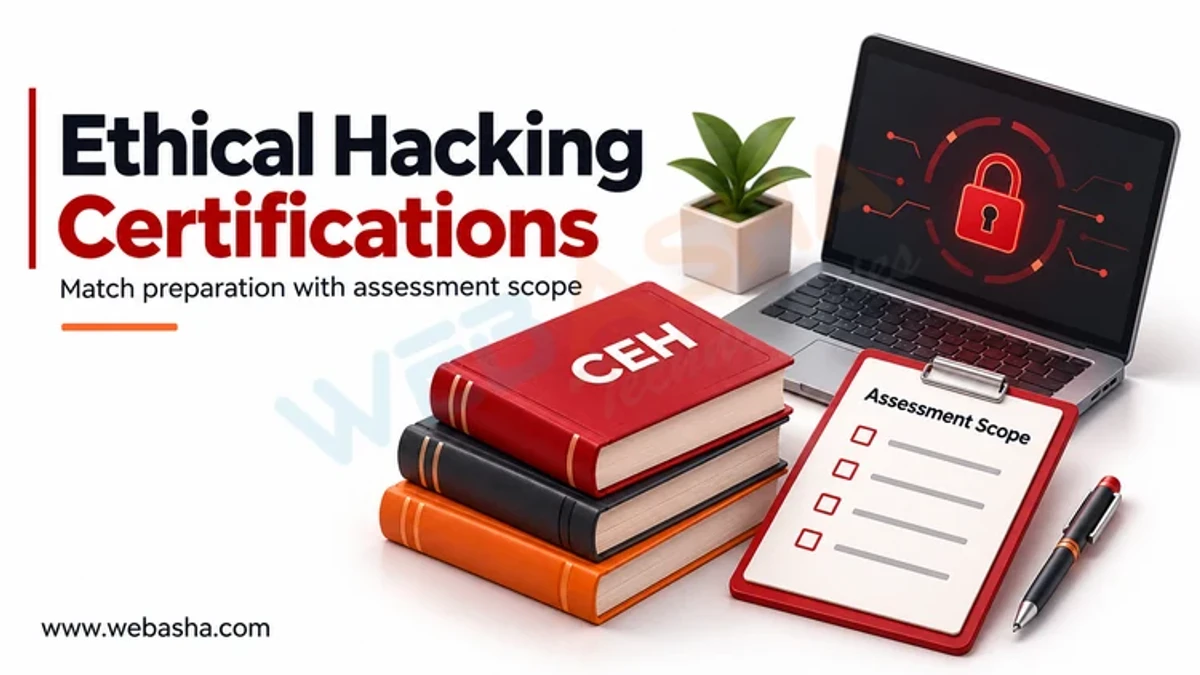
Quick answer: Choose a certification by the capability you need to demonstrate and the requirements you can meet. Compare foundational knowledge, practical assessment and course preparation separately. Check the awarding body's current objectives, eligibility, exam rules and renewal terms before paying. A credential can support learning and an application, but its value depends on the role and the evidence behind it. Use a small decision record explaining why one assessment fits your next step, rather than treating every named certification as a compulsory ladder.
Key takeaways
- Start with a demonstrated gap or role requirement.
- Separate foundational credentials from practical assessment.
- Check current eligibility with the awarding body.
- Compare exam, training and maintenance terms separately.
- Support credentials with explainable work.
Table of Contents
- What should a certification help you demonstrate?
- How do the assessment purposes differ?
- What should you check in a practical credential?
- How should you verify CEH-related requirements?
- When is a more demanding course the right next step?
- Which terms belong in a comparison worksheet?
- What should a sound credential decision look like?
- References
What should a certification help you demonstrate?
Consider two fictional learners. One understands basic security vocabulary but cannot yet explain a network service. The other administers systems and wants an assessed exercise involving penetration-testing work. They do not need identical purchases simply because both are interested in ethical hacking. Write down the missing capability and how an assessment would show progress.
The NIST NICE Framework: tasks, knowledge and skills gives a task-and-skill vocabulary for that decision. Look at the work you want to perform, then compare assessment objectives. Avoid collecting credentials because their names appear together in an online list. A clear purpose makes it easier to judge prerequisites, preparation effort and whether the result will be relevant to the next application.
How do the assessment purposes differ?
| Option | Purpose to examine | Important distinction |
|---|---|---|
| ISC2 CC | Entry-level security foundations | Not a penetration-testing credential |
| Cisco CCST Cybersecurity | Foundational cybersecurity concepts | Training and examination are separate steps |
| INE eJPT | Entry-level practical penetration-testing assessment | Read current objectives and exam rules |
| CEH and CEH Practical | Different assessment products | Check eligibility and exact product |
| OffSec PEN-200 and OSCP pathway | Penetration-testing preparation and assessment | Course access is not a passed credential |
The ISC2 Certified in Cybersecurity and Cisco CCST Cybersecurity course and objectives describe foundation-oriented options. Read their current scope rather than presenting either as proof of independent penetration-testing competence. Different assessments can be useful at different stages without forming a universal sequence that every learner must complete.
What should you check in a practical credential?
Read the tasks, environment, allowed resources, reporting requirements and assessment conditions. The INE eJPT certification presents entry-level practical penetration-testing objectives. Use those objectives to identify what you need to practise, rather than assuming that a course with a similar name covers every requirement or includes an examination attempt.
For the systems administrator in the example, compare the objectives with actual experience. They may be comfortable with operating systems but unfamiliar with assessment reporting. A preparation plan should address that gap. Ask how the exam's conditions relate to your normal study environment and what evidence you can share afterward, since exam confidentiality and lab publication rules can restrict portfolio material.
How should you verify CEH-related requirements?
Read the EC-Council examination eligibility rather than relying on an old description of who can apply. Its CEH route distinguishes official training from applying without that training and includes an experience requirement for the latter route. Confirm the current process and supporting documentation for your circumstances before buying a voucher.
The EC-Council CEH Practical describes CEH Practical as a separate hands-on assessment. Do not assume the names mean one purchase automatically includes every assessment or resulting credential. Ask for an itemised package that identifies training, examination, any application fee and access terms. If a seller makes a claim that differs from the awarding body's rules, obtain clarification before paying.
When is a more demanding course the right next step?
The OffSec PEN-200 prerequisites and course recommends practical Windows and Linux administration, networking and scripting foundations for PEN-200. Read the current syllabus and assessment information before choosing it as an entry point. Familiarity with a few tool names is different from being able to work through an unfamiliar problem and produce defensible evidence.
Use a readiness exercise: take a permitted lab note you wrote earlier and explain the system behaviour, your evidence and the next review step without a walkthrough. If basic terms or the report remain unclear, choose targeted preparation first. If the gaps are narrower, plan practice around those gaps rather than buying several unrelated foundation credentials.
Which terms belong in a comparison worksheet?
| Term | Question to resolve | Why it matters |
|---|---|---|
| Assessment | Which exact exam or credential is included? | Avoids product-name confusion |
| Access | When do materials and labs expire? | Determines available practice time |
| Retake | What happens after an unsuccessful attempt? | Changes the contingency plan |
| Maintenance | What renewal or continuing requirements apply? | Extends responsibility beyond passing |
| Eligibility | What evidence or route is required? | Prevents an unsuitable purchase |
Use the awarding body's current information for each row. Keep a dated copy of the offer privately and obtain missing conditions in writing. Avoid assuming that a discount changes the eligibility rules. Preparation time and the ability to practise consistently also belong in the decision, even when they do not appear on an invoice.
What should a sound credential decision look like?
Write three short sentences: the task you want to demonstrate, the evidence the assessment provides and the preparation gap you will address first. For the foundation learner, the next step might be a basic networking exercise before choosing a practical exam. For the administrator, it might be report review alongside a relevant assessment syllabus.
After studying, keep an independent lab example that you may legally share. Explain what the credential assessed and what your sample demonstrates beyond the badge. Verify any employer-specific requirement in the actual vacancy. A certificate can help communicate assessed learning, while authority, supervision and professional responsibility still depend on the work environment and the employer's expectations.
Related reading: compare course practice and feedback; check scripting foundations; read actual role requirements.
If you want instructor feedback, ask WebAsha for a syllabus, supervised lab arrangements and written access terms before enrolling.
References
Frequently Asked Questions
What's Your Reaction?
 Like
0
 Dislike
0
 Love
0
 Funny
0
 Wow
0
 Sad
0
 Angry
0

Vaishnavi is a skilled tech professional at the Ethical Hacking Training Institute in Pune, responsible for managing and optimizing the technical infrastructure that supports advanced cybersecurity education. With deep expertise in network security, backend operations, and system performance, she ensures that practical labs, online modules, and assessments run smoothly and securely. Her behind-the-scenes contributions play a vital role in delivering a seamless and secure learning experience for aspiring ethical hackers.