Online Ethical Hacking Courses: Compare Practice and Feedback
Choose an online course by the task you want to learn, your starting knowledge and the feedback you will receive. Compare a sample lesson and lab instructions before paying for a long programme. Web-security labs, general foundations and a penetration-testing course serve different purposes. Check prerequisites, access duration, assessment format and publication rules separately.
Topic: Ethical Hacking in Cybersecurity & Ethical Hacking · Course information
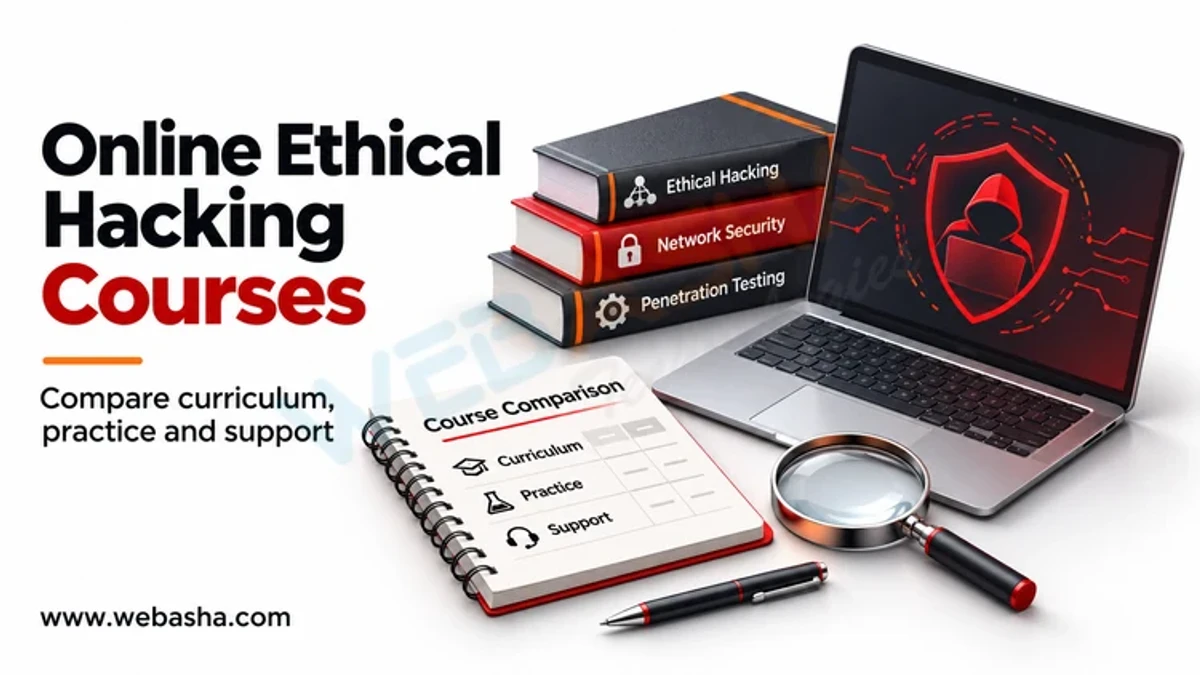
Quick answer: Choose an online course by the task you want to learn, your starting knowledge and the feedback you will receive. Compare a sample lesson and lab instructions before paying for a long programme. Web-security labs, general foundations and a penetration-testing course serve different purposes. Check prerequisites, access duration, assessment format and publication rules separately. A useful course leaves you able to explain a permitted exercise and improve your report after review, rather than only showing that you watched the lessons.
Key takeaways
- Start with a specific learning task and prerequisite check.
- Distinguish free study material from paid assessment access.
- Inspect the lab environment and feedback arrangements.
- Compare written terms before committing to a programme.
- Use a sample exercise to test the course fit.
Table of Contents
- What should you want to do after the course?
- How do different official learning resources compare?
- How should you check whether the level fits?
- What would a useful course trial look like?
- Which course features affect the quality of practice?
- What should you check before paying?
- How can you judge whether the course helped?
- References
What should you want to do after the course?
Write an outcome you can observe: "Explain an HTTP exchange in a permitted lab and write a short assessment note." That is more useful than "learn all hacking." If you cannot yet explain a request and response, begin with web foundations. If your target involves systems assessment, check networking and operating-system knowledge before selecting advanced exercises.
The NIST SP 800-50 Rev. 1: cybersecurity learning programs discusses learning programmes and evaluation. Apply the principle on a small scale: decide what the course should change in your ability and how you will check it. Keep the learning goal separate from an employment promise. Finishing lessons and demonstrating a task are related but different milestones.
How do different official learning resources compare?
| Resource | Useful learning direction | Check before choosing |
|---|---|---|
| PortSwigger Web Security Academy | Web-security material and interactive labs | Topic sequence and permitted use |
| Microsoft Learn security concepts | General security vocabulary and concepts | Whether depth matches the intended task |
| Cisco CCST Cybersecurity training | Entry-level cybersecurity foundations | Training objectives and exam distinction |
| OffSec PEN-200 | Penetration-testing course preparation | Recommended practical foundations and package terms |
The PortSwigger Web Security Academy and Microsoft Learn: cybersecurity concepts serve different learning needs. Neither should be presented as a complete substitute for every other programme. Read a sample lesson from the resource relevant to your goal, and judge whether you can follow the explanation without skipping terms you do not understand.
How should you check whether the level fits?
Try three small explanations before enrolling: how a browser reaches a service, how a user account relates to file permissions and what a command's input and output mean. If those are unclear, plan foundation study rather than assuming a difficult course will fill every gap automatically. Ask the provider which knowledge is taught and which is expected on entry.
The Cisco CCST Cybersecurity course and objectives lists foundations for its training. The OffSec PEN-200 prerequisites and course recommends practical Windows and Linux administration, networking and scripting knowledge for PEN-200. Those are statements about specific resources, not universal admission rules for ethical hacking. Use the actual provider's current requirements for the option you are considering.
What would a useful course trial look like?
Consider a learner who can use a browser but cannot explain HTTP state. They compare a short introductory lesson with a more advanced lab. After the introductory lesson, they should be able to identify a request, a response and a question that remains unclear. They should not need to copy a complete attack walkthrough to produce any explanation.
The MDN web development learning resources provides a foundation reference for the vocabulary in that trial. Set aside a quiet study session, take notes and write a short summary without replaying the lesson. If every sentence depends on unfamiliar terms, choose an earlier starting point. If the material is familiar, inspect a more relevant sample before committing.
Which course features affect the quality of practice?
| Feature | Question to ask | Evidence to request |
|---|---|---|
| Lab access | What environment is explicitly permitted? | Setup and scope instructions |
| Feedback | Who reviews reasoning and reports? | Example rubric or anonymised feedback |
| Assessment | What is tested beyond attendance? | Published objectives and format |
| Support | How are blocked exercises handled? | Written support terms |
| Access | When does material or lab access end? | Current enrolment conditions |
A live class can still provide little individual feedback, and self-paced study can still involve careful review if you arrange it. Ask about the actual process rather than assuming the delivery label answers the question. Make sure the timetable allows you to practise and revise instead of consuming lessons continuously.
What should you check before paying?
Separate training access, lab access, examination attempts and any certification application. The INE eJPT certification describes a particular practical credential and its objectives; buying a course with similar words in the title does not automatically include that credential. Check the exact package and current terms directly with the provider.
Record taxes, required software, access expiry, rescheduling conditions and refund terms in writing. Check prerequisites and any application process independently of a sales conversation. Avoid making a decision from a placement claim or a countdown banner. Choose the purchase only when you understand what work you will do, what feedback is available and which costs remain outside the quoted package.
How can you judge whether the course helped?
Repeat the original outcome after studying. Explain a new permitted example without following the exact lesson sequence. Write the evidence, your conclusion and one limitation, then ask someone to review it. If the reviewer cannot tell what you observed, revise the report before adding another course to your list.
For the learner studying HTTP, a useful result might be a clear description of how account state changes the conversation and why that matters for a lab question. The next course should address a demonstrated gap, such as permissions or reporting. Keep a short record of feedback and changes so you can see progress in work quality as well as completed lessons.
Related reading: assess programming foundations; plan hands-on practice; compare credential purposes.
If you want instructor feedback, ask WebAsha for a syllabus, supervised lab arrangements and written access terms before enrolling.
References
Frequently Asked Questions
What's Your Reaction?
 Like
0
 Dislike
0
 Love
0
 Funny
0
 Wow
0
 Sad
0
 Angry
0

Vaishnavi is a skilled tech professional at the Ethical Hacking Training Institute in Pune, responsible for managing and optimizing the technical infrastructure that supports advanced cybersecurity education. With deep expertise in network security, backend operations, and system performance, she ensures that practical labs, online modules, and assessments run smoothly and securely. Her behind-the-scenes contributions play a vital role in delivering a seamless and secure learning experience for aspiring ethical hackers.