Best Anti-Phishing Tools for SOC Analysts to Use
SOC analysts handle phishing with tools at each stage. Secure email gateways and Microsoft Defender for Office 365 or Google Workspace protections block most phishing, backed by DMARC, SPF and DKIM. Report buttons let users send suspicious messages to the SOC. For analysis, analysts use email header analysers, urlscan.io to safely view links, VirusTotal to check files and URLs, and sandboxes for attachments.
Topic: Cyber Threats, Scams & Online Safety in Cybersecurity & Ethical Hacking · Tools
Also covers: SOC & Blue Team
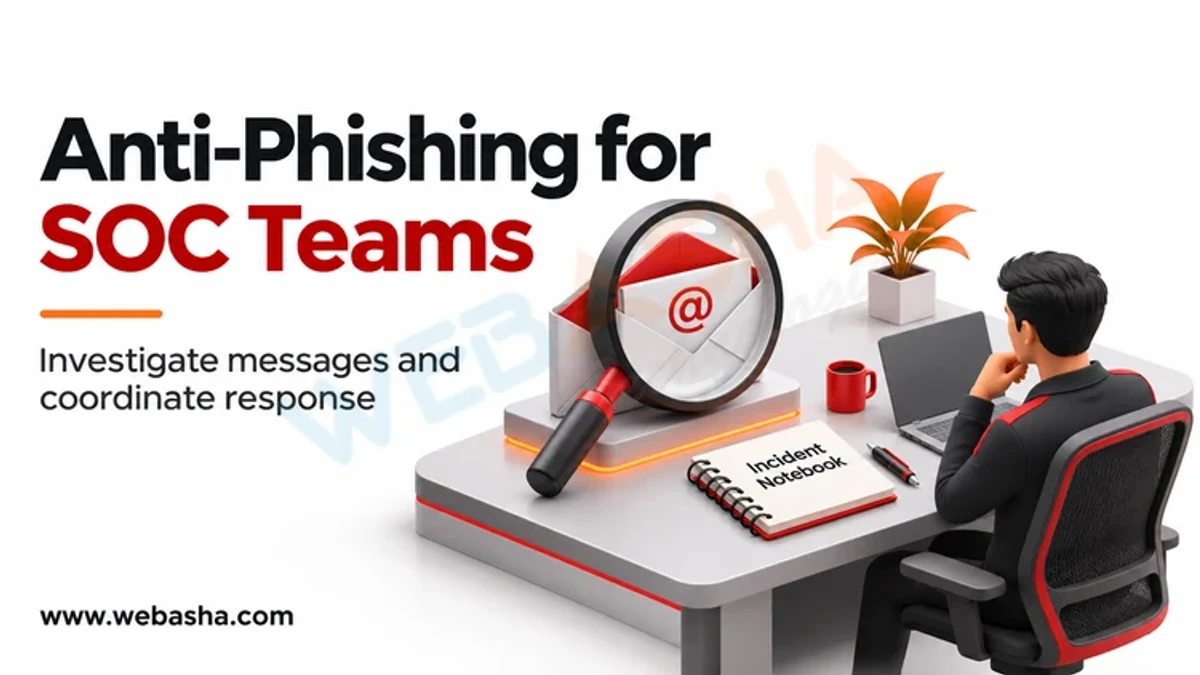
Quick answer: SOC analysts handle phishing with tools at each stage. Secure email gateways and Microsoft Defender for Office 365 or Google Workspace protections block most phishing, backed by DMARC, SPF and DKIM. Report buttons let users send suspicious messages to the SOC. For analysis, analysts use email header analysers, urlscan.io to safely view links, VirusTotal to check files and URLs, and sandboxes for attachments. Case management and SOAR platforms such as TheHive with Cortex or Microsoft's automated investigation group reports and automate lookups. Mailbox search and purge tools remove the same message from every inbox.
Key takeaways
- Combine prevention, reporting, analysis and response tools.
- Automate repetitive lookups so analysts focus on judgement.
- Never click suspicious links directly; use isolated scanners.
- Be careful submitting internal documents to public services.
- Purging similar messages quickly limits damage.
Table of Contents
- Which Tools Fit Each Stage?
- What Is a Phishing Triage Workflow?
- How Do You Analyse Email Headers?
- How Can SOAR Speed Up Phishing Response?
- What Should Analysts Be Careful About?
- Which Metrics Show the Phishing Programme Is Working?
- References
Which Tools Fit Each Stage?
| Stage | Tools |
|---|---|
| Prevention | Secure email gateway, Defender for Office 365, Google Workspace protections, DMARC |
| Reporting | Report Message add-ins, phishing mailbox |
| URL analysis | urlscan.io, browser isolation |
| File and hash reputation | VirusTotal |
| Attachment detonation | Sandboxes (commercial or self-hosted such as CAPE) |
| Case management and automation | TheHive and Cortex, Defender automated investigation |
| Response | Content search and purge, user and session revocation |
What Is a Phishing Triage Workflow?
- Receive the reported email with full headers (as an attachment, not forwarded).
- Check sender, return path and authentication results.
- Extract URLs, domains, IPs and attachment hashes.
- Check reputation and detonate safely.
- Decide: benign, spam, or phishing (T1566).
- If phishing: purge from all mailboxes, block indicators, check who clicked or replied.
- Reset and revoke sessions for anyone who entered credentials.
- Give feedback to the reporter.
How Do You Analyse Email Headers?
Authentication-Results: mx.example.com;
  spf=fail (sender IP 203.0.113.9 not permitted) smtp.mailfrom=payroll-example.com;
  dkim=none;
  dmarc=fail header.from=example.com
Return-Path: <[email protected]>
Reply-To: [email protected]
Red flags here: SPF and DMARC fail, the return path domain differs from the visible sender, and replies go to a free mail account. NIST SP 800-177 explains these authentication results.
How Can SOAR Speed Up Phishing Response?
- Automatically parse reported emails and extract indicators.
- Run reputation lookups and sandboxing in parallel.
- Group duplicate reports into one case.
- Offer one-click purge and block actions with analyst approval.
CISA's phishing guidance recommends combining such response capability with prevention and MFA.
What Should Analysts Be Careful About?
- Public scanners may make submissions visible to others; avoid uploading confidential documents.
- Use isolated browsers or virtual machines for any manual checks.
- Remove personal data from cases shared outside the team, in line with the DPDP Act.
- Report significant incidents to CERT-In within six hours.
Related: phishing that bypasses filters and how DMARC works. WebAsha offers SOC analyst training.
Which Metrics Show the Phishing Programme Is Working?
| Metric | Target trend |
|---|---|
| Time from first report to purge | Falling |
| User report rate | Rising |
| Accounts compromised via phishing | Falling |
| Share of users on phishing-resistant MFA | Rising |
| Reports answered with feedback | Near 100 percent |
CISA recommends phishing-resistant MFA as the strongest control, and NIST SP 800-61 Rev. 3 frames the response process.
References
Frequently Asked Questions
What's Your Reaction?
 Like
0
 Dislike
0
 Love
0
 Funny
0
 Wow
0
 Sad
0
 Angry
0

Vaishnavi is a skilled tech professional at the Ethical Hacking Training Institute in Pune, responsible for managing and optimizing the technical infrastructure that supports advanced cybersecurity education. With deep expertise in network security, backend operations, and system performance, she ensures that practical labs, online modules, and assessments run smoothly and securely. Her behind-the-scenes contributions play a vital role in delivering a seamless and secure learning experience for aspiring ethical hackers.