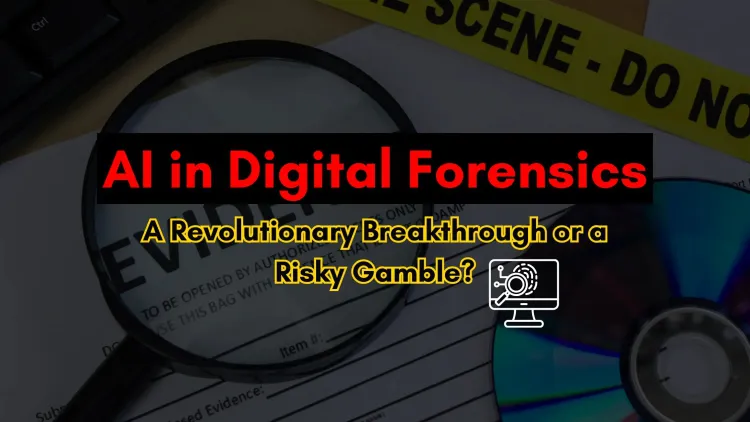
AI in Digital Forensics: Where It Helps, Where It Fails and How to Use It Safely
Artificial Intelligence (AI) is transforming digital forensics by enabling rapid evidence analysis, automating forensic investigations, and enhancing cybersecurity threat detection. AI-powered tools can analyze massive datasets, detect malware patterns, reconstruct cybercrimes, and even identify deepfake manipulations. However, its integration into digital forensics also presents risks, including bias in AI models, deepfake forgery, privacy concerns, and challenges in legal admissibility. This blog explores the revolutionary impact of AI in digital forensics, the potential risks, and how to balance automation with ethical concerns. It also addresses legal considerations and best practices for using AI responsibly in forensic investigations.
Quick answer: AI helps digital forensics by triaging large volumes of data, classifying images and documents, spotting anomalies in logs and speeding malware analysis. Its risks are errors, bias, unexplainable results, privacy exposure and doubts about court admissibility. Used well, AI suggests leads while a trained examiner verifies every finding and documents the method.
Key takeaways
- AI is best used for triage and prioritisation. It is not a replacement for an examiner or for evidence that can be explained in court.
- Typical uses: sorting millions of files, finding relevant emails, classifying images, detecting log anomalies and clustering malware samples.
- Main risks: false positives and negatives, model bias, opaque reasoning, privacy exposure and poor reproducibility.
- Deepfakes and AI-generated content add a new job: checking whether media is authentic.
- In India, electronic evidence rules and the chain of custody still apply. Check current law with a legal expert.
What is AI in digital forensics?
Digital forensics collects, preserves, analyses and reports electronic evidence. AI here means machine learning and related methods that find patterns in that evidence: language models and text classifiers for documents, image recognition for pictures and video, anomaly detection for logs and network traffic, and clustering for malware samples. The foundation is still the established process described in NIST's guide to integrating forensic techniques into incident response, NIST SP 800-86.
Where does AI help investigators?
| Task | How AI helps | What a human must check |
|---|---|---|
| Triage of large data sets | Ranks files, chats and emails by relevance | That nothing important was ranked low; sample the "irrelevant" pile |
| Text and e-discovery | Finds topics, names, relationships and sentiment across documents | Context, translation and slang that models misread |
| Image and video | Flags categories of content, faces, objects | Every flagged item, since error rates are real |
| Log and network analysis | Detects anomalies and builds timelines | Whether an anomaly is malicious or normal behaviour |
| Malware analysis | Clusters samples and suggests families | Confirm by static and dynamic analysis |
| Speech and audio | Transcribes calls and recordings | Accuracy, accents and mixed languages |
What are the risks and limits?
- Errors. Models produce false positives and false negatives. Language models can state invented details with confidence.
- Bias. A model trained on skewed data can perform worse on some groups, languages or content types.
- Explainability. A court may ask how a conclusion was reached. "The model said so" is not an answer.
- Reproducibility. Model versions, settings and randomness can change the output. If you cannot reproduce a result, you cannot defend it.
- Privacy and data handling. Sending case data to a third-party cloud model can breach confidentiality, legal rules or case protocols.
- Deepfakes and manipulated media. AI makes forged audio, images and video easier, so authenticity checks become part of the work.
Is AI-assisted evidence admissible?
There is no simple yes. Courts look at whether the method is reliable, whether it was applied properly, and whether the evidence's integrity and chain of custody are intact. In India, the rules on electronic records changed when new criminal-law statutes replaced the older laws; the Bharatiya Sakshya Adhiniyam, 2023 deals with electronic evidence and its certification. A legal expert should confirm the current requirements. Practically: treat AI output as an investigative lead, and rely on traditional, explainable analysis to prove the finding.
What are the best practices for forensic teams?
- Keep a human in the loop. A trained examiner reviews and owns every conclusion.
- Preserve first. Work on forensic images with verified hashes, never on originals.
- Validate tools. Test on known data sets to measure error rates. The NIST Computer Forensics Tool Testing programme is a model for how validation is done.
- Document everything: tool and model version, settings, prompts, input data, outputs, and who reviewed them.
- Control data. Use on-premises or approved tools for sensitive cases. Do not paste case data into public AI services.
- Disclose use. Be ready to explain to a court or client how AI was used and its limits.
- Train staff on what the models can and cannot do.
What does this mean for someone learning forensics?
Learn the fundamentals first: file systems, memory, logs, networks, hashing and chain of custody. Then learn where automation helps. A forensic analyst who understands both can use AI to save time without trusting it blindly. See the future of AI in digital forensics for more on trends.
Revolutionary breakthrough or risky gamble?
Neither label fits. AI speeds up parts of forensic work that were slow, and it adds risks that need controls. The teams that do well treat it like any other tool: validated, documented and supervised.
Next steps
To build the underlying skills, see WebAsha's CHFI training. For related reading: how AI helps investigators track online threats.
Frequently Asked Questions
What's Your Reaction?
 Like
0
 Dislike
0
 Love
0
 Funny
0
 Wow
0
 Sad
0
 Angry
0

Vaishnavi is a skilled tech professional at the Ethical Hacking Training Institute in Pune, responsible for managing and optimizing the technical infrastructure that supports advanced cybersecurity education. With deep expertise in network security, backend operations, and system performance, she ensures that practical labs, online modules, and assessments run smoothly and securely. Her behind-the-scenes contributions play a vital role in delivering a seamless and secure learning experience for aspiring ethical hackers.