AI in Reverse Engineering: How It Helps Malware Analysis and Software Auditing, and Where It Falls Short
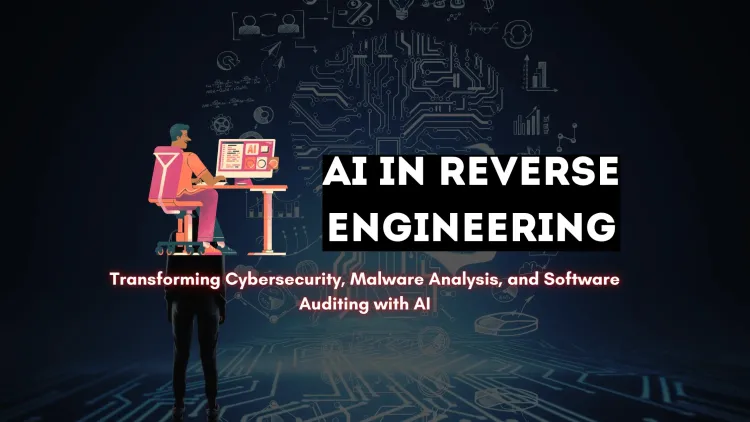
Artificial Intelligence (AI) is revolutionizing reverse engineering by automating complex tasks such as malware detection, vulnerability assessment, binary analysis, and debugging. AI-driven decompilers, machine learning models, and neural networks help cybersecurity professionals analyze obfuscated code, detect software vulnerabilities, and enhance malware classification faster than traditional methods. AI is also impacting hardware reverse engineering, enabling automated circuit diagram reconstruction, chip layout analysis, and counterfeit detection. Despite its advantages, AI-powered reverse engineering faces challenges such as data availability, interpretability, and ethical concerns. As AI continues to evolve, it will play a critical role in automated cybersecurity defense, predictive patching, and even quantum computing-based reverse engineering.
Quick answer: AI helps reverse engineers by explaining decompiled functions in plain language, suggesting names for variables and routines, summarising what a sample does and speeding up triage. It makes mistakes, so every claim must be checked against the code. Use it with a decompiler such as Ghidra and keep sensitive samples out of public services.
Key takeaways
- AI speeds up reading decompiled code, naming functions and writing summaries.
- It is good for explaining routines and bad at being certain. Output can be wrong or invented.
- Decompilers such as Ghidra, IDA and Binary Ninja remain the foundation; AI sits on top.
- Do not upload private or sensitive samples to public AI services.
- Beginners should learn assembly and static analysis first, then add AI as a helper.
What is reverse engineering?
Reverse engineering is working out how software or hardware works from the finished product, without its source code. In security it is used to analyse malware, audit software for flaws and understand a vulnerability after a patch. Typical tools are disassemblers and decompilers such as Ghidra, IDA and Binary Ninja, plus debuggers.
How does AI help?
| Task | How AI helps | Caution |
|---|---|---|
| Reading decompiled code | Explains a function in plain language | May misread logic |
| Naming | Suggests names for functions and variables | Names can be plausible but wrong |
| Triage | Summarises likely behaviour of a sample | A summary is a lead, not a verdict |
| Pattern matching | Finds similar code across samples | False matches happen |
| Writing helpers | Drafts scripts and detection rules | Must be tested |
| Reporting | Drafts an analysis summary | Needs editing and checking |
Some services use AI to summarise code. For example, VirusTotal offers a feature called Code Insight, and community plugins connect language models to Ghidra and IDA. Features change fast, so check each project page before relying on one. We do not rank tools here because we have not tested them side by side.
Where does AI fail in reverse engineering?
- Hallucination. The explanation can sound sure and be wrong.
- Obfuscation and packing. Heavily protected code gives poor input, so output is poor.
- Context limits. Large programs do not fit in one request, and relationships between functions can be lost.
- Privacy. Uploading a customer's binary or a live malware sample to a public service can break contracts or tip off the attacker.
- Over-trust. A beginner who skips learning assembly cannot spot a wrong answer.
How should you use AI safely in analysis?
- Analyse samples in an isolated lab, as in our Kali-based lab practice or a dedicated malware VM.
- Check the permission to share the code before sending anything to an external model. Prefer local models for sensitive work.
- Treat each AI statement as a hypothesis. Confirm in the disassembly, a debugger or the sandbox.
- Record what the AI suggested and what you verified.
How does AI connect to the wider security field?
Reverse engineering is one use of AI in security. See how AI is transforming cybersecurity research, AI-driven malware classification and AI in ethical hacking for more.
How does a beginner start?
- Learn how programs run: memory, the stack and system calls.
- Learn basic x86 or x64 assembly and C.
- Install Ghidra and work through a small, harmless training program you compiled yourself.
- Move to published training samples in an isolated VM.
- Add AI as an assistant once you can judge its answers.
Reverse engineering is legal for analysis of your own software and for authorised security research. Licence terms and local law, including the IT Act, can restrict reverse engineering of others' software, so check before you start.
Next steps
Next steps: for a defensive path into analysis, see our Certified SOC Analyst course, and read how AI is transforming cybersecurity research.
Related reading
Frequently Asked Questions
What's Your Reaction?
 Like
0
Like
0
 Dislike
0
Dislike
0
 Love
0
Love
0
 Funny
0
Funny
0
 Wow
0
Wow
0
 Sad
0
Sad
0
 Angry
0
Angry
0

Vaishnavi is a skilled tech professional at the Ethical Hacking Training Institute in Pune, responsible for managing and optimizing the technical infrastructure that supports advanced cybersecurity education. With deep expertise in network security, backend operations, and system performance, she ensures that practical labs, online modules, and assessments run smoothly and securely. Her behind-the-scenes contributions play a vital role in delivering a seamless and secure learning experience for aspiring ethical hackers.