AI vs Human Hackers: Strengths, Limits and Why the Best Results Combine Both
The battle between AI and human hackers is reshaping the future of cybersecurity. AI-powered security systems offer speed, automation, and large-scale monitoring, detecting threats faster than humans. However, human hackers bring creativity, unpredictability, and advanced social engineering tactics that AI struggles to counter. While AI excels at automating penetration testing, detecting malware, and blocking phishing attacks, ethical hackers and cybercriminals alike exploit AI's limitations, such as zero-day vulnerabilities and adversarial AI manipulation. This blog explores the strengths and weaknesses of AI vs. human hackers, their roles in cyber warfare, and why AI and human intelligence must work together for ultimate cybersecurity protection.
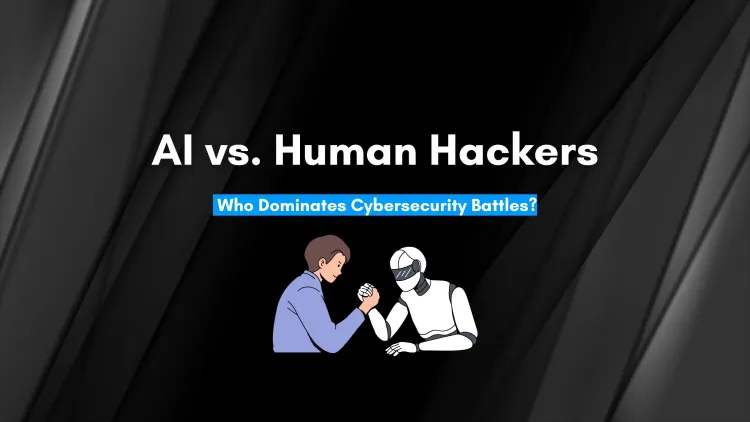
Quick answer: Neither wins outright. AI is strong at speed, scale and pattern recognition, such as triaging alerts, scanning code and spotting anomalies. Human hackers are stronger at creativity, business context, chaining unusual weaknesses and deciding what matters. The best security work combines AI for breadth and people for judgement.
Key takeaways
- AI excels at repetitive, high-volume work: log analysis, scanning, triage and drafting.
- Humans excel at creative chaining, understanding business logic and judging real impact.
- Both attackers and defenders use AI, so the contest is about process and skill.
- AI tools make mistakes, miss context and can be manipulated; outputs need human review.
- Best practice: let AI widen coverage and speed, and keep people accountable for decisions.
What does "AI vs human hackers" actually mean?
People mean three things by it: attackers using AI to work faster, defenders using AI to detect and respond, and AI systems trying to find vulnerabilities on their own. In all three, AI is a tool used by humans, not a separate side. The more useful question is which tasks each does better, and how to combine them. This article avoids statistics and win-rate claims because they are rarely comparable.
Where does AI help?
- Volume: reading millions of log lines, flagging anomalies and clustering similar alerts.
- Speed: triaging phishing reports, summarising incidents and enriching indicators in seconds.
- Pattern spotting: machine learning can detect unusual behaviour, such as odd logins or traffic patterns.
- Code and configuration review: suggesting possible flaws in code, infrastructure files and dependencies.
- Assistance: drafting scripts, queries, reports and explanations.
- Research projects: competitions such as DARPA's AI Cyber Challenge have explored systems that find and patch software flaws automatically. Treat results from controlled challenges as promising but different from real-world environments.
Where do human hackers still lead?
- Creativity: chaining several small weaknesses in an unexpected way.
- Business logic: understanding that "apply coupon" twice breaks the pricing, which no scanner knows is wrong.
- Context and impact: deciding which finding really threatens the organisation and why.
- Social engineering and negotiation: reading people and situations.
- Judgement and ethics: staying inside the scope, avoiding harm and communicating risk responsibly.
- Handling novelty: dealing with systems or situations unlike anything in a model's training data.
How do they compare?
| Aspect | AI | Human |
|---|---|---|
| Speed and scale | Very high | Limited by time |
| Consistency | High, but can be confidently wrong | Varies with fatigue and skill |
| Creativity | Recombines known patterns | Can find genuinely new approaches |
| Context | Limited to what it is given | Understands business and people |
| Accountability | None; the operator is responsible | Professional and legal responsibility |
| Cost per task | Low for routine work | Higher, best spent on hard problems |
What are the risks of relying on AI?
- False positives and negatives: both waste time or leave gaps.
- Hallucinations: a tool may invent a vulnerability, a function or a fix.
- Manipulation: attackers can try to trick AI tools with crafted inputs, including prompt injection.
- Data exposure: sending sensitive code or logs to external services can breach policy.
- Skill erosion: juniors who never learn to investigate manually may not spot AI errors.
How should security teams combine them?
- Use AI for triage, enrichment and first drafts, then have a person decide.
- Give humans the creative, high-impact work: threat modelling, business logic testing and complex investigations.
- Verify every AI-reported vulnerability before reporting it.
- Set a policy on what data may be used with which AI tools.
- Train staff to understand how the tools fail.
What does this mean for your career?
Learn the fundamentals, such as networking, operating systems, web security and how attacks work, so that you can tell when an AI answer is wrong. Then learn to use AI tools as a force multiplier. Security roles that need judgement, communication and accountability are likely to remain in demand, but no one can promise how the job market will change, so keep building skills.
Common mistakes
- Believing a tool's output without verification.
- Assuming a scanner finds everything a tester would.
- Pasting confidential data into public AI services.
- Treating the question as a contest rather than a workflow.
Next steps
Read AI vs manual pentesting and AI-powered cybersecurity in ethical hacking. To build the base skills, see our CEH v13 AI course.
Related reading
Frequently Asked Questions
What's Your Reaction?
 Like
0
 Dislike
0
 Love
0
 Funny
0
 Wow
0
 Sad
0
 Angry
0

Vaishnavi is a skilled tech professional at the Ethical Hacking Training Institute in Pune, responsible for managing and optimizing the technical infrastructure that supports advanced cybersecurity education. With deep expertise in network security, backend operations, and system performance, she ensures that practical labs, online modules, and assessments run smoothly and securely. Her behind-the-scenes contributions play a vital role in delivering a seamless and secure learning experience for aspiring ethical hackers.