DeepSeek AI vs. OpenAI | Which One is Right for You?
Compare DeepSeek AI vs. OpenAI to find the best AI platform for your needs. Explore their core technologies, features, performance, pricing, and use cases to make an informed decision. DeepSeek AI vs. OpenAI, OpenAI vs. DeepSeek, DeepSeek AI review, OpenAI comparison, AI model comparison, DeepSeek features, OpenAI features, AI performance comparison, AI pricing, AI use cases, best AI model, AI for business, AI for automation, AI for content creation, AI technology comparison.
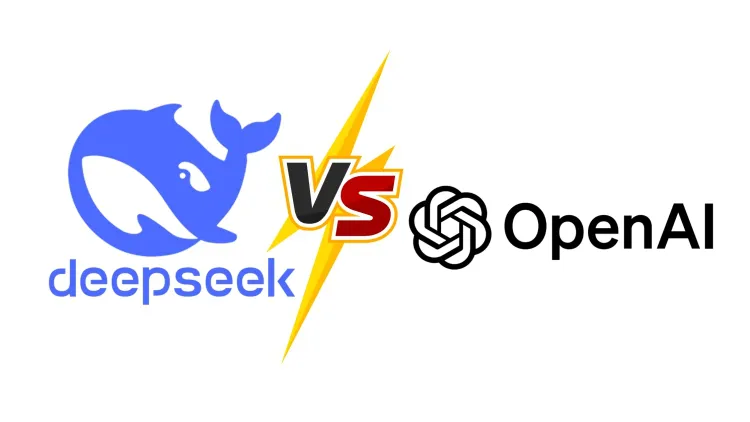
Table of content
- Introduction to DeepSeek and OpenAI
- Core Technologies and Features
- Performance and Accuracy
- Use Cases and Applications
- Pricing and Accessibility
- Final Verdict: Which One is Right for You?
DeepSeek AI vs. OpenAI | Which One is Right for You?
Choosing between DeepSeek AI and OpenAI can be challenging as both offer cutting-edge AI capabilities. This article will help you decide which AI model best fits your needs.
Introduction to DeepSeek AI and OpenAI
DeepSeek AI and OpenAI are two leading names in artificial intelligence. OpenAI, known for its powerful ChatGPT, has revolutionized the AI industry with natural language processing (NLP) models. On the other hand, DeepSeek AI has emerged as a strong competitor with its own advanced AI algorithms and automation capabilities.
Founded to push the boundaries of AI research, OpenAI has released several groundbreaking models, including GPT-3 and GPT-4. These models have been widely adopted in various industries, from content creation to software development. OpenAI’s focus is on creating AI that can understand and generate human-like text efficiently.
DeepSeek, while newer to the market, has introduced unique AI capabilities such as real-time adaptability and improved decision-making algorithms. It is designed for enterprises looking for scalable AI solutions, particularly in business automation and real-time data analysis.
Both platforms have their strengths and weaknesses, and understanding their core technologies and use cases can help determine which one suits your needs better.
Core Technologies and Features
Both DeepSeek and OpenAI utilize deep learning, neural networks, and NLP to process and generate human-like text. However, they have key differences in how they implement these technologies.
OpenAI’s models, especially the GPT series, are trained on extensive datasets that encompass multiple languages and domains. The key strength of OpenAI is its vast training corpus and ability to produce contextually relevant and fluent responses. It is particularly strong in areas like conversational AI, coding assistance, and creative content generation.
DeepSeek differentiates itself by focusing on real-time learning. Unlike OpenAI, which relies heavily on pre-trained models, DeepSeek continuously updates its models based on new data, making it more adaptive to recent trends and user interactions. This makes it more suited for dynamic environments where information changes rapidly.
Additionally, DeepSeek is designed with business intelligence in mind, offering deep integration with enterprise software. It provides tools for advanced data analysis and decision-making support, making it highly valuable for companies needing AI-driven insights.
Performance and Accuracy
When comparing DeepSeek vs. OpenAI, performance and accuracy are key factors to consider.
OpenAI’s models have been extensively tested and refined over multiple iterations, resulting in highly optimized AI performance. The models can generate coherent, human-like text, summarize large pieces of content, and even assist in programming tasks with high accuracy. However, they sometimes struggle with real-time data processing since their knowledge base is limited to the data they were trained on.
DeepSeek, on the other hand, claims superior contextual accuracy due to its real-time learning approach. This allows it to process new information as it becomes available, making it more reliable for tasks that require up-to-date knowledge. Businesses leveraging DeepSeek can gain an edge by having AI-driven insights that evolve with industry trends.
Both platforms have their advantages—OpenAI for its polished and well-structured outputs and DeepSeek for its adaptability and real-time processing capabilities.
Use Cases and Applications
DeepSeek and OpenAI power a variety of applications, including customer support, content generation, programming assistance, and AI-driven automation.
OpenAI’s models are widely used for creative writing, generating marketing content, chatbot development, and software programming assistance. Its ability to generate well-structured text makes it a go-to choice for writers, developers, and educators.
DeepSeek, on the other hand, is preferred in industries that require real-time decision-making, such as finance, healthcare, and enterprise automation. It provides enhanced AI-driven insights, helping businesses make data-driven decisions in a more efficient manner.
Both AI models serve distinct user needs, with OpenAI excelling in general-purpose AI tasks and DeepSeek focusing on industry-specific automation and analytics.
Pricing and Accessibility
Pricing plays a major role in choosing between DeepSeek and OpenAI.
OpenAI follows a tiered subscription model, offering both free and premium plans. Users can access basic features for free, but advanced capabilities require a paid subscription. Businesses needing high-volume AI processing must opt for enterprise plans.
DeepSeek offers flexible pricing models tailored to business needs. Unlike OpenAI, it provides enterprise-level customizations, allowing companies to integrate AI according to their specific requirements. While OpenAI has a more predictable pricing structure, DeepSeek provides businesses with cost-effective AI solutions that can be adapted to different scales.
Final Verdict: Which One is Right for You?
Ultimately, your choice between DeepSeek and OpenAI depends on your specific needs.
If you require extensive AI-generated content and conversational capabilities, OpenAI might be your best bet. However, if you’re looking for enhanced real-time adaptability and business automation, DeepSeek is worth considering.
OpenAI is ideal for content creators, programmers, and businesses looking for a well-established AI tool with proven performance. DeepSeek, on the other hand, is more suitable for industries requiring up-to-date data processing and intelligent automation.
By evaluating your business goals and required AI functionalities, you can determine whether DeepSeek or OpenAI aligns better with your needs.
Comparison Table: DeepSeek vs. OpenAI
| Feature | DeepSeek | OpenAI |
|---|---|---|
| Core Technology | Real-time learning, deep learning algorithms | Large-scale NLP models, GPT-based AI |
| Performance | High contextual accuracy, real-time adaptability | Optimized for conversational AI, trained on vast datasets |
| Use Cases | Business intelligence, automation, data analytics | Creative writing, chatbot development, programming assistance |
| Pricing | Flexible, enterprise-level customizations | Tiered subscription model with free and premium plans |
| Accessibility | Industry-specific integrations | Widespread adoption, API-based accessibility |
FAQ's
What's Your Reaction?
 Like
0
Like
0
 Dislike
0
Dislike
0
 Love
0
Love
0
 Funny
0
Funny
0
 Wow
0
Wow
0
 Sad
0
Sad
0
 Angry
0
Angry
0

With a passion for staying on the cutting edge of technology trends, I am dedicated to delivering content that not only informs but also inspires. Whether you need in-depth analysis pieces, informative guides, or thought-provoking opinion pieces, I craft content that resonates with tech enthusiasts and professionals alike.

![RHCE EX294 Certification Cost in India [2026 Updated] | Fees, Training, Salary & Voucher Details](https://webasha-blog.s3.ap-south-1.amazonaws.com/uploads/images/202505/image_750x415_68203ff1e1b1c.webp)

![10 Tips to Ace the AWS Certification Exam in 1st Attempt [Complete 2026 Guide]](https://webasha-blog.s3.ap-south-1.amazonaws.com/uploads/images/202505/image_750x415_68270d1ebf14e.webp)