Linux Administrator Résumé for Freshers: Sample and Skills
A fresher Linux administrator résumé should show relevant foundations and practical work you can explain honestly. Include a short profile, education, grouped skills, original projects, earned credentials and any real internship. The fictional sample here uses a filesystem review to distinguish ordinary file permissions from a read-only mount.
Topic: Linux Administration in IT Infrastructure · Career guidance
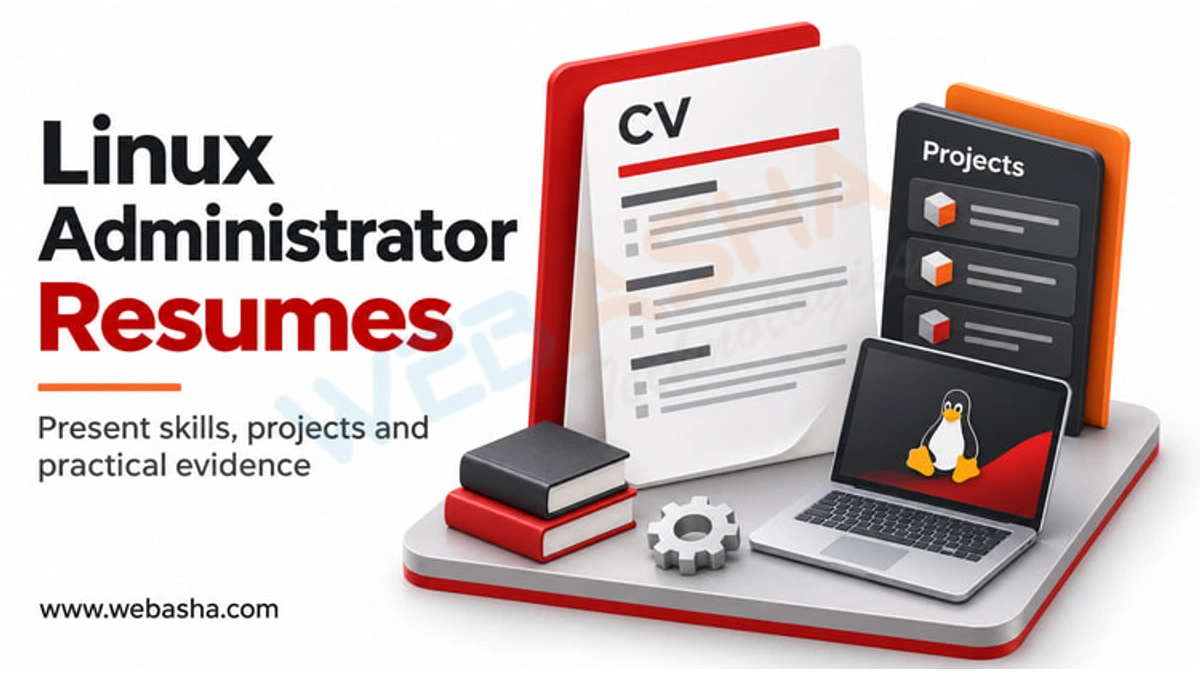
Quick answer: A fresher Linux administrator résumé should show relevant foundations and practical work you can explain honestly. Include a short profile, education, grouped skills, original projects, earned credentials and any real internship. The fictional sample here uses a filesystem review to distinguish ordinary file permissions from a read-only mount. It demonstrates reasoning without inventing employment or a completed repair. Adapt the copyable sections to your own facts, then check the exported document and the employer's application fields before sending it.
Key takeaways
- Label projects and employment separately.
- Connect technical skills to a task and result.
- Keep training separate from earned credentials.
- Distinguish file mode from filesystem writeability.
- Review exports and parsed application fields.
Table of Contents
- What should a Linux administrator fresher résumé show?
- What does a realistic sample CV structure contain?
- How can a filesystem case demonstrate useful troubleshooting?
- How should you organize technical skills?
- How should RHCSA and other credentials appear?
- How can projects and internships remain distinct?
- What should you check in the exported file and application?
- How should you prepare to discuss the résumé in an interview?
- References
What should a Linux administrator fresher résumé show?
Show the tasks you understand, the environments in which you practised and the checks you performed. A fresher can present original lab work without inventing a junior administrator job. The CV-writing guide recommends relevant, clear sections and current contact information. Start with a concise profile, education, skills, projects and any actual internship or employment. Include earned credentials separately from training. Read the target vacancy before selecting content. A support role may emphasize tickets and supervised changes; another may require scripting, storage or service troubleshooting. List the parts you can explain accurately and identify the learning environment. You do not need every Linux, networking and cloud certificate mentioned in a sample.
What does a realistic sample CV structure contain?
The following fictional structure is for adaptation, not an employment history. Replace bracketed fields, remove unsupported claims and follow the employer's requested format. This guide provides copyable wording rather than an attached DOCX or PDF download. Keep the profile specific: the role sought, the relevant foundation and one practical task. Place the strongest relevant project where it is easy to find. A course certificate should not appear as an issuer's professional credential. Use real dates and your exact education status. Do not copy another person's degree, employer, credential or technical result from a sample.
| Section | Fictional entry to adapt |
|---|---|
| Profile | Entry-level Linux support candidate with system-administration study and supplied-record troubleshooting practice. Seeking supervised operations work. |
| Education | [Actual qualification], [institution], [completed or expected date]. |
| Technical skills | Shell navigation, files, identities, services, packages, storage and networking actually practised; name the distribution and learning scope. |
| Project | Read-only filesystem review: compared file-mode, path and mount records; explained why a writable-looking mode did not establish successful writes. |
| Credentials and training | [Exact earned credential/status] separately from [course or current preparation]. |
| Experience | [Actual internship/employment], dates, permitted duties, your contribution and supported outcome. |
How can a filesystem case demonstrate useful troubleshooting?
In a fictional lab worksheet, an application cannot write to a report file. The supplied ordinary mode permits its intended identity to write, path traversal is confirmed, and the application record reports a read-only filesystem error. The relevant mount record is read-only. This is not solved by assuming every write failure needs broader file permissions. The chmod manual describes mode changes, while the mount manual describes the separate read-only mount setting. The pathname-resolution manual explains traversal checks. The résumé bullet can say: “Reviewed supplied mode, path and mount records; distinguished a read-only filesystem condition from ordinary mode permissions and escalated the proposed change for review.” Do not write that you repaired the filesystem if the exercise contains no authorized repair or retest. A read-only condition can have several causes; the record alone does not establish disk failure or justify an immediate remount.
| Supplied fact | Useful interpretation | Claim to avoid |
|---|---|---|
| Mode allows intended write | Ordinary mode is not the shown barrier | Every access-control layer is correct |
| Path traversal confirmed | One separate lookup requirement is satisfied | The application must be able to write |
| Relevant mount is read-only | Writeability has another restriction | chmod can make that mount writable |
| No repair or retest supplied | Diagnosis and escalation are the output | Resolved a production storage outage |
How should you organize technical skills?
Group skills around operations: files and text, users and permissions, packages, services and logs, storage, networking and automation. Mention tools only when you can explain the input, expected effect and verification. Distinguish Linux command-line practice from administering a real production system. A virtual machine can provide useful learning, but it does not automatically demonstrate enterprise change control, on-call incident ownership or a specific hardware platform. For scripting, describe what the script actually does and how it handles input or failure. Avoid calling a short command a complete backup system or listing several languages after watching introductory lessons. For the filesystem case, be prepared to explain why a permission bit and a mount setting answer different questions. The value lies in the reasoning, not in claiming that the worksheet exercised every kernel or filesystem behaviour.
How should RHCSA and other credentials appear?
The current RHCSA objectives provide a useful subject checklist, including system tools, software, services, storage and security. They do not make RHCSA a compulsory prerequisite for every junior Linux role. List the exact earned credential, issuer and relevant current-status information. If studying, use a separate training entry with the actual course and dates. Passing a practice exercise or attending a class does not confer the issuer's award. Networking or cloud study can support a vacancy that needs those skills, but do not add CCNA or AWS credentials you do not hold. For older awards, keep the original title and date rather than silently changing the name to match a new certification framework. Use current objectives for a future exam booking; a résumé sample is not a permanent version specification.
How can projects and internships remain distinct?
A project entry should state its objective, permitted environment, your action and observed result. Name collaborators or supervision where that changes the contribution. A personal or classroom lab belongs under Projects or Training, rather than a fictional employer. If you completed an internship, describe the actual assigned duties. Observing a maintenance task differs from performing it, and performing a reviewed change differs from independently approving it. For the read-only example, a report or worksheet is a valid learning deliverable. An actual lab retest can strengthen it if you performed one and kept the result. Quantification is useful only when the measurement exists. Keep confidential hostnames, account information, tickets and private keys out of a public portfolio. Obtain permission before sharing an employer's configuration or incident details.
What should you check in the exported file and application?
Use readable headings, ordinary fonts and selectable text. Follow the employer's file-type and size requirements, then inspect the export for lost characters, broken links and page overflow. The Greenhouse parsing documentation identifies formatting problems in that product, including image-based documents and complex layouts. It supports careful export review without proving a universal rule for every hiring system. Replace every template placeholder before uploading. Review parsed fields when the portal provides them, especially dates, education and contact details. Do not assume that the file's appearance proves those fields were interpreted correctly. Use job-description terms only where they accurately describe your work. A keyword list cannot replace a project you can explain.
How should you prepare to discuss the résumé in an interview?
Choose one project and rehearse its requirement, observations, decision and remaining uncertainty. Ask a reviewer to change one fact and explain how your conclusion changes. For the filesystem exercise, suppose the mount is writable instead. You now need another explanation; the old diagnosis no longer follows. Discuss the next appropriate identity, path, policy or application check without inventing an executed repair. Review the profile against the project detail. A statement such as production Linux expert would conflict with a supplied-record learning example. Replace it with your actual level and intended supervised role. Check the final document's dates, links, spelling and credential status. Keep a master version and adapt the relevant sections for each vacancy. Your goal is an accurate account of readiness that gives an interviewer specific work to discuss.
Related reading: Network engineer fresher résumé; RHCSA interview questions.
References
Frequently Asked Questions
What's Your Reaction?
 Like
0
 Dislike
0
 Love
0
 Funny
0
 Wow
0
 Sad
0
 Angry
0

With a passion for staying on the cutting edge of technology trends, I am dedicated to delivering content that not only informs but also inspires. Whether you need in-depth analysis pieces, informative guides, or thought-provoking opinion pieces, I craft content that resonates with tech enthusiasts and professionals alike.