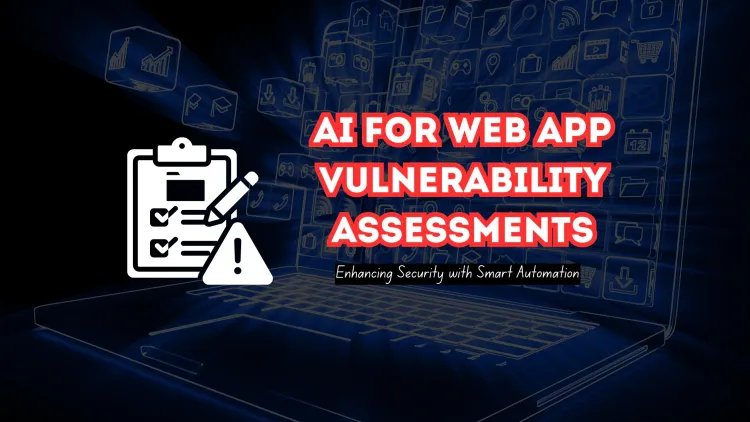
Using AI for Vulnerability Assessments in Web Applications | Enhancing Security with Smart Automation
The increasing sophistication of cyber threats has made vulnerability assessments crucial for web application security. Traditional methods rely on manual testing and rule-based scanners, which can be time-consuming and prone to inaccuracies. AI-driven vulnerability assessment tools are revolutionizing cybersecurity by automating threat detection, reducing false positives, and improving risk prioritization. AI enhances security by continuously learning from new threats, detecting zero-day vulnerabilities, and automating patch management. However, challenges such as false negatives, ethical concerns, and data dependency still exist. The future of AI in cybersecurity lies in self-learning security systems, AI-powered penetration testing, and integration with blockchain security. Organizations that embrace AI-driven security tools will have a significant advantage in defending against emerging cyber threats.
Quick answer: AI improves web application vulnerability assessment by learning application behaviour, finding patterns that rule-based scanners miss and reducing noise by prioritising real risks. It still needs human validation, since it can misjudge context and miss logic flaws. Pair AI scanning with manual testing for best coverage.
Key takeaways
- Test against the OWASP Top 10 categories first.
- AI scanners can cut noise but miss logic flaws.
- Re-scan after each release.
Table of Contents
- Introduction
- What is Vulnerability Assessment?
- How AI is Used in Web Application Vulnerability Assessments
- AI vs. Traditional Vulnerability Assessment
- Benefits of AI in Vulnerability Assessments
- Challenges of AI in Web Security Assessments
- Future of AI in Vulnerability Assessments
- Conclusion
Introduction
With the rapid growth of web applications, cybersecurity threats have become more sophisticated. Traditional vulnerability assessments rely on manual testing and rule-based scanners, which can be time-consuming and prone to errors. Artificial Intelligence (AI) is revolutionizing this process by enhancing vulnerability detection, automating assessments, and improving threat intelligence. AI-driven vulnerability assessments help security teams identify and mitigate risks faster and more efficiently.
In this blog, we will explore how AI is transforming vulnerability assessments in web applications, its benefits, challenges, and future implications for cybersecurity.
What is Vulnerability Assessment?
Vulnerability assessment is the process of identifying, analyzing, and prioritizing security weaknesses in web applications, networks, and systems. It helps organizations detect vulnerabilities before cybercriminals exploit them. The process typically involves:
- Scanning: Identifying weaknesses using automated tools.
- Analysis: Evaluating the severity and impact of vulnerabilities.
- Prioritization: Ranking vulnerabilities based on risk level.
- Remediation: Applying fixes to eliminate or reduce security risks.
AI enhances these steps by automating the detection process, reducing false positives, and improving accuracy.
How AI is Used in Web Application Vulnerability Assessments
AI-driven tools use machine learning (ML), natural language processing (NLP), and deep learning to enhance vulnerability assessment processes. Here’s how AI contributes:
1. Automated Threat Detection
AI-powered tools can analyze vast amounts of data from logs, network traffic, and previous cyberattacks to detect security vulnerabilities. These tools can:
- Identify common security flaws such as SQL injection, cross-site scripting (XSS), and broken authentication.
- Detect zero-day vulnerabilities by analyzing patterns and behaviors.
2. AI-Powered Scanning Tools
Traditional scanners rely on pre-defined rules, but AI-powered scanners continuously learn from new threats. Popular AI-based scanning tools include:
- Deep Exploit – An AI-based penetration testing tool.
- Acunetix – Uses AI to detect web vulnerabilities.
- Tenable.io – AI-driven security assessment tool.
3. Intelligent Risk Prioritization
AI analyzes vulnerabilities based on severity, impact, and likelihood of exploitation. Instead of treating all vulnerabilities equally, AI prioritizes critical threats, helping security teams focus on the most pressing issues.
4. Reducing False Positives
Traditional vulnerability scanners generate many false positives, leading to wasted time and resources. AI enhances accuracy by:
- Learning from past security incidents.
- Differentiating between real threats and benign activities.
5. Real-Time Monitoring & Adaptive Security
AI continuously monitors web applications for unusual activity, detecting new vulnerabilities as they emerge. It can:
- Identify suspicious behavior in user inputs.
- Adapt security measures based on evolving threats.
6. Automated Patch Management
AI can suggest or even deploy security patches automatically, reducing the time between vulnerability detection and mitigation.
AI vs. Traditional Vulnerability Assessment
| Feature | Traditional Vulnerability Assessment | AI-Driven Vulnerability Assessment |
|---|---|---|
| Speed | Slower, manual processes | Faster, automated analysis |
| Accuracy | High false positives | Improved accuracy with ML |
| Threat Detection | Rule-based scanning | Behavioral and anomaly-based detection |
| Zero-Day Detection | Limited | More effective |
| Risk Prioritization | Static risk scoring | Dynamic risk analysis |
| Remediation | Manual patching | Automated suggestions |
Benefits of AI in Vulnerability Assessments
- Faster Assessments – AI automates scanning, reducing assessment time.
- Continuous Learning – AI models improve over time, adapting to new threats.
- Improved Accuracy – AI reduces false positives and detects zero-day vulnerabilities.
- Better Risk Management – AI prioritizes high-risk vulnerabilities effectively.
- Enhanced Automation – AI-driven tools reduce the need for manual testing.
Challenges of AI in Web Security Assessments
Despite its advantages, AI-driven vulnerability assessments have some challenges:
- False Negatives – AI might miss subtle vulnerabilities.
- Dependence on Quality Data – AI models require vast and accurate datasets to improve detection.
- Ethical Concerns – Cybercriminals can misuse AI for automated attacks.
- Integration Complexity – Organizations may struggle to integrate AI with existing security frameworks.
Future of AI in Vulnerability Assessments
AI will continue to transform cybersecurity with advancements in:
- Self-Learning Security Systems – AI models that improve autonomously.
- Automated Ethical Hacking – AI-driven penetration testing.
- AI-Powered Bug Bounties – AI tools assisting security researchers.
- Blockchain Security with AI – Enhanced security for decentralized applications.
As AI evolves, it will play an increasingly critical role in securing web applications against cyber threats.
Conclusion
AI-driven vulnerability assessments are revolutionizing web application security by enhancing threat detection, risk prioritization, and remediation. While AI provides faster and more accurate assessments, human oversight remains essential to ensure ethical and effective security practices. Organizations that integrate AI-powered tools into their cybersecurity strategies will have a significant advantage in identifying and mitigating vulnerabilities before they can be exploited.
By leveraging AI, businesses can build stronger defenses, reduce risks, and stay ahead of emerging cyber threats.
To take this further with guided labs and an instructor, see our WAPT course in Pune.
Related reading
- How AI and Automation are Revolutionizing Ethical Hacking and Vulnerability Testing
- How AI is Shaping the Future of Ethical Hacking | Enhancing Cybersecurity with Intelligent Automation
- AI in Penetration Testing Certifications | How Artificial Intelligence is Revolutionizing Ethical Hacking and Security Assessments
Reference
For the authoritative details, see OWASP Top 10.
Frequently Asked Questions
What's Your Reaction?
 Like
0
Like
0
 Dislike
0
Dislike
0
 Love
0
Love
0
 Funny
0
Funny
0
 Wow
0
Wow
0
 Sad
0
Sad
0
 Angry
0
Angry
0

Vaishnavi is a skilled tech professional at the Ethical Hacking Training Institute in Pune, responsible for managing and optimizing the technical infrastructure that supports advanced cybersecurity education. With deep expertise in network security, backend operations, and system performance, she ensures that practical labs, online modules, and assessments run smoothly and securely. Her behind-the-scenes contributions play a vital role in delivering a seamless and secure learning experience for aspiring ethical hackers.

![Top 10 Famous Ethical Hackers in India [Updated 2026]](https://www.webasha.com/blog/uploads/images/202608/image_450x280_b3317756e192c8d5e1fb674259f1a0c3.jpg)