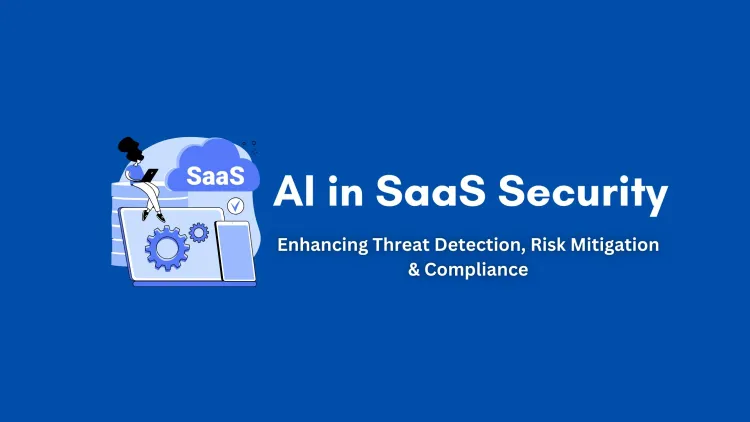
How AI is Revolutionizing SaaS Security | A Comprehensive Guide to Threat Detection, Risk Mitigation, and Compliance
With the rise of cloud-based SaaS applications, security challenges such as data breaches, unauthorized access, and compliance risks have increased significantly. Traditional security solutions struggle to keep up with sophisticated cyber threats, making Artificial Intelligence (AI) a crucial tool for enhancing SaaS security. AI-powered security solutions provide real-time threat detection, behavioral analysis, automated incident response, and AI-driven encryption techniques to prevent cyberattacks and secure sensitive data. This blog explores the role of AI in SaaS security, its benefits, implementation challenges, and best practices for businesses to strengthen their SaaS infrastructure. By integrating AI-driven cybersecurity measures, organizations can improve access control, automate compliance management, and proactively detect security threats, ensuring a secure SaaS ecosystem for users and enterprises alike.
Quick answer: AI improves SaaS security by monitoring user behaviour, detecting unauthorised access, flagging risky data sharing and helping with compliance checks. Best practice is to combine it with strong identity controls, regular access reviews and clear data policies. Challenges include integration effort, false alerts and data privacy.
Key takeaways
- Watch for risky data sharing and mass downloads by one user.
- Review third-party app permissions regularly.
- Turn on multi-factor authentication for every SaaS app.
Table of Contents
- Introduction
- How AI Enhances SaaS Security
- Challenges in Implementing AI for SaaS Security
- Best Practices for Securing SaaS Applications with AI
- Future of AI in SaaS Security
- Conclusion
Introduction
With the rapid adoption of Software-as-a-Service (SaaS) applications, businesses are shifting towards cloud-based solutions for scalability and efficiency. However, this also brings security challenges, such as data breaches, unauthorized access, and compliance risks. To combat these threats, Artificial Intelligence (AI) is being integrated into SaaS security to enhance threat detection, risk mitigation, and real-time monitoring.
Here is how AI improves SaaS security, the benefits it offers, and the challenges businesses face in implementing it.
How AI Enhances SaaS Security
1. AI-Powered Threat Detection
Traditional security methods rely on rule-based systems, which often fail against advanced cyber threats. AI-driven security can analyze large datasets, identify patterns, and detect anomalies in real-time to prevent security breaches.
2. Behavioral Analysis for User Authentication
AI-based User and Entity Behavior Analytics (UEBA) helps monitor user activities and flag unusual behaviors. For example, if an employee accesses sensitive data at an unusual time or from an unknown location, AI can trigger alerts or enforce multi-factor authentication (MFA).
3. Automated Incident Response
AI can automate security responses by detecting and neutralizing threats before they cause damage. Machine learning algorithms can predict and prevent potential security risks, reducing response time and minimizing human intervention.
4. AI-Driven Data Encryption and Access Control
AI enhances data encryption by dynamically adjusting security protocols based on risk levels. It also controls access permissions based on real-time threat intelligence, ensuring only authorized users can access sensitive information.
Benefits of Using AI in SaaS Security
| Benefit | Description |
|---|---|
| Real-Time Threat Detection | AI continuously monitors for suspicious activities and prevents cyberattacks. |
| Improved Access Management | AI verifies user identities through behavioral analysis and adaptive authentication. |
| Reduced False Positives | AI minimizes security alerts that do not pose a real threat, reducing alert fatigue. |
| Faster Incident Response | AI-powered automation speeds up the process of detecting and responding to threats. |
| Predictive Security | AI anticipates future threats using historical attack patterns and machine learning. |
| Compliance and Regulatory Support | AI helps businesses comply with GDPR, HIPAA, and other security regulations. |
Challenges in Implementing AI for SaaS Security
1. High Implementation Costs
AI security solutions require significant investment in terms of infrastructure, skilled professionals, and integration with existing SaaS platforms.
2. Complexity in Data Processing
AI relies on large datasets to train security models. Ensuring data quality and accuracy is needed for effective AI-driven security solutions.
3. Ethical and Privacy Concerns
AI-based security systems collect and analyze massive amounts of data, which raises concerns about data privacy, transparency, and compliance with regulations like GDPR and CCPA.
4. Adversarial AI Threats
Cybercriminals are also leveraging AI to create sophisticated attacks, such as deepfake phishing and AI-generated malware, challenging the effectiveness of traditional AI-driven security models.
Best Practices for Securing SaaS Applications with AI
1. Implement AI-Based Identity and Access Management (IAM)
Use AI to monitor access requests, detect anomalies, and enforce multi-factor authentication for enhanced security.
2. Deploy AI-Powered Security Information and Event Management (SIEM)
AI-driven SIEM solutions analyze logs and security events in real-time to detect and respond to threats faster.
3. Use Machine Learning for Predictive Threat Detection
Train machine learning models to recognize new attack patterns and prevent potential cyber threats before they occur.
4. Automate Compliance Management
AI can streamline compliance checks and audits, ensuring that SaaS applications meet regulatory requirements.
5. Regularly Update AI Security Models
AI models must be continuously updated with new threat intelligence to stay ahead of evolving cyber threats.
Future of AI in SaaS Security
The integration of AI with cybersecurity is evolving, and in the coming years, we can expect:
- More advanced AI-powered security frameworks that can detect zero-day vulnerabilities.
- AI-driven self-healing SaaS applications that can automatically recover from cyberattacks.
- Greater collaboration between AI and human security teams to improve overall cybersecurity efficiency.
Conclusion
AI is changing SaaS security by offering real-time threat detection, automated response, and predictive analytics. While challenges exist, businesses that use AI-driven security solutions will have a competitive edge in protecting sensitive data and preventing cyber threats.
By implementing AI-powered security measures, organizations can ensure safer SaaS environments, better compliance, and reduced risks from cyberattacks.
To take this further with guided labs and an instructor, see our guided cyber security labs.
Related reading
Frequently Asked Questions
What's Your Reaction?
 Like
0
Like
0
 Dislike
0
Dislike
0
 Love
0
Love
0
 Funny
0
Funny
0
 Wow
0
Wow
0
 Sad
0
Sad
0
 Angry
0
Angry
0

Vaishnavi is a skilled tech professional at the Ethical Hacking Training Institute in Pune, responsible for managing and optimizing the technical infrastructure that supports advanced cybersecurity education. With deep expertise in network security, backend operations, and system performance, she ensures that practical labs, online modules, and assessments run smoothly and securely. Her behind-the-scenes contributions play a vital role in delivering a seamless and secure learning experience for aspiring ethical hackers.