How AI Is Used in Transportation: Traffic, Logistics and Self-Driving Vehicles
Artificial Intelligence is changing transportation by making mobility safer, faster, and more efficient. AI is being used in autonomous vehicles, smart traffic management, logistics, public transport, and aviation to optimize operations and improve user experiences. Self-driving cars use AI to navigate roads, AI-powered traffic lights reduce congestion, and predictive maintenance systems prevent mechanical failures in transport fleets. Real-world applications include Tesla’s Autopilot for self-driving, AI-based traffic management in Singapore, and Amazon’s AI-powered logistics systems. Despite the benefits, challenges such as safety risks, cybersecurity threats, and job displacement must be addressed. The future of AI in transportation includes hyperloop systems, electric self-driving vehicles, and AI-driven urban planning. This blog covers AI’s role in modern transportation, its impact, and future trends.
Topic: Machine Learning in AI & Data · Explainer
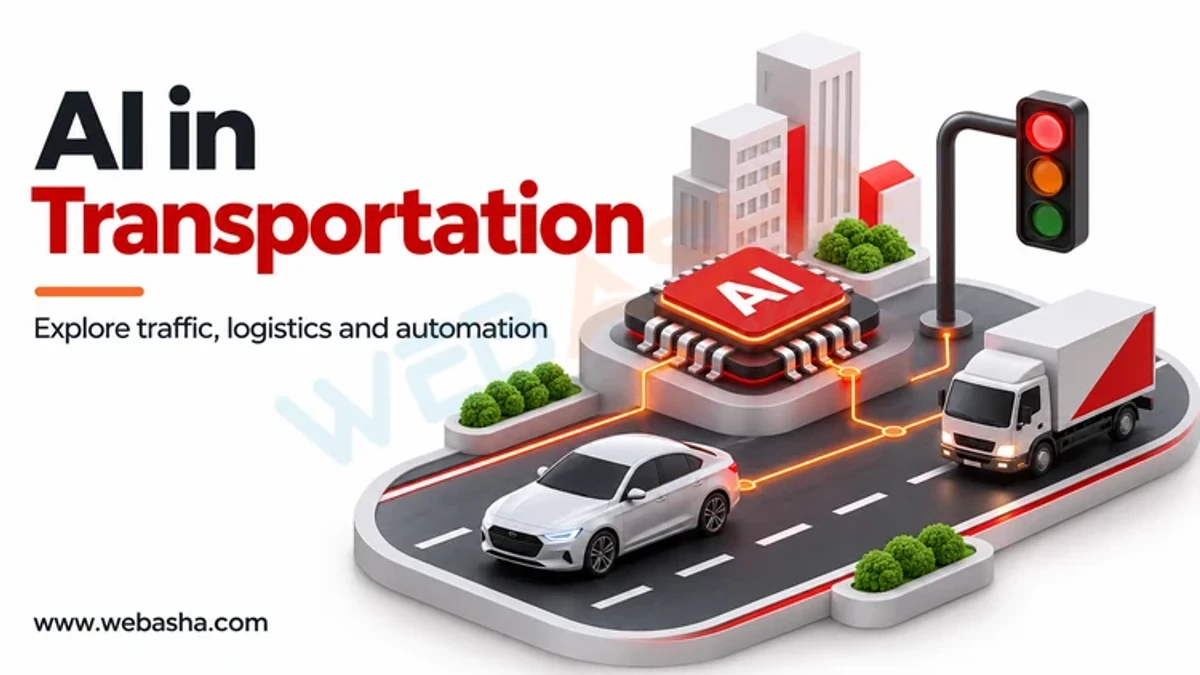
Quick answer: AI is used in transport for traffic signal timing, travel-time prediction, predictive maintenance, logistics routing and driver assistance, and these are largely mature. Fully self-driving vehicles work only in limited areas. Key risks are safety in edge cases, accountability, privacy and cybersecurity of connected systems.
Key takeaways
- Navigation, maintenance and logistics are mature uses; self-driving is still limited.
- SAE J3016 defines six automation levels, and most cars are at Level 2.
- Risks include safety edge cases, accountability, privacy and cyber attacks.
- Python, machine learning and computer vision are the core skills.
Where is AI used in transport today?
Transport produces large amounts of data from cameras, sensors, GPS, tickets and vehicle systems, which is what machine learning needs. Some uses are mature and some are still being tested. It helps to separate them.
| Area | What AI does | Maturity |
|---|---|---|
| Traffic signals and flow | Adjusts signal timing from camera and sensor data, predicts congestion | Deployed in pilots and some cities |
| Navigation and ETA | Predicts travel time from live and historical data | Widely used in consumer apps |
| Predictive maintenance | Flags likely failures in trains, aircraft engines and fleets from sensor data | Widely used |
| Logistics and routing | Plans delivery routes and loads, forecasts demand | Widely used |
| Driver assistance | Lane keeping, adaptive cruise control, automatic braking | Common in new cars |
| Self-driving vehicles | Full control of the vehicle in defined conditions | Limited areas and trials |
Self-driving levels, plainly
The SAE J3016 standard describes six levels, from 0 (no automation) to 5 (full automation everywhere). Most cars sold with "autopilot" style features are at Level 2, where the driver must stay attentive and in charge. Higher levels exist only in limited, mapped areas. Read the standard's summary at SAE International. For a closer look at the road side, see AI on the road: autonomous vehicles.
How the technology fits together
- Perception: computer vision and sensor fusion detect vehicles, lanes, people and signs.
- Prediction: models estimate what other road users will do next.
- Planning and control: software chooses a path and sends commands to steering and brakes.
- Connectivity: faster networks help share data between vehicles and infrastructure. See 5G and 6G and AI.
What are the limits and risks?
- Safety and edge cases. Unusual weather, road works and unpredictable people are hard to handle.
- Accountability. When an automated system is involved in a crash, who is responsible is a legal question that rules are still working out.
- Data and privacy. Cameras and location data raise surveillance concerns.
- Cybersecurity. Connected vehicles and signal systems can be attacked, so security has to be designed in.
- Jobs. Automation may change driving and logistics work, and reskilling matters.
What are the skills for this field?
People building these systems use Python, data handling, machine learning, computer vision, embedded systems and increasingly MLOps. Our post on smarter robots covers related ground.
Next steps
If you want to start building, begin with Python and the basics of machine learning. See the Machine Learning course.
Related reading
Frequently Asked Questions
What's Your Reaction?
 Like
0
 Dislike
0
 Love
0
 Funny
0
 Wow
0
 Sad
0
 Angry
0

Vaishnavi is a skilled tech professional at the Ethical Hacking Training Institute in Pune, responsible for managing and optimizing the technical infrastructure that supports advanced cybersecurity education. With deep expertise in network security, backend operations, and system performance, she ensures that practical labs, online modules, and assessments run smoothly and securely. Her behind-the-scenes contributions play a vital role in delivering a seamless and secure learning experience for aspiring ethical hackers.