
AI in Cybersecurity | Hype or Game Changer? Examining Its Real Impact on Digital Security
Artificial Intelligence (AI) is transforming cybersecurity by enhancing threat detection, automating security operations, and predicting cyberattacks before they happen. With its ability to process vast amounts of data in real time, detect anomalies, and automate responses, AI is seen as a game-changer in cybersecurity. However, concerns about false positives, adversarial AI attacks, ethical risks, and high implementation costs raise questions about its effectiveness and reliability. This blog explores whether AI is truly a revolutionary force in cybersecurity or just overhyped technology, discussing its benefits, risks, and future potential in fighting cyber threats.
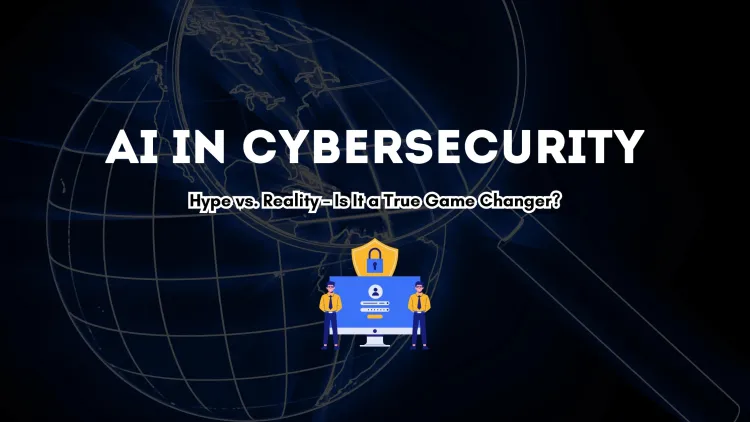
Quick answer: AI in cybersecurity is both real and overhyped. It genuinely helps with threat detection, anomaly spotting and faster response at scale. It does not remove the need for skilled people, good data or basic security hygiene, and attackers use it too. Treat it as a strong assistant, not a magic fix.
Key takeaways
- AI helps with detection at scale but does not fix poor basics.
- Ask vendors for evidence.
- Pilot before buying.
Table of Contents
- Introduction
- How AI is Being Used in Cybersecurity
- AI in Cybersecurity: Real Change or Hype?
- Future of AI in Cybersecurity
- Conclusion: AI in Cybersecurity – Hype or Real Change?
Introduction
Artificial Intelligence (AI) is transforming various industries, and cybersecurity is no exception. With rising cyber threats, sophisticated attacks, and increasing digital dependence, organizations are looking toward AI as a potential solution. But is AI truly a big change for cybersecurity, or just another overhyped technology? Below, we weigh the real impact of AI in cybersecurity: its benefits, risks, challenges, and future potential.
How AI is Being Used in Cybersecurity
AI is revolutionizing cybersecurity by automating threat detection, analyzing vast amounts of data, and predicting attacks before they occur. Below are some key ways AI is enhancing cybersecurity:
1. Threat Detection & Prevention
- AI-based systems continuously monitor network traffic and identify anomalies that indicate potential cyber threats.
- Machine learning models analyze historical attack patterns to predict and prevent cyberattacks before they happen.
2. Automated Security Responses
- AI enables automated responses to cyber threats, reducing the need for manual intervention.
- Security Orchestration, Automation, and Response (SOAR) platforms use AI to analyze and mitigate cyber threats in real-time.
3. Fraud Detection
- AI-powered fraud detection tools analyze transaction behaviors, spending patterns, and user activities to detect and block fraudulent transactions.
- Financial institutions use AI to combat identity theft and online payment fraud.
4. AI for Malware Detection
- Traditional signature-based antivirus solutions struggle with new and evolving malware. AI uses behavioral analysis to detect zero-day threats and polymorphic malware.
- AI-driven sandboxing techniques isolate and analyze suspicious files before they reach critical systems.
5. AI-Powered Phishing Detection
- AI scans emails, messages, and website links to detect phishing attempts.
- Advanced natural language processing (NLP) algorithms identify social engineering tactics in phishing emails.
6. AI in Identity & Access Management (IAM)
- AI enhances authentication by analyzing user behavior, device fingerprints, and geolocation data.
- Adaptive authentication techniques such as AI-driven multi-factor authentication (MFA) and biometric verification improve security.
7. Cyber Threat Intelligence (CTI)
- AI aggregates cyber threat data from multiple sources to provide real-time threat intelligence reports.
- AI helps government agencies, enterprises, and cybersecurity firms stay ahead of emerging cyber threats.
AI in Cybersecurity: Real Change or Hype?
Advantages of AI in Cybersecurity
| Benefit | Explanation |
|---|---|
| Speed & Efficiency | AI automates security processes, reducing response time to cyber threats. |
| Proactive Threat Hunting | AI helps detect unknown threats by analyzing anomalies and attack patterns. |
| Reduced Human Errors | AI minimizes security risks caused by human oversight, misconfigurations, and fatigue. |
| Scalability | AI-driven security systems can monitor large networks and cloud environments more effectively. |
| Cost Reduction | Automating cybersecurity tasks reduces the need for large security teams and expensive manual processes. |
Challenges & Limitations of AI in Cybersecurity
| Challenge | Explanation |
|---|---|
| AI Bias & False Positives | AI models may misclassify threats, leading to unnecessary alerts and disruptions. |
| Adversarial AI Attacks | Cybercriminals are using AI-powered tools to evade detection and bypass AI-driven defenses. |
| Data Privacy Concerns | AI security tools require access to large datasets, raising privacy and compliance issues. |
| High Implementation Cost | AI-based cybersecurity solutions can be expensive and resource-intensive. |
| Lack of Skilled Professionals | AI in cybersecurity demands skilled professionals to train, manage, and interpret AI models. |
Future of AI in Cybersecurity
AI is expected to play an even bigger role in cybersecurity in the future. Here are some potential advancements:
- AI-Powered Cybersecurity Operations Centers (SOCs): AI will enhance real-time monitoring, response automation, and threat prediction.
- Quantum AI for Cybersecurity: Quantum computing will revolutionize encryption and AI-driven cybersecurity defense mechanisms.
- AI-Driven Deception Technology: AI will improve honeypots and deception techniques to lure cybercriminals into fake environments.
- Self-Healing AI Systems: Future AI security tools may automatically fix vulnerabilities and recover from cyberattacks.
Conclusion: AI in Cybersecurity – Hype or Real Change?
While AI is not a silver bullet, it clearly changes cybersecurity. By improving detection, automating responses, and providing deep threat intelligence, AI helps organizations combat cyber threats more effectively. However, ethical concerns, adversarial AI threats, and implementation challenges must be addressed so that AI remains a force for good in cybersecurity.
The future will likely be a collaborative approach, where AI works alongside human experts rather than replacing them. Organizations that embrace AI-driven security strategies while maintaining human oversight will have the best defense against the changing cyber threats.
To take this further with guided labs and an instructor, see our cyber security training.
Related reading
Frequently Asked Questions
What's Your Reaction?
 Like
0
Like
0
 Dislike
0
Dislike
0
 Love
0
Love
0
 Funny
0
Funny
0
 Wow
0
Wow
0
 Sad
0
Sad
0
 Angry
0
Angry
0

Vaishnavi is a skilled tech professional at the Ethical Hacking Training Institute in Pune, responsible for managing and optimizing the technical infrastructure that supports advanced cybersecurity education. With deep expertise in network security, backend operations, and system performance, she ensures that practical labs, online modules, and assessments run smoothly and securely. Her behind-the-scenes contributions play a vital role in delivering a seamless and secure learning experience for aspiring ethical hackers.












![Top 10 Famous Ethical Hackers in India [Updated 2026]](https://www.webasha.com/blog/uploads/images/202608/image_140x98_da23f65c290cfbf1237d77aec58a2f0f.jpg)