Cybersecurity Interview Questions for Freshers With Practical Examples
Prepare for cybersecurity interviews by explaining core concepts, applying them to a small scenario and stating what evidence you would check next. Freshers should practise access control, network security, password storage and incident triage, then connect those topics to work they have actually completed.
Prepare for cybersecurity interviews by explaining core concepts, applying them to a small scenario and stating what evidence you would check next. Freshers should practise access control, network security, password storage and incident triage, then connect those topics to work they have actually completed.
The questions below are a practice set for beginner interviews, not a prediction of a particular employer’s assessment. Sample answers show a reasonable starting point. Adapt them to the role, listen to the question and expect follow-ups.
How to use this guide
- Give a short answer, then explain one concrete example.
- Separate observed facts from conclusions that need more evidence.
- Use your own lab work when discussing experience.
- Say when an action needs approval or specialist help.
How should freshers answer cybersecurity interview questions?
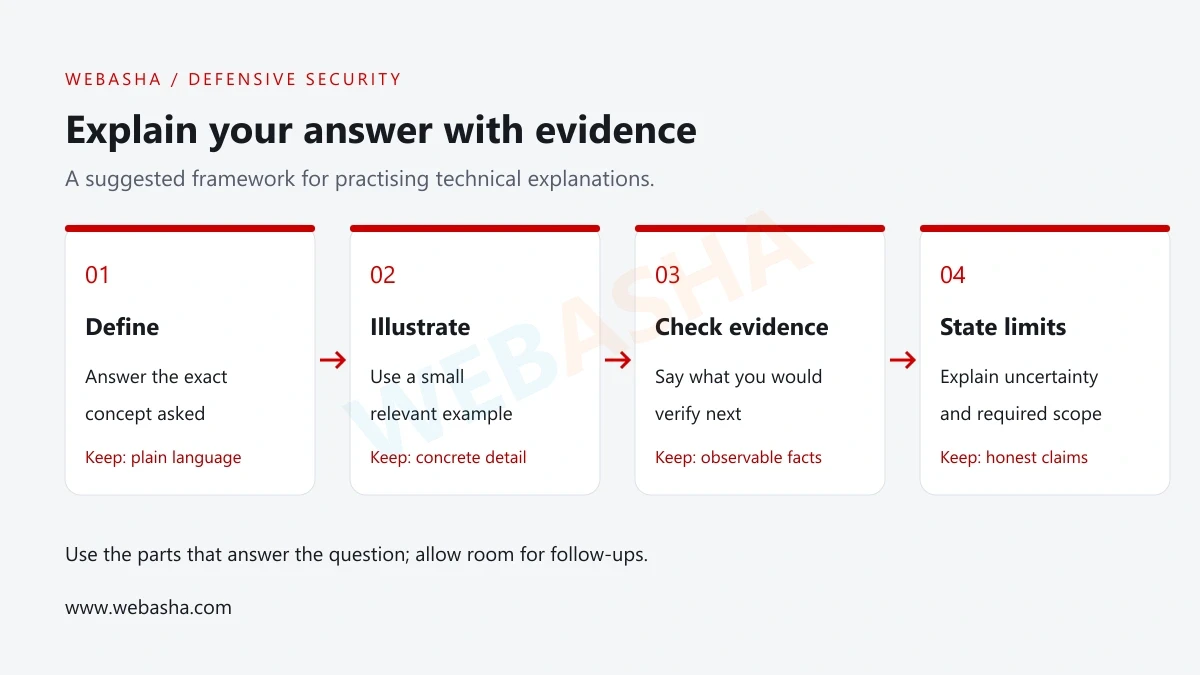
Begin with the concept the interviewer asked about. Add an example that makes the distinction visible, then explain the next check you would make. If a question is ambiguous, ask whether the interviewer wants a user-level explanation, a system design discussion or an incident response.
For example, if asked whether failed logins prove an attack, identify the observable pattern first. Ask about the time window, accounts, successful sign-ins and expected user activity. A useful answer leaves the interviewer able to follow your reasoning.
Core cybersecurity interview questions and sample answers
1. What is the CIA triad?
Confidentiality limits information disclosure, integrity protects against improper changes, and availability concerns reliable access when needed. For a student results portal, these mean restricting access to marks, preventing unauthorised edits and keeping the service usable during results day. [1]
Follow-up: could a control help one goal while harming another? Yes: an overly broad emergency block may restrict disclosure while also preventing legitimate access. Explain the scope and recovery checks you would discuss with the owner.
2. What is the difference between a threat, a vulnerability and risk?
A vulnerability is a weakness. A threat is a potential cause of harm. Risk considers the likelihood and consequences of harm in context. An outdated internet-facing application is a weakness; someone exploiting it is a threat scenario; business exposure informs the risk. [1]
When asked which vulnerability to fix first, ask about exposure, asset importance, evidence of exploitation and available mitigations. A severity label is useful input, but you still need the environment and owner’s priorities.
3. How are authentication and authorisation different?
Authentication establishes who or what is requesting access. Authorisation decides whether that identity may perform a particular action. A signed-in student can read their own record, while changing another student’s marks should require a different permission. OWASP recommends checking permissions on every request. [2]
4. What does least privilege mean in practice?
Give an identity the access required for its task and review that access as the task changes. A reporting service that only reads approved records should not also receive permission to delete the database. Consider duration, scope and the process for removing access. [2]
Follow-up: how would you verify an access change? Test the intended allowed action and a forbidden action using approved test identities. A changed configuration alone does not establish that every access path enforces it.
Network security and cryptography questions
5. What does HTTPS protect, and what does it leave unresolved?
HTTPS uses TLS to protect HTTP traffic in transit. TLS supplies confidentiality and integrity for the protected connection and commonly authenticates the server through certificates. It does not establish that all content on the website is harmless or that its business is trustworthy. [3]
Follow-up: what if a certificate warning appears? Report the exact warning and investigate the certificate, hostname and system time through an approved process. Do not suggest disabling validation as a routine fix.
6. How are hashing and encryption different?
Encryption is designed to recover the original data with the appropriate key. A cryptographic hash produces a digest used in tasks such as checking file consistency. For password verification, use a dedicated password-hashing scheme with a unique salt and an appropriate work factor, rather than treating a fast file hash as a password-storage design. [4]
7. What is a salt?
A salt is a unique value used in password hashing so identical passwords do not produce the same stored result when salts differ. It is stored with the hash and need not be secret. Salting does not make a weak password unguessable. [4]
8. How would you investigate a website that will not open?
Ask whether the issue affects one user, one device or everyone. Check the error, DNS resolution, network reachability and service status using approved diagnostics. Distinguish a name-resolution failure from a certificate problem or an application error before proposing a change.
This is a troubleshooting practice scenario, not an instruction to probe a public target. For foundation study, see the WebAsha cybersecurity beginner guide.
Web security questions with defensive examples
9. What is SQL injection, and how is it prevented?
SQL injection happens when untrusted input changes the structure of a database query. Bind data values through parameterised queries instead of building query text by concatenating user input. For structural choices such as a sort direction, select from fixed application-owned options. [5]
Follow-up: is input validation enough? Validation can reject inappropriate values, but it does not replace parameter binding. Likewise, a stored procedure is not automatically safe if it builds dynamic SQL unsafely. [5]
10. Why is hiding an admin button insufficient access control?
The browser interface is not the final permission boundary. The server must enforce access to the action itself. In an approved test environment, verify that a low-privilege identity is refused even if it submits a request outside the normal interface. [2]
Explain expected behaviour and evidence you would collect, without demonstrating an unauthorised request against someone else’s application. If your portfolio includes access testing, show the lab scope and the permission rule that the test is meant to verify.
Incident-response interview scenarios
11. An employee reports a suspicious email. What do you do?
Ask them to use the organisation’s reporting channel and avoid interacting with the message. Record what they already did: opened an attachment, followed a link or entered credentials. CISA advises recognising and reporting suspicious messages; the organisation’s response team should direct further handling. [6]
In your answer, distinguish a report from a confirmed compromise. If credentials were entered, escalate promptly through the incident process. Avoid forwarding a live suspicious attachment to an informal group for opinions.
12. Several failed logins appear. Is this a brute-force attack?
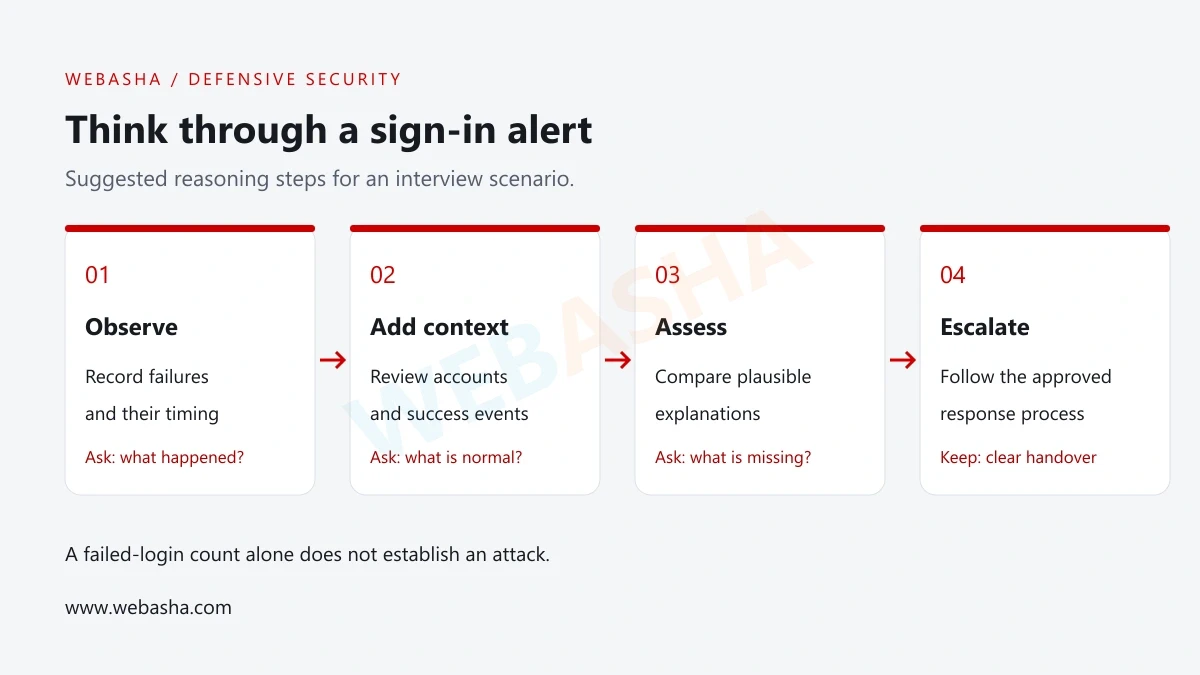
The failures are an observation, and the explanation remains to be established. Review the time window, account distribution, source information, successful events and expected activity. A misconfigured client or a user repeatedly mistyping a password could also create failures.
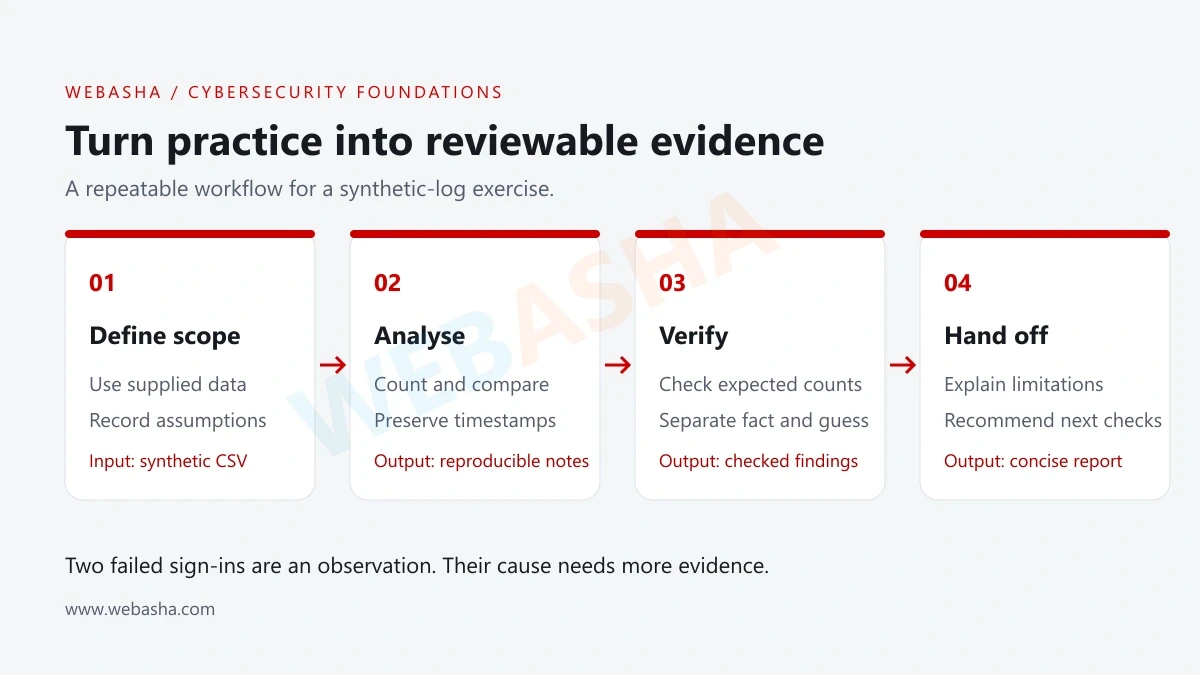
For the interview, state what would increase concern and which owner you would notify. A count without timing or context is insufficient to establish malicious intent.
13. You suspect malware on a workstation. What happens next?
Notify the incident owner, record what you observed and follow the organisation’s containment instructions. Avoid improvising a wipe or deleting files that may matter to the investigation. Urgent containment and evidence preservation need coordination; record the actions and their timing.
NIST SP 800-61 Rev. 3 integrates incident response with cybersecurity risk management. Use that broader view to discuss preparation, detection, response and recovery instead of describing recovery as the end of all security work. [7]
14. Practical exercise: count failed sign-ins in Python
Prerequisite: a local Python 3 interpreter. Save the following as count_failures.py and run it with python count_failures.py, or the Python 3 launcher used on your workstation. It reads a synthetic list in memory, prints counts and makes no network request.
from collections import Counter

events = [
    ("learner-a", "failure"),
    ("learner-a", "failure"),
    ("learner-b", "success"),
    ("learner-c", "failure"),
]
failures = Counter(user for user, result in events if result == "failure")
for user, count in sorted(failures.items()):
    print(user, count)
Python’s Counter counts occurrences of hashable values. Here it counts account names selected from failed events. [8]
Expected output:
learner-a 2
learner-c 1
Explain the result: learner-a has two failed events in this sample. The script contains no timestamps, source addresses or session context, so it cannot establish a time-based attack or confirm compromise.
Follow-up tests: try an empty list, all successful events and one failure. Before using external records, define a schema, reject malformed values and account for duplicate records. This example uses lowercase status values exactly as shown; a different spelling will not match the filter.
The snippet was executed locally against its synthetic data and checked against the displayed output. It is a counting exercise, not an incident detector.
Project and behavioural interview questions
15. Tell me about a security project you completed.
Choose a project whose evidence you can show. Explain the problem, lab scope, approach and result. Name one limitation. If a tutorial supplied the starting point, credit it and describe your contribution. Keep personal lab work separate from employment experience.
An answer could describe the counting exercise above, but only claim that you ran it if you did. A stronger extension would include a documented dataset, time-window logic and tests you can demonstrate. See the WebAsha beginner portfolio guide for documentation ideas.
16. What do you do when you do not know the answer?
State the gap plainly, identify what you do know and propose a sensible next check. For example: “I have not used that SIEM. I would first review the event schema and the team’s triage procedure, then validate a query against a known sample.”
17. Describe a mistake and how you handled it.
Use a real, appropriate example. Explain what went wrong, who you informed, how you verified the correction and what changed in your process. Remove private data and avoid claiming a production incident when the work occurred in a lab.
18. What if someone asks you to test a system without approval?
Clarify the owner, written scope, permitted methods and reporting route before testing. Escalate unclear instructions to your supervisor. In a learning interview, you can demonstrate the same concept with a synthetic example or a system explicitly provided for the exercise.
Common answer problems and how to improve them
| Problem | Better practice |
|---|---|
| Reciting a definition without applying it | Use a small example and explain the relevant security boundary. |
| Calling every alert a confirmed attack | State observations, plausible explanations and evidence still needed. |
| Recommending an immediate broad change | Explain scope, approval, impact and how the result would be checked. |
| Listing tools you cannot explain | Choose one task and describe what the tool helped you observe. |
| Inventing project results or employment | Use actual records and label tutorials, labs and team contributions accurately. |
Practise answering a changed version of the same question. If a failed-login example becomes a successful login from an unfamiliar device, your next checks should change too. This helps reveal whether you understand the reasoning behind your original answer.
A focused seven-day interview preparation plan
| Day | Practice task |
|---|---|
| 1 | Read the job description and identify required foundation topics. |
| 2 | Explain the CIA triad, risk and access control using your own examples. |
| 3 | Review HTTPS, password hashing and defensive web-security concepts. |
| 4 | Work through email and sign-in scenarios; record missing evidence. |
| 5 | Run the synthetic Python exercise and explain its limits. |
| 6 | Rehearse a project walkthrough and behavioural answers with a partner. |
| 7 | Review unclear answers, check portfolio links and prepare questions for the team. |
This schedule is an editorial study aid, not a readiness guarantee. For a SOC-focused role, put more time into evidence and handovers; the SOC analyst skills guide can help you identify areas to study.
Explore the Cyber Security Course at WebAsha Technologies for structured foundation learning and lab practice. Contact WebAsha to discuss your starting level, syllabus and project-review needs.
Official references
- NIST: Small business cybersecurity glossary
- OWASP: Authorization Cheat Sheet
- MDN: Transport Layer Security
- OWASP: Password Storage Cheat Sheet
- OWASP: SQL Injection Prevention Cheat Sheet
- CISA: Avoid phishing scams tip sheet
- NIST SP 800-61 Rev. 3: Incident response
- Python documentation: collections.Counter
Frequently Asked Questions
What's Your Reaction?
 Like
0
 Dislike
0
 Love
0
 Funny
0
 Wow
0
 Sad
0
 Angry
0

With a passion for staying on the cutting edge of technology trends, I am dedicated to delivering content that not only informs but also inspires. Whether you need in-depth analysis pieces, informative guides, or thought-provoking opinion pieces, I craft content that resonates with tech enthusiasts and professionals alike.