
What Is CrowdStrike Falcon and How Does It Help Stop Ransomware?
In 2026, ransomware continues to dominate the cyber threat landscape, with more sophisticated attacks targeting enterprises daily. To combat this, many organizations are turning to CrowdStrike Falcon, an advanced cloud-native endpoint protection platform that uses AI-driven behavioral analytics, real-time threat detection, and automated incident response to stop ransomware before it spreads. This blog explores how Falcon works, why it's trending, and the newest tools it offers like Falcon Surface and CrowdStrike OverWatch. It also highlights how Falcon protects endpoints without slowing down performance, offers case examples, and addresses common questions about ransomware defense.
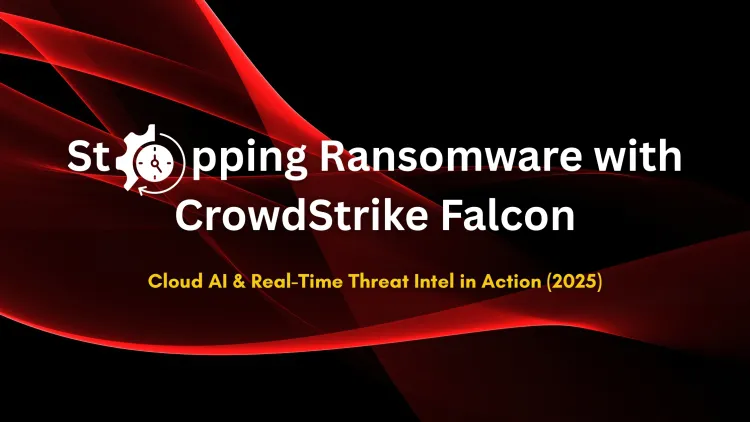
Quick answer: CrowdStrike Falcon is a cloud-delivered endpoint security platform built on one lightweight agent. The agent records activity on laptops and servers, and the cloud analyses it with machine learning, behavioural detections and threat intelligence to block malware and ransomware, support investigations and enable response. It does not remove the need for patching, backups and monitoring.
Key takeaways
- Falcon uses one lightweight sensor on each endpoint and does most analysis in the cloud.
- Core modules include next-generation antivirus (Prevent), EDR (Insight), threat intelligence and managed hunting.
- Ransomware is stopped mainly by spotting behaviour, such as mass file encryption and credential theft, not only known files.
- No tool is perfect. Layered defences such as patching, MFA, backups and segmentation are still needed.
- In July 2024 a faulty content update crashed many Windows systems, a reminder to plan for vendor and update risk.
What is CrowdStrike Falcon?
Falcon is the endpoint and cloud security platform from CrowdStrike. A small agent, called a sensor, runs on Windows, macOS and Linux machines and sends telemetry about processes, network connections and file activity to the vendor's cloud. Detection logic, machine learning models and intelligence live in the cloud and are updated without a heavy local signature database. Product names and bundles change, so check the vendor's platform page for current modules.
What are the main components?
| Capability | What it does |
|---|---|
| Next-generation antivirus (Falcon Prevent) | Blocks malware and exploits using machine learning and behaviour rules |
| EDR (Falcon Insight) | Records endpoint activity so analysts can investigate and contain threats |
| Threat intelligence | Adds information about attacker groups and indicators to detections |
| Managed hunting (Falcon OverWatch) | Vendor analysts look for hidden intrusions in customer telemetry |
| Automation (Falcon Fusion) | Runs workflows for containment and notification |
How does Falcon detect ransomware?
Ransomware is a set of behaviours rather than a single file. A modern platform watches for those behaviours:
- A process rapidly opening and rewriting many files, often renaming them.
- Deleting shadow copies or backups to stop recovery.
- Credential theft from memory, followed by movement to other machines.
- Office documents spawning scripting tools, a common initial step.
- Disabling security tools or tampering with services.
When these patterns match, the agent can block the process, isolate the host from the network and alert analysts. Behaviour-based detection helps against new variants, because it does not depend on having seen the exact file before. The MITRE ATT&CK framework gives names to many of these behaviours, and defenders map detections to it.
What does an investigation look like?
An analyst typically opens the detection, reads the process tree (which process started which), checks the user and host, looks at network connections and file writes, searches for the same indicators on other hosts, and then isolates the machine and removes persistence. The platform provides the data and containment buttons; the analyst's judgement decides whether it was a false positive. A trainer with product access could add screenshots of this workflow.
What are the limits and risks?
- Not a complete defence. Attackers use valid credentials, misconfigurations and unmanaged devices that an endpoint agent cannot see.
- Tuning and staffing. Alerts need people. Small teams often rely on a managed service.
- Update and concentration risk. On 19 July 2024 a faulty content update from CrowdStrike caused widespread Windows crashes worldwide. The vendor published a root cause analysis afterwards. The lesson for any security agent is to stage updates where possible, keep recovery procedures ready and test them.
- Cost and licensing. Platforms are commercial products; evaluate fit and price directly with vendors.
What else do you need against ransomware?
- Offline or immutable backups, and restore tests.
- Prompt patching of internet-facing systems.
- Multi-factor authentication, ideally phishing-resistant, for remote access and admins.
- Network segmentation and least-privilege accounts.
- An incident response plan that people have practised.
Common mistakes
- Installing an agent and assuming the job is done.
- Leaving sensors in detect-only mode and never moving to prevention after tuning.
- Missing devices that have no agent installed.
- Not testing restores of backups.
Next steps
To see how EDR fits into daily security operations, read top AI cybersecurity tools and consider our Certified SOC Analyst course, which covers triage and investigation.
Related reading
- How AI is Reinventing Cybersecurity in 2026 | From Smart Threat Detection to Automated Response Using Tools Like CrowdStrike and Darktrace
- How AI is Making Traditional Anti-Virus Solutions Obsolete?
- The Invisible Shield | How Cybersecurity Tools in 2026 Are Protecting You from Hackers, Data Breaches, Ransomware, and Online Threats
Frequently Asked Questions
What's Your Reaction?
 Like
0
Like
0
 Dislike
0
Dislike
0
 Love
0
Love
0
 Funny
0
Funny
0
 Wow
0
Wow
0
 Sad
0
Sad
0
 Angry
0
Angry
0

Vaishnavi is a skilled tech professional at the Ethical Hacking Training Institute in Pune, responsible for managing and optimizing the technical infrastructure that supports advanced cybersecurity education. With deep expertise in network security, backend operations, and system performance, she ensures that practical labs, online modules, and assessments run smoothly and securely. Her behind-the-scenes contributions play a vital role in delivering a seamless and secure learning experience for aspiring ethical hackers.












![Top 10 Famous Ethical Hackers in India [Updated 2026]](https://www.webasha.com/blog/uploads/images/202608/image_140x98_da23f65c290cfbf1237d77aec58a2f0f.jpg)