How AI is Making Traditional Anti-Virus Solutions Obsolete?
Traditional antivirus solutions are becoming obsolete due to their reliance on outdated signature-based detection methods, which fail against zero-day attacks, polymorphic malware, and fileless threats. AI-powered cybersecurity solutions offer real-time threat detection, behavioral analysis, and machine learning-driven threat intelligence, making them more effective than conventional AV software. AI can predict, detect, and respond to threats faster, reduce false positives, and analyze encrypted and obfuscated malware that traditional solutions struggle with. While AI-driven cybersecurity tools are more effective, they also face challenges such as adversarial AI attacks and implementation costs. However, as cyber threats continue to evolve, AI-powered antivirus solutions are rapidly replacing traditional security methods, marking a new era in cybersecurity.
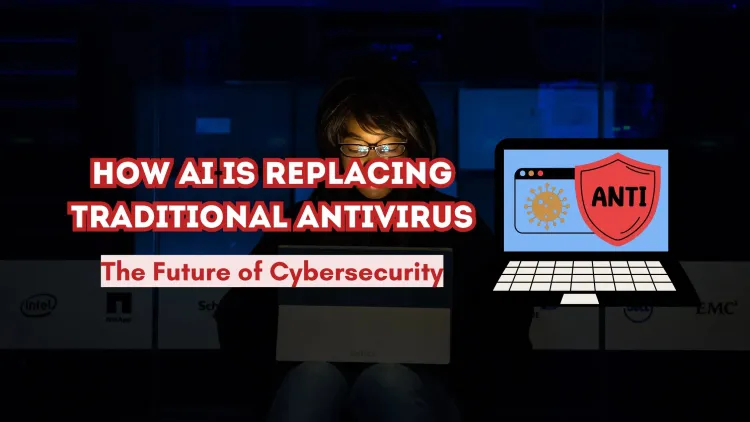
Quick answer: AI is not making antivirus obsolete, but it is changing it. Signature-based scanning still catches known malware quickly, yet it struggles with zero-day and polymorphic threats. Modern endpoint tools add machine learning and behavioural detection on top, so most organisations now use a layered approach rather than a single method.
Key takeaways
- Signature scanning is still fast for known malware, so it is not obsolete.
- Modern endpoint tools add behaviour analysis.
- Antivirus alone does not stop phishing or stolen credentials.
Table of Contents
- Why AI is Essential for Dark Web Monitoring
- The Limitations of Traditional Anti-Virus Solutions
- How AI is Transforming Cybersecurity
- AI vs. Traditional Anti-Virus: A Comparison
- AI-Powered Security Solutions Replacing Traditional AV
- Challenges and Limitations of AI in Cybersecurity
- The Future of AI in Cybersecurity
- Conclusion: Is AI Making Traditional AV Obsolete?
Introduction
For decades, traditional anti-virus (AV) software has been the primary line of defense against malware. However, as cyber threats evolve, conventional AV solutions struggle to keep up. Signature-based detection methods can no longer efficiently combat modern threats such as zero-day exploits, polymorphic malware, and advanced persistent threats (APTs).
With the rise of Artificial Intelligence (AI) and Machine Learning (ML), cybersecurity has entered a new era. AI-driven security tools are proving to be more effective than traditional AV solutions by using behavioral analysis, anomaly detection, and predictive threat intelligence. This shift raises an important question: Is AI making traditional anti-virus software obsolete?
The Limitations of Traditional Anti-Virus Solutions
1. Signature-Based Detection is Outdated
Traditional AV solutions rely on signature-based detection, where malware must first be identified, analyzed, and added to a database before it can be detected in the future. This method is ineffective against:
- Zero-day attacks – No prior signature exists for newly developed threats.
- Polymorphic malware – Malicious code that constantly changes to evade detection.
- Fileless malware – Attacks that execute directly in memory, bypassing traditional AV scans.
2. High False Positives and False Negatives
Traditional AV software often misidentifies harmless files as threats (false positives) or fails to detect evolving malware (false negatives), reducing its reliability.
3. Limited Real-Time Analysis
Most AV tools rely on periodic scans, leaving systems vulnerable between updates. Advanced threats operate in real-time, making delayed detection ineffective.
4. Struggles with Encrypted and Obfuscated Malware
Modern malware uses encryption and obfuscation techniques to bypass signature-based scanning, rendering traditional AV ineffective.
How AI is Transforming Cybersecurity
AI-powered security solutions overcome the limitations of traditional AV by using machine learning, deep learning, and behavioral analytics to detect threats in real-time.
1. AI Uses Behavioral Analysis Instead of Signatures
Instead of relying on static malware signatures, AI analyzes behavioral patterns in real-time. This allows AI-driven tools to detect malware before it is officially identified by security researchers.
2. AI Improves Threat Detection with Machine Learning
AI models continuously learn from past attacks, new malware samples, and system behavior, improving over time. Unlike static signature-based methods, AI evolves with the threat landscape.
3. AI Detects Zero-Day and Polymorphic Malware
By analyzing file behavior, network traffic, and execution patterns, AI can detect malware that changes its code to evade signature detection.
4. AI Reduces False Positives and False Negatives
AI-driven solutions improve accuracy by correlating multiple data points instead of relying on a single signature, reducing misclassification.
5. AI Enhances Real-Time Threat Detection and Response
- AI-powered Endpoint Detection and Response (EDR) systems monitor devices continuously for suspicious activity.
- AI-driven Security Information and Event Management (SIEM) tools analyze massive datasets in real-time to detect threats instantly.
AI vs. Traditional Anti-Virus: A Comparison
| Feature | Traditional Anti-Virus | AI-Powered Security |
|---|---|---|
| Detection Method | Signature-based | Behavior-based |
| Response Time | Slow (needs signature updates) | Instant, real-time detection |
| Zero-Day Protection | Poor | Excellent |
| Polymorphic Malware Detection | Weak | Strong |
| Fileless Malware Defense | Limited | Effective |
| False Positives | High | Reduced |
| Learning Capability | Static | Adaptive and evolving |
AI-Powered Security Solutions Replacing Traditional AV
1. Next-Gen AI-Based Antivirus Solutions
Security companies like CrowdStrike, Cylance, Darktrace, and SentinelOne offer AI-powered antivirus alternatives that analyze behavior instead of relying on outdated signatures.
2. AI-Powered Threat Intelligence
AI can predict and mitigate attacks before they happen by analyzing data from previous breaches, malware samples, and cybercrime patterns.
3. AI in Automated Incident Response
AI-driven Security Orchestration, Automation, and Response (SOAR) platforms automatically investigate and mitigate threats without human intervention.
4. AI-Driven Network Security
AI-powered Network Detection and Response (NDR) tools monitor traffic in real time, detecting abnormal patterns and potential intrusions.
Challenges and Limitations of AI in Cybersecurity
While AI offers significant advantages, it is not without challenges:
- Adversarial AI Attacks – Cybercriminals use AI to manipulate and evade AI security models with adversarial techniques.
- Data Privacy Concerns – AI requires vast datasets, raising ethical and privacy issues.
- False Alarms and Model Bias – Poorly trained AI models can still generate false positives and negatives.
- High Implementation Costs – AI-powered cybersecurity solutions can be expensive for small businesses.
The Future of AI in Cybersecurity
As AI continues to evolve, we can expect:
- Self-learning AI that requires minimal human intervention.
- AI-powered deception techniques to lure attackers into fake environments.
- Quantum AI security to counteract future quantum computing threats.
- Fully automated AI SOCs (Security Operations Centers) for instant cyber threat mitigation.
Conclusion: Is AI Making Traditional AV Obsolete?
Yes, AI-driven security solutions are rapidly replacing traditional antivirus software by offering real-time detection, behavioral analysis, and predictive threat intelligence that outdated signature-based methods cannot match. While traditional AV still has a place in basic security, businesses and individuals must adopt AI-powered cybersecurity solutions to stay ahead of modern cyber threats.
As cyberattacks become more sophisticated, AI will continue to dominate the future of cybersecurity, making traditional antivirus solutions obsolete in the fight against malware and evolving threats.
To take this further with guided labs and an instructor, see our classroom SOC analyst training.
Related reading
- How AI is Helping in Malware Detection and Analysis | Transforming Cybersecurity with Intelligent Threat Hunting
- Is MalwareGPT the Future of Malware Analysis? Exploring AI-Powered Threat Detection, Automated Malware Classification, and the Future of Cybersecurity
- How AI is Used to Decrypt and Analyze Malicious Code | Advanced Techniques for Cybersecurity
Frequently Asked Questions
What's Your Reaction?
 Like
0
Like
0
 Dislike
0
Dislike
0
 Love
0
Love
0
 Funny
0
Funny
0
 Wow
0
Wow
0
 Sad
0
Sad
0
 Angry
0
Angry
0

Vaishnavi is a skilled tech professional at the Ethical Hacking Training Institute in Pune, responsible for managing and optimizing the technical infrastructure that supports advanced cybersecurity education. With deep expertise in network security, backend operations, and system performance, she ensures that practical labs, online modules, and assessments run smoothly and securely. Her behind-the-scenes contributions play a vital role in delivering a seamless and secure learning experience for aspiring ethical hackers.










![Top 10 Famous Ethical Hackers in India [Updated 2026]](https://www.webasha.com/blog/uploads/images/202608/image_140x98_da23f65c290cfbf1237d77aec58a2f0f.jpg)