How Secure Is FreedomGPT? A Practical Look at Its Privacy, Security Features and Real Risks
With the rise of AI chatbots, privacy and security concerns have become a major topic of discussion. FreedomGPT, an uncensored, privacy-focused AI, allows users to operate AI models locally without third-party oversight. While this provides enhanced privacy and user control, it also introduces security challenges such as the risk of malicious misuse, lack of content moderation, and the absence of built-in encryption. This blog explores FreedomGPT's security features, including local hosting, open-source transparency, and user data autonomy, while also discussing its potential risks. Additionally, we compare it with other AI models like ChatGPT and Google Bard, analyze its vulnerabilities, and provide best practices for using FreedomGPT securely. By the end of this blog, you will have a clear understanding of whether FreedomGPT is a secure AI tool and how to mitigate risks while using it responsibly.
Topic: AI in Cybersecurity in Cybersecurity & Ethical Hacking · Explainer
Also covers: Cyber Threats, Scams & Online Safety
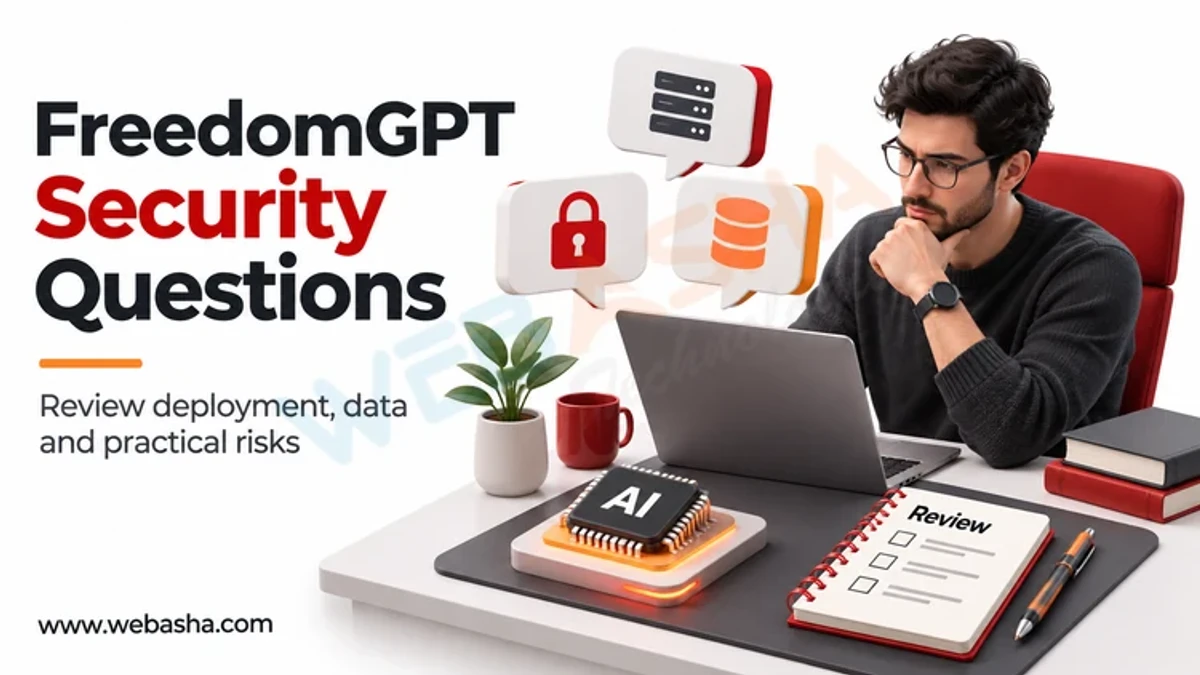
Quick answer: FreedomGPT is as safe as the way you use it. Run locally with a model downloaded from a trusted source, your prompts can stay on your machine. Use its hosted service, and prompts travel to servers. Either way it has few content safeguards, so outputs can be wrong or harmful, and fake installers are a real risk. Verify claims yourself rather than trusting them.
Key takeaways
- Local and hosted modes have different privacy. Local can keep prompts on your device; hosted sends them over the internet.
- 'Open source' means the code can be inspected, not that it has been audited or is safe. Read the current privacy policy and test the app.
- The biggest practical risks are fake installers, wrong or harmful answers from an unfiltered model, and pasting sensitive data into a cloud mode.
- You can check what an app sends by watching its network connections while it runs in a local mode.
- In India, misusing AI output for fraud or impersonation can still fall under the IT Act, 2000, and personal data is covered by the DPDP Act, 2023.
What is FreedomGPT?
FreedomGPT is an AI chat application marketed as uncensored and privacy-focused. It started in 2023 as a desktop app that ran an open language model on your own computer. Since then it has also offered a hosted service that gives access to many models through one interface. You can see its current positioning on the official site, and the desktop code on GitHub. For a product overview, read our article on FreedomGPT's features, working and ethical considerations.
The security answer depends on which mode you use, so start there.
How do local and hosted modes differ for privacy?
| Question | Local mode | Hosted mode |
|---|---|---|
| Where does the model run? | On your computer | On a remote server |
| Do prompts leave your device? | They need not, but verify | Yes, over the internet |
| Works without internet? | Yes, after the model is downloaded | No |
| Who could see your prompts? | Anyone with access to your device or backups | The service and its providers, under their policy |
| Main risks | Fake installers, malware on your PC, small-model errors | Data exposure, policy changes, third-party providers |
The original idea behind FreedomGPT was local use, and that is where the privacy case is strongest. If you choose a hosted model, treat the app like any cloud chatbot.
What do the commonly claimed security features really mean?
Marketing for AI tools tends to repeat a few claims. Here is what each one does and does not give you.
- "Runs locally, so private." True only if the app is actually running a local model and not contacting a server. Local also moves the security job to you: your disk, your backups and your malware defences now protect your chats.
- "Open source, so audited." Open code can be inspected, but most users never inspect it and a past audit does not cover today's build. The hosted service may not use the same code.
- "No logging." This is a statement about a product's policy and behaviour. It should be checked in the current privacy policy and, where you can, in the app's behaviour. Also check whether the app stores chat history on your own disk.
- "Decentralised, so no surveillance." Removing a central moderator does not remove tracking by your operating system, your network or a hosted provider. Decentralised is not the same as private.
- "Uncensored." This describes the model's tuning. It means fewer refusals and no safety net, not extra protection for you.
What are the real security risks?
1. Fake or tampered installers
Popular AI apps are a common disguise for malware. Search results and social posts often point to look-alike download pages. Download only from the official website or the project's GitHub releases page, check that the URL is correct, and scan the installer before running it. Where checksums or signatures are published, verify them.
2. Untrusted model files
A local app loads model files you download, sometimes from third-party sources. Some model formats, especially older Python pickle-based checkpoints, can run code when loaded. Formats designed only for weights, such as GGUF and safetensors, are safer, but inference software itself has had security bugs. Keep the app and its engine updated and check the National Vulnerability Database for known issues. Prefer models from well-known publishers.
3. Harmful, wrong or biased output
An unfiltered model will answer questions that mainstream assistants refuse, and small local models also make confident mistakes. Do not rely on it for medical, legal, financial or security decisions. The model can also write convincing phishing messages or malware code on request, which is why defenders need to understand these tools. For more, see the risks of uncensored AI models.
4. Data leakage through the cloud mode or through your own habits
If you choose a hosted model, your prompt leaves your device. Do not paste client data, source code, passwords or personal data into it. In India, personal data handling is covered by the Digital Personal Data Protection Act, 2023, and many employers forbid putting company data into unapproved AI tools.
5. Weak local hygiene
Local does not mean secure. If your laptop has malware, an unlocked screen or an unencrypted disk, your local chats are exposed. Turn on full-disk encryption (BitLocker, FileVault or LUKS) and keep your system patched.
6. Prompt injection and tools
If you connect a model to files, browsers or other tools, instructions hidden in a document or web page can steer the model into leaking data or taking actions. The OWASP Top 10 for LLM applications covers this class of risk. A plain chat app with no tools has far less exposure.
Legal and ethical points in India
Using AI output to deceive or defraud is an offence regardless of the tool. The Information Technology Act, 2000 includes provisions on identity theft and cheating by personation using a computer resource (sections 66C and 66D). Writing a phishing message with a model and sending it is not excused by saying "the AI wrote it". For learning and defence, practise only on your own lab systems and with written authorisation for any real test.
How does it compare with mainstream assistants?
The honest comparison is about trade-offs, not a winner.
| Point | FreedomGPT (local mode) | Mainstream cloud assistants |
|---|---|---|
| Where prompts go | Can stay on your device | Provider's servers, under its terms |
| Safety filtering | Minimal | Yes, under published policies |
| Answer quality | Limited by the model your hardware can run | Generally stronger |
| Data controls | You manage them | Provider settings; business plans often differ from consumer plans |
| Code visibility | Desktop code is open | Usually closed |
Provider data terms change, so read each one's current policy before using it for work. For a longer side-by-side, see ChatGPT vs FreedomGPT.
How can you verify what the app sends?
Do not take a claim on trust. Test it in a safe environment such as a spare machine or a virtual machine.
- Install the app from the official source and disconnect the internet after downloading a model.
- Start a chat. If it works offline, the model is local.
- Reconnect and run a packet capture with Wireshark, or list connections with
ss -tunpon Linux,netstat -anoon Windows orlsof -ion macOS, while you chat. - Look at which hosts the app contacts. Update checks are common. Prompt-sized traffic to unknown servers is not.
- Check where chat history is stored on disk and whether you can delete it.
Only capture traffic on machines and networks you own. This test does not prove anything for future versions, so repeat it after major updates.
What is a safe-use checklist?
- Download from the official site or GitHub releases only. Scan the installer.
- Use local mode with models from reputable publishers for anything private.
- Keep the app, its inference engine and your operating system updated.
- Encrypt your disk and lock your screen.
- Never enter secrets, client data or personal data into any cloud mode.
- Treat every answer as unverified. Check facts against a reliable source.
- Do not connect it to files, browsers or tools unless you understand prompt injection.
- Follow your employer's AI policy. Ask before using it for work.
For organisations, add a short approval process: who owns the tool, what data it may touch, where logs go, and who checks updates. The OWASP project publishes guidance for LLM applications at owasp.org.
So, is FreedomGPT secure?
It can be a reasonable choice for private, low-stakes experimentation in local mode, run by someone who verifies the download and understands the limits. It is a poor choice for sensitive data in hosted mode, for work without approval, or for anyone who expects the model to be accurate. The software itself is only one part of the answer. Your device, your habits and the model you load matter just as much.
Next steps
If you try it, run the verification test above in a virtual machine first. To learn how security teams assess AI tools and attacks on them, see our AI and LLM security course. You may also like our comparison ChatGPT vs FreedomGPT.
Frequently Asked Questions
What's Your Reaction?
 Like
0
 Dislike
0
 Love
0
 Funny
0
 Wow
0
 Sad
0
 Angry
0

Vaishnavi is a skilled tech professional at the Ethical Hacking Training Institute in Pune, responsible for managing and optimizing the technical infrastructure that supports advanced cybersecurity education. With deep expertise in network security, backend operations, and system performance, she ensures that practical labs, online modules, and assessments run smoothly and securely. Her behind-the-scenes contributions play a vital role in delivering a seamless and secure learning experience for aspiring ethical hackers.