CISA First-Attempt Preparation with Audit Evidence
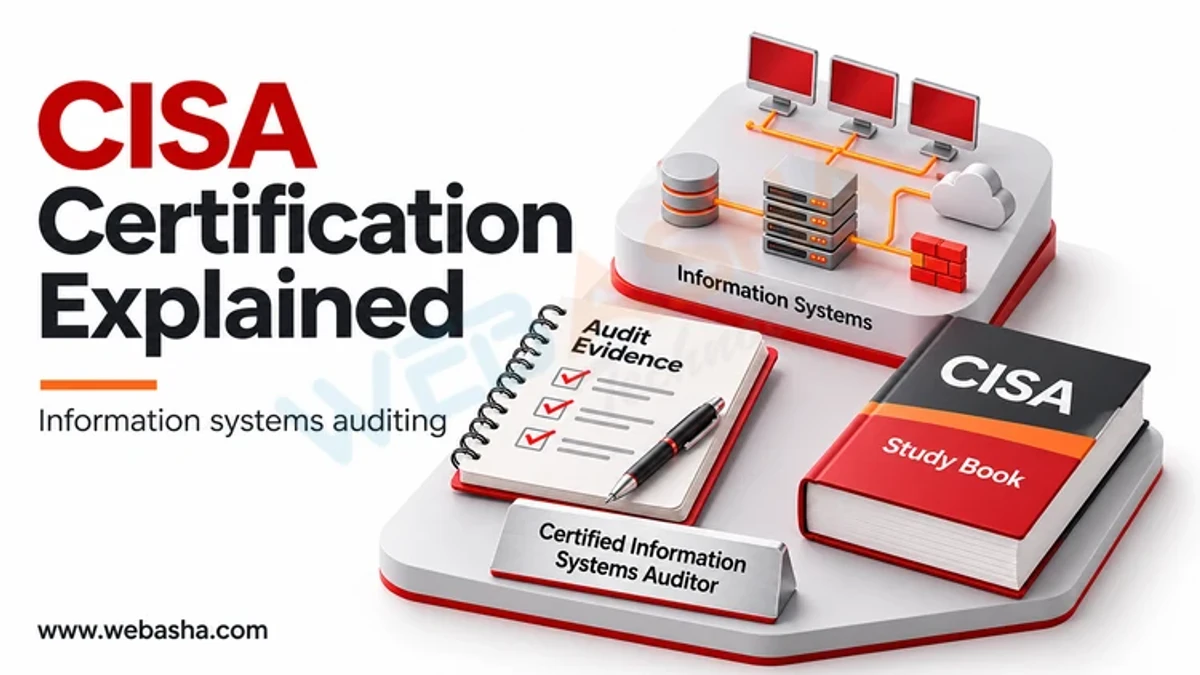
Prepare for CISA using the current ISACA outline, legitimate practice questions and careful evidence reasoning. The exam has 150 questions over four hours, with a scaled pass score rather than a raw percentage. This guide uses a fictional purchasing-control review to distinguish a complete population, selected evidence and a justified audit conclusion.
Topic: Cybersecurity Careers & Certifications in Cybersecurity & Ethical Hacking · Certification preparation

Quick answer: Prepare for CISA using the current ISACA outline, legitimate practice questions and careful evidence reasoning. The exam has 150 questions over four hours, with a scaled pass score rather than a raw percentage. This guide uses a fictional purchasing-control review to distinguish a complete population, selected evidence and a justified audit conclusion. Cover all five domains, rehearse timing and check the separate experience and application requirements before describing yourself as certified.
Key takeaways
- Use current domain weights.
- Establish population completeness before drawing broad conclusions.
- Separate control design from operating evidence.
- Review the assumption behind a wrong answer.
- Keep exam passage separate from certification.
Table of Contents
- What should a first-attempt CISA plan use as its baseline?
- How can you practise audit reasoning with supplied records?
- How should you separate design, operation and conclusion?
- How do you learn from practice questions instead of memorizing answers?
- How can one case help without narrowing study too far?
- How should you rehearse time and appointment requirements?
- What happens after passing the exam?
- How would you document an approval-timing exception?
- References
What should a first-attempt CISA plan use as its baseline?
Use the current issuer outline and candidate guide before choosing books or a course. ISACA’s CISA outline now has domain weights of 18%, 18%, 12%, 26% and 26%, respectively. The older 21/16/18/20/25 distribution should not determine a new preparation plan.
| Domain | Weight |
|---|---|
| Information systems auditing process | 18% |
| Governance and management of IT | 18% |
| Acquisition, development and implementation | 12% |
| Operations and business resilience | 26% |
| Protection of information assets | 26% |
ISACA’s candidate guide lists 150 multiple-choice questions over four hours and a passing scaled score of 450 on a 200 to 800 scale. That score is not a raw percentage. Keep preparation scores separate from official scoring.
How can you practise audit reasoning with supplied records?
Consider a fictional purchasing system. The control requires a second person to approve purchase orders above an agreed threshold. The audit scope covers April transactions. Management supplies a spreadsheet containing only orders that already have an approval reference.
Can you conclude that every April order was approved? No. The supplied list may exclude the exceptions you need to test. First establish the complete population, reconcile it to an independent source and understand the extraction criteria.
What evidence would you request next? Request the relevant transaction population, approval records, applicable rule and evidence of who could change either source. Confirm the period, system and completeness before selecting items.
This is a paper exercise using invented facts. It shows why a clean-looking file is not enough. A report containing only approved transactions can be accurate about its rows while remaining unsuitable for a conclusion about all transactions.
How should you separate design, operation and conclusion?
A written rule describes expected control design. A walkthrough helps explain the process. Testing selected transactions can provide evidence about operation, subject to how the population and sample were established. None of these should silently substitute for the others.
| Supplied evidence | What still needs checking |
|---|---|
| Approved policy | Whether the system and staff follow it. |
| Demonstration of one order | Whether the example represents the period under review. |
| Spreadsheet of approved orders | Whether unapproved orders were excluded. |
| Selected approval records | Whether they are authentic, timely and relevant to the sampled transactions. |
In the purchasing case, an approval added after the order was released does not necessarily meet a prior-approval requirement. Compare the required sequence with reliable timestamps and the process owner’s explanation. Investigate clock or extraction issues before treating every apparent mismatch as a confirmed exception.
Write a limited conclusion tied to the evidence: “Population completeness is not yet established, so transaction compliance testing cannot support the proposed period-wide conclusion.” Do not replace missing evidence with a confident assumption.
How do you learn from practice questions instead of memorizing answers?
For each original practice question, identify your role, the audit objective, the evidence available and the decision requested. An auditor’s next step may be to obtain evidence or report a finding; it is not automatically to implement a technical fix.
When you choose incorrectly, record the mistaken assumption. In this case, the mistake is trusting management’s filtered list as the full population. Then change one fact: suppose the list reconciles to the ledger, including rejected and unapproved orders. Explain how that affects the next step without assuming it proves every approval was effective.
ISACA’s professional ethics code emphasizes objectivity, due care, confidentiality and disclosure of significant facts. Practise applying those responsibilities when a manager asks you to omit an unresolved evidence limitation from a draft report.
Use legitimate study questions with explanations. Do not acquire alleged live exam content. Build explanations in your own words so that unfamiliar wording does not hide a familiar audit problem.
How can one case help without narrowing study too far?
Map the purchasing case to several domains: audit planning and sampling, governance and ownership, system implementation, operating changes and information access. Then add separate cases for topics it does not cover, such as disaster recovery or cryptographic key management. A single example cannot replace the full outline.
ISACA’s CISA preparation page lists official review resources and study options. Compare their edition and scope with the current outline. Ask a course provider how instructors review the reasoning behind a wrong answer rather than only announcing the correct option.
Allocate extra work where your evidence is weak. If you recognize control types but cannot judge evidence relevance, practise evidence comparisons. If continuity concepts are unfamiliar, work through a restore-and-acceptance scenario. Domain weighting informs coverage; your actual misunderstandings determine what needs another explanation.
How should you rehearse time and appointment requirements?
Use a timed practice set to observe where you slow down, then a full-format rehearsal when ready. Divide your review notes into content gaps, misread qualifiers and time-management problems. A “BEST” or “FIRST” question requires attention to the supplied context, not a universal action sequence.
Before booking, inspect the issuer’s identification, scheduling and delivery requirements. Check the name on your account against your permitted identification and leave time for any remote compatibility arrangements. Use the terms shown for your appointment rather than a course seller’s informal summary.
If an attempt is unsuccessful, review the current retake rules and fees before rescheduling. A first-attempt plan should make useful progress even when the first result is not a pass. Do not publish reconstructed exam questions as part of a study review.
What happens after passing the exam?
ISACA’s CISA certification requirements distinguish exam passage from the credential. The experience and application requirements still apply; candidates have five years after passing to apply. Passing alone does not award the credential; complete the issuer’s remaining requirements.
Keep a truthful experience record and arrange the required verification. Evaluate any permitted waiver through the current application process rather than assuming that a degree or another credential makes the full experience requirement disappear.
ISACA’s maintenance page requires at least 20 CPE hours annually and 120 over three years, alongside other obligations. Record eligible activities and supporting evidence if certified.
Finish the purchasing exercise with an audit note that names the population gap, requested reconciliation, responsible contact and effect on the conclusion. Once adequate evidence arrives, update the workpaper with what was actually tested and what remains outside scope.
How would you document an approval-timing exception?
Compare the sequence
Extend the supplied purchasing case with four selected orders. Three have approval recorded before release. The fourth shows release at 09:10 and approval at 09:25. The agreed control requires approval before release, so the fourth item needs investigation rather than being counted as compliant merely because an approval exists.
| Workpaper field | Entry to establish |
|---|---|
| Control criterion | Approval required before order release. |
| Observed sequence | Supplied release precedes supplied approval by 15 minutes. |
| Reliability check | Confirm timestamp meaning, source and clock context. |
Keep the conclusion proportionate
If the records are reliable, describe the selected item’s exception and seek the process owner’s explanation. Four selected items do not establish a population-wide exception rate without a suitable sampling basis. Preserve the evidence and the selection method beside the finding. If the timestamps refer to different stages than assumed, correct the interpretation before issuing the report.
Related reading: PMP preparation; CISM preparation.
References
Frequently Asked Questions
What's Your Reaction?
 Like
0
 Dislike
0
 Love
0
 Funny
0
 Wow
0
 Sad
0
 Angry
0

With a passion for staying on the cutting edge of technology trends, I am dedicated to delivering content that not only informs but also inspires. Whether you need in-depth analysis pieces, informative guides, or thought-provoking opinion pieces, I craft content that resonates with tech enthusiasts and professionals alike.