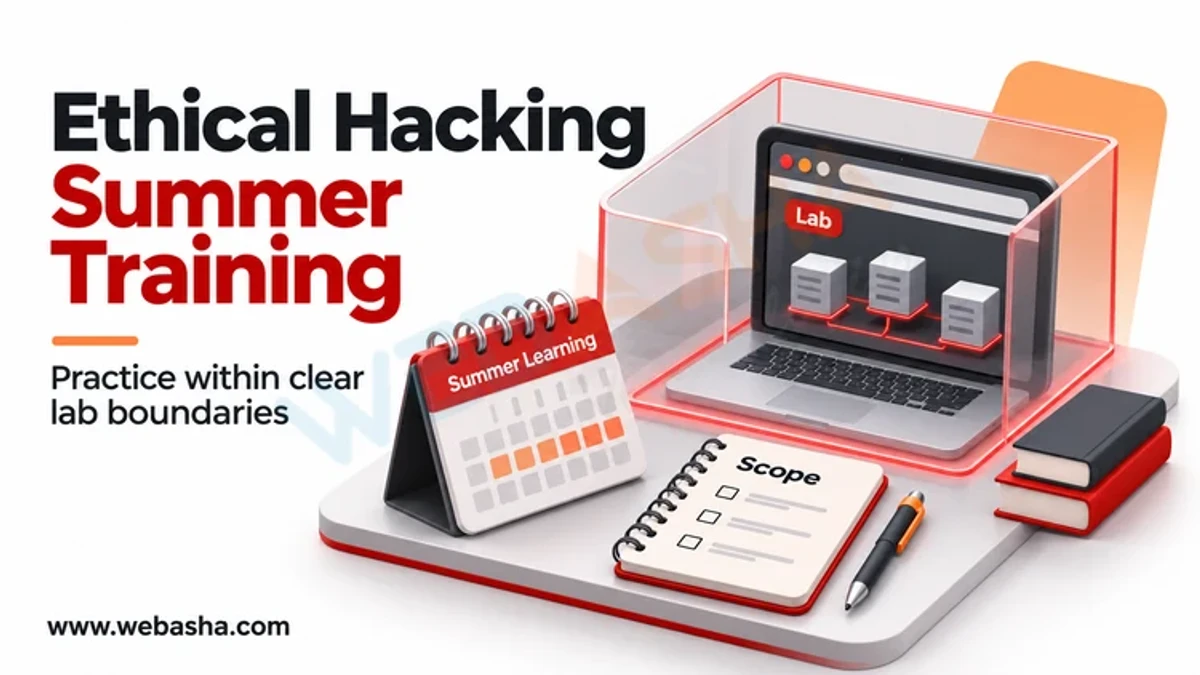
How to Become a Certified Ethical Hacker: A Practical Path
Becoming a Certified Ethical Hacker involves more than attending a class or buying a voucher. Confirm your issuer-approved eligibility route, learn the foundations, practise within authorization and prepare for the exact assessment. This guide distinguishes CEH, CEH Practical and the Master designation, then uses a fictional scope-change request to show how ethical practice affects daily decisions.
Topic: Ethical Hacking in Cybersecurity & Ethical Hacking · Certification preparation

Quick answer: Becoming a Certified Ethical Hacker involves more than attending a class or buying a voucher. Confirm your issuer-approved eligibility route, learn the foundations, practise within authorization and prepare for the exact assessment. This guide distinguishes CEH, CEH Practical and the Master designation, then uses a fictional scope-change request to show how ethical practice affects daily decisions. Check current examination and maintenance instructions before committing money or booking an attempt, and use specific feedback to guide your learning.
Key takeaways
- Separate learning, eligibility and examination entitlement.
- Distinguish CEH from Practical and the Master designation.
- Practise explaining observations and limits.
- Review new test methods before expanding scope.
- Maintain the exact credential earned without outcome promises.
Table of Contents
- What does becoming a Certified Ethical Hacker involve?
- Which foundations should you learn before tool-heavy practice?
- How does a scope-change exercise teach ethical practice?
- How should you choose training and practise independently?
- What should you check before scheduling the examination?
- How should you handle results and a possible retake?
- How do you keep the credential useful after passing?
- References
What does becoming a Certified Ethical Hacker involve?
Start by separating learning, examination eligibility and the awarded credential. The CEH examination page describes the knowledge examination, while CEH Practical is a separate practical assessment. Passing a course does not silently establish both credentials. The application process describes the official-training and approved experience-based routes. Its current CEH and CEH Practical sections require qualifying information-security experience unless the official-training route applies. Obtain approval for the route you intend to use rather than treating a voucher purchase as approval. The same application page describes CEH Master as a designation for holders of both certificates, not a separately purchasable certification. Decide which outcome you actually need before comparing packages. A programme's marketing version should not be confused with the exact examination and eligibility instructions.
Which foundations should you learn before tool-heavy practice?
Learn how an operating system manages identities, files and processes; how addressing, DNS and transport protocols support a request; and how a basic web application authenticates users and processes data. Choose original exercises that require explanation. For example, trace a supplied browser request through a proxy to an application, identify which component supplied each record, and describe what remains unknown. This is more useful than memorizing a scanner's menu. Keep a short glossary, but connect each term to an operation. Authentication is different from permission, a port observation is different from a vulnerability, and encryption is different from appropriate data handling. If one of those distinctions is unclear, practise it before advancing to more complex assessment work. Use only approved learning environments and data. Technical curiosity is not permission to test a public service.
How does a scope-change exercise teach ethical practice?
A fictional learning engagement permits review of supplied configuration records for a training application. During the review, someone asks the learner to add an availability stress test to demonstrate resilience. The original approval did not authorize generating load, and it names neither a suitable test window nor a stop threshold. What should the learner do? Keep the approved review separate from the new request. Ask the responsible owner to define the additional method, affected resources, operational safeguards, evidence handling and stop conditions before any such work begins. The issuer code of ethics addresses authorized use, confidentiality and competence. An enthusiastic message from a colleague is not a substitute for authority over every affected service or dependency. What should be communicated? State which work can continue under existing approval, what is paused, who must decide and what information is missing. This is professional delivery, not a failure to be technically capable.
| Supplied requirement or request | Decision | Record to retain |
|---|---|---|
| Review provided configuration | Continue within the agreed limits | Original scope and permitted records |
| Generate availability-test traffic | Outside the stated approval | Change request and affected dependencies |
| Colleague says it is fine | Authority remains to be confirmed | Responsible owner and escalation path |
| No stop threshold supplied | Operational risk is unresolved | Approved window, limits and stop conditions |
How should you choose training and practise independently?
Compare the exact syllabus, authorized lab access, feedback and examination entitlements in writing. Ask who issues the voucher, which assessment it covers, what the access dates are and whether eligibility approval is included or still outstanding. A useful practice cycle has an objective, a permitted environment, recorded observations and a short report. Ask a reviewer to identify an unsupported statement. Repair the reasoning before repeating the exercise under a changed condition. Do not judge preparation only by hours attended or tools recognized. A learner should be able to explain why a method is relevant, what result would weaken the hypothesis and when to stop. Practice records can demonstrate learning without publishing confidential data or protected exam questions. If studying independently, confirm that your route is accepted before paying non-refundable charges. Older pages and provider summaries can conflict with current application requirements.
| Package field | Question to ask |
|---|---|
| Eligibility | Which issuer route and approval apply to me? |
| Assessment | Knowledge exam, Practical, or both? |
| Access | Which materials and labs, with what usable dates? |
| Feedback | Who reviews original reports and practical errors? |
| Examination conditions | Which delivery, conduct and retake rules apply? |
What should you check before scheduling the examination?
Read the current examination page, delivery instructions, identification requirements and accommodation process for your assessment. The knowledge and Practical formats differ, so prepare for the actual product rather than a generic CEH label. Do not rely on a universal 70% passing claim. Current issuer pages describe form-dependent criteria, and some older summaries retain different wording. Ask for written clarification where the instructions conflict. Arrange a final rehearsal using original questions and authorized exercises. Explain your answers aloud, review weak areas and check the technical delivery setup. Read the independent-work and confidentiality rules before the day. A certification is a measure under a defined assessment scheme. It does not grant authority to assess a third party, replace all workplace supervision or promise a particular job.
How should you handle results and a possible retake?
Use the official result and the feedback actually provided. If unsuccessful, identify a demonstrated gap and review the current retake policy before scheduling another attempt. Cooling periods, attempt limits and a purchased entitlement are separate conditions. Keep a personal error log that describes the concept or operation you need to improve without recording or sharing protected examination items. For the scope-change exercise, a useful learning note says that the new method required a separate operational decision; it does not record a real organization's confidential configuration. If successful, state the exact credential and current status truthfully. Do not describe an unearned Practical certificate or Master designation merely because a course package included an opportunity to attempt them.
How do you keep the credential useful after passing?
Review the continuing-education policy and the fees and cycle applicable to your award. Track eligible activities and supporting records as you complete them instead of reconstructing everything near a deadline. Continue learning through authorized work and feedback. Build small sanitized examples that show a question, an observation and a decision. When a workplace request changes, use the same scope discipline as in the training case: identify the new method and affected operations, then obtain the appropriate decision. For career applications, connect learning to work you can explain honestly. A concise report, a well-reasoned boundary decision and a clear account of your own contribution can support an interview. Avoid presenting the certificate as proof of experience you have not gained or as a guarantee of employment.
Related reading: CEH route and eligibility checks; CEH Practical interview exercises.
References
Frequently Asked Questions
What's Your Reaction?
 Like
0
 Dislike
0
 Love
0
 Funny
0
 Wow
0
 Sad
0
 Angry
0

With a passion for staying on the cutting edge of technology trends, I am dedicated to delivering content that not only informs but also inspires. Whether you need in-depth analysis pieces, informative guides, or thought-provoking opinion pieces, I craft content that resonates with tech enthusiasts and professionals alike.