CPENT Certification Guide: Domains, Skills and Who It Suits
CPENT, the Certified Penetration Testing Professional, is EC-Council's advanced, hands-on penetration testing certification, now marketed as CPENT AI. Its course has 14 core modules covering scoping, OSINT, social engineering, web and API testing, defence evasion, Windows, Linux and Active Directory, binary exploitation, pivoting, IoT and reporting.
Topic: Penetration Testing in Cybersecurity & Ethical Hacking · Certification preparation
Also covers: Cybersecurity Careers & Certifications
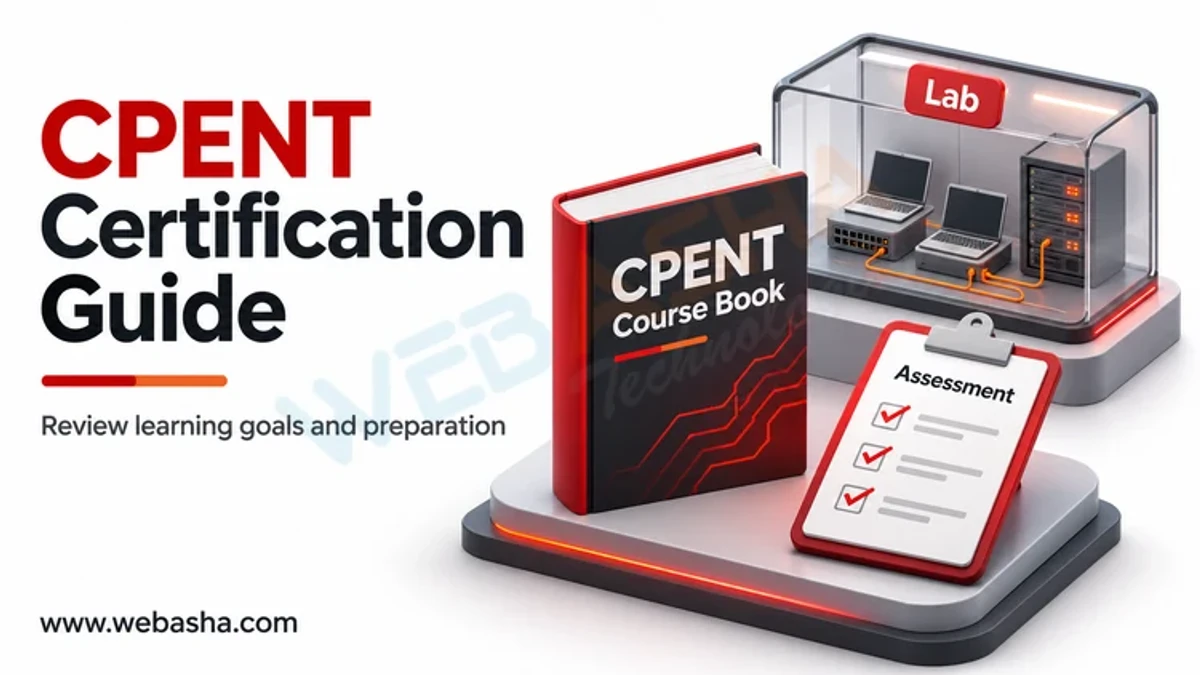
Quick answer: CPENT, the Certified Penetration Testing Professional, is EC-Council's advanced, hands-on penetration testing certification, now marketed as CPENT AI. Its course has 14 core modules covering scoping, OSINT, social engineering, web and API testing, defence evasion, Windows, Linux and Active Directory, binary exploitation, pivoting, IoT and reporting. The exam is fully practical: 24 hours, or two 12-hour sessions, followed by a report. It suits people who already have around two years of security experience, a CEH, or equivalent skills, and who want to prove they can run a complete test across segmented networks.
Key takeaways
- CPENT is an advanced practical certification, not an entry-level one.
- The syllabus spans 14 core modules plus self-study topics.
- The exam lasts 24 hours and ends with a written report.
- Scoring 90% or more also awards LPT (Master).
- It fits working testers and experienced ethical hackers best.
Table of Contents
- What Is the CPENT Certification?
- Which Domains Does CPENT Cover?
- How Is the CPENT Exam Structured?
- Who Is CPENT For?
- Which Skills Should You Have First?
- Where Does CPENT Fit in a Career Path?
- How Do You Keep the Certification Active?
- References
What Is the CPENT Certification?
CPENT is offered by EC-Council, the body behind CEH. The official CPENT AI page positions CEH as foundational, CPENT as the advanced hands-on step, and LPT (Master) as an extra title for candidates who score 90% or higher on CPENT. The current version adds AI-assisted testing topics, such as AI-supported scanning and enumeration, to each phase of the course. Unlike a multiple-choice exam, CPENT asks you to work through filtered network segments, pivot between them and document what you find. That makes it a test of method and stamina as well as technical knowledge.
Which Domains Does CPENT Cover?
EC-Council lists 14 core modules. Grouped by domain, they look like this:
| Domain | Core modules |
|---|---|
| Planning | Penetration testing methodologies; scoping and engagement |
| Reconnaissance and people | OSINT; social engineering penetration testing |
| Applications | Web application testing; API and JSON Web Token testing |
| Network and perimeter | Perimeter defence evasion; lateral movement and pivoting |
| Systems | Windows and Linux exploitation and privilege escalation; Active Directory testing |
| Specialist | Reverse engineering, fuzzing and binary exploitation; IoT testing |
| Reporting | Report writing and post-testing actions |
Self-study modules add scripting in PowerShell, Bash and Python, plus wireless, OT and SCADA, cloud, database and mobile testing. Web topics map well to the OWASP Web Security Testing Guide.
How Is the CPENT Exam Structured?
| Item | What EC-Council states |
|---|---|
| Format | Fully practical, proctored online |
| Duration | One 24-hour session or two 12-hour sessions |
| Report | Due within seven days of the final session |
| Pass mark | Varies by exam form, 60% to 85%; one FAQ says 70% |
| LPT (Master) | Awarded at 90% or higher |
Exam strategy is covered in the CPENT exam guide.
Who Is CPENT For?
- Penetration testers who want a practical, report-based credential.
- CEH holders ready to move from knowledge tests to hands-on work.
- Security engineers who test their own organisation's networks with authorisation.
- Consultants who scope engagements and write client reports.
Beginners are better served by networking, Linux and fundamentals first. The CEH vs CPENT comparison shows how the two relate.
Which Skills Should You Have First?
EC-Council asks for at least two years of information security experience, a CEH, or equivalent knowledge before the programme, and two years of experience to attempt the exam directly. In practice you should already understand TCP/IP, Windows and Linux administration, Active Directory basics, web application flaws and some scripting. The NIST NICE Framework lists the knowledge and tasks expected of penetration testers, which is a useful checklist.
Where Does CPENT Fit in a Career Path?
CPENT sits after foundational certifications and alongside other hands-on exams. It is valued for its reporting component, which reflects the planning, execution and reporting phases in NIST SP 800-115. Mapping your findings to MITRE ATT&CK techniques makes reports more useful to defenders. A certification supports a career; it does not guarantee a role.
How Do You Keep the Certification Active?
EC-Council says the certification is valid for one year from certification and is extended each year, subject to continuing education fees, within a three-year cycle of continuing education credits. Track your credits from the start. Practise only on official ranges, your own labs or systems with written permission; unauthorised access is an offence under Sections 43 and 66 of the IT Act 2000. To plan your preparation, ask about CPENT training.
References
Frequently Asked Questions
What's Your Reaction?
 Like
0
 Dislike
0
 Love
0
 Funny
0
 Wow
0
 Sad
0
 Angry
0

Vaishnavi is a skilled tech professional at the Ethical Hacking Training Institute in Pune, responsible for managing and optimizing the technical infrastructure that supports advanced cybersecurity education. With deep expertise in network security, backend operations, and system performance, she ensures that practical labs, online modules, and assessments run smoothly and securely. Her behind-the-scenes contributions play a vital role in delivering a seamless and secure learning experience for aspiring ethical hackers.