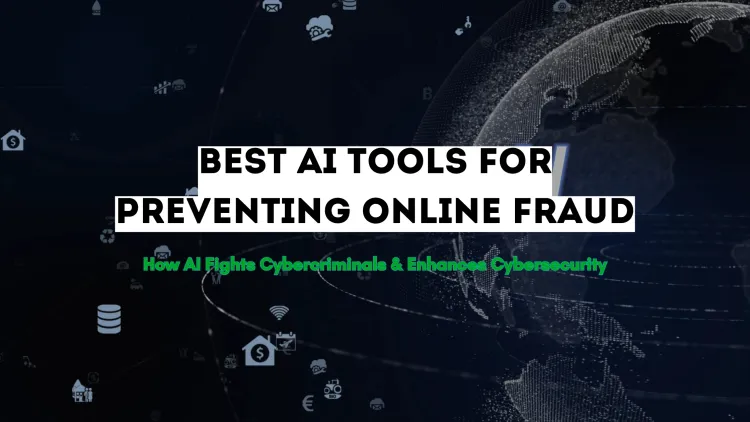
The Best AI Tools for Preventing Online Fraud | How AI is Fighting Cybercriminals
Online fraud is an ever-growing threat in the digital world, costing businesses and consumers billions of dollars annually. As cybercriminals adopt more sophisticated attack strategies, traditional fraud detection methods struggle to keep up. AI-powered fraud prevention tools are revolutionizing cybersecurity by leveraging machine learning, deep learning, behavioral analytics, and natural language processing (NLP) to detect fraudulent activities in real-time. This blog explores the top AI tools for preventing online fraud, their key features, how they work, and why they are essential for modern businesses. While AI provides highly accurate and scalable fraud detection, it is not foolproof, and cybercriminals are continuously evolving their tactics. Combining AI with human intelligence, continuous monitoring, and multi-layered security measures is crucial to staying ahead of online fraudsters.
Quick answer: AI fraud prevention tools combine machine learning, behavioural analytics and language analysis to flag phishing, identity theft and payment fraud in real time. When choosing one, check what data it analyses, how it handles false positives, whether it integrates with your systems, and how it explains decisions. Test it on your own data first.
Key takeaways
- Check what data a tool needs and where it stores it.
- Run a pilot on your own data before signing a contract.
- Ask for false positive rates in writing.
Table of Contents
- Introduction
- How AI is Revolutionizing Online Fraud Prevention
- The Best AI Tools for Preventing Online Fraud
- Why Businesses Need AI Fraud Prevention Tools
- Future of AI in Online Fraud Prevention
- Conclusion
Introduction
With the rapid growth of online transactions, cybercriminals have developed sophisticated methods to commit fraud. Traditional fraud prevention techniques struggle to keep up with evolving threats, leading businesses and individuals to adopt AI-powered fraud detection tools. These tools use machine learning (ML), deep learning, natural language processing (NLP), and behavioral analytics to detect and prevent fraud in real time.
From phishing scams and identity theft to payment fraud and fake accounts, AI-driven solutions provide faster, more accurate, and adaptive fraud prevention. In this blog, we will explore the best AI tools for preventing online fraud, how they work, and why they are essential for modern cybersecurity.
How AI is Revolutionizing Online Fraud Prevention
AI-powered fraud prevention tools go beyond traditional rule-based security systems. They analyze massive datasets in real time, recognize patterns, and detect anomalies that indicate fraudulent activity. AI provides faster detection, fewer false positives, and better adaptability than traditional security measures.
Key Features of AI Fraud Prevention Tools:
- Real-time fraud detection – AI scans transactions and online activities instantly.
- Machine learning models – AI learns from past fraud cases to detect new threats.
- Behavioral analysis – AI monitors user activity to identify unusual behavior.
- NLP for phishing detection – AI scans emails, messages, and websites for fraud signs.
- Deepfake detection – AI analyzes media files to identify deepfake scams.
- Adaptive security – AI continuously updates based on evolving cyber threats.
Now, let’s explore the top AI tools that help businesses and individuals prevent online fraud.
The Best AI Tools for Preventing Online Fraud
1. Darktrace
Best for: AI-powered cybersecurity and real-time threat detection
Darktrace is an AI-driven cybersecurity platform that detects and responds to online threats, including fraud. It uses self-learning AI to monitor network traffic, user behavior, and transaction patterns, identifying fraud attempts before they cause damage.
Key Features:
- AI-powered anomaly detection
- Real-time fraud prevention
- Autonomous response to cyber threats
- Scans emails, transactions, and network traffic
2. Feedzai
Best for: Banking, fintech, and e-commerce fraud prevention
Feedzai is an AI-driven risk management platform used by banks, financial institutions, and online retailers. It analyzes transactions, user behavior, and financial data to detect fraud in real time.
Key Features:
- Machine learning-based fraud detection
- Real-time transaction monitoring
- Identity verification and account takeover prevention
- Works across banking, fintech, and retail industries
3. SEON
Best for: Detecting fake accounts and online identity fraud
SEON is an AI-powered fraud prevention tool that specializes in digital identity verification. It helps businesses detect fake accounts, bot traffic, and identity fraud by analyzing user behavior, device information, and social media presence.
Key Features:
- AI-driven digital identity verification
- Risk scoring for online transactions
- Device fingerprinting for fraud prevention
- Real-time fraud detection for businesses
4. Forter
Best for: E-commerce fraud prevention and chargeback reduction
Forter is an AI-driven fraud prevention platform designed for e-commerce businesses. It helps online retailers detect and block fraudulent transactions while reducing chargebacks and false positives.
Key Features:
- AI-powered fraud detection for online payments
- Behavioral analytics to track buyer habits
- Protection against account takeovers and refund fraud
- Automated fraud prevention for e-commerce platforms
5. Kount
Best for: AI-driven fraud prevention for businesses of all sizes
Kount is a AI fraud prevention tool that protects businesses from payment fraud, account takeovers, and identity theft. It uses adaptive AI models to continuously learn and improve fraud detection.
Key Features:
- AI-based fraud detection for online payments
- Behavioral biometrics for user verification
- Chargeback prevention and risk scoring
- Identity verification and authentication solutions
6. Emailage (LexisNexis Risk Solutions)
Best for: AI-driven email fraud detection and verification
Emailage uses AI-powered risk analysis to detect fraudulent email accounts, phishing attempts, and email-based scams. It helps businesses verify customer identities and prevent email fraud.
Key Features:
- AI-driven email risk analysis
- Fraudulent email detection
- Identity verification for online businesses
- Integration with fraud prevention platforms
7. Arkose Labs
Best for: Preventing bot-driven fraud and automated cyberattacks
Arkose Labs specializes in fraud prevention for websites, apps, and online platforms. It uses AI to detect bot-driven fraud, automated scams, and credential stuffing attacks.
Key Features:
- AI-powered fraud prevention for websites
- CAPTCHA-like security to block bots
- Risk assessment and behavioral analysis
- Protects against account takeovers and automated fraud
8. Sift
Best for: AI-powered fraud detection for e-commerce and financial services
Sift is an AI-driven fraud prevention tool that helps businesses detect suspicious transactions, fake accounts, and high-risk user behavior.
Key Features:
- Machine learning-based fraud detection
- AI-powered risk scoring and real-time analysis
- E-commerce fraud prevention and chargeback protection
- Protects digital businesses from fraud and abuse
Why Businesses Need AI Fraud Prevention Tools
AI-powered fraud prevention tools help reduce financial losses, improve security, and enhance customer trust. Here’s why businesses should invest in AI-driven fraud detection:
Real-Time Protection – AI detects and blocks fraud before damage occurs.
Higher Accuracy – AI reduces false positives and improves fraud detection rates.
Adaptive Learning – AI models continuously evolve to detect new fraud tactics.
Multi-Layered Security – AI integrates with identity verification, biometrics, and behavioral analytics.
Cost Savings – Preventing fraud reduces financial losses and chargebacks.
Future of AI in Online Fraud Prevention
AI is rapidly advancing, and fraud prevention tools will become even more intelligent and predictive. The future of AI in fraud detection includes:
Blockchain integration for secure transactions
Federated learning for privacy-friendly fraud detection
Deepfake detection AI for identifying synthetic identity fraud
Predictive fraud prevention using AI-powered forecasting models
Explainable AI (XAI) for better transparency in fraud detection decisions
Conclusion
AI-powered fraud prevention tools are revolutionizing cybersecurity, offering real-time detection, high accuracy, and adaptive security. Whether you're a business owner, financial institution, or individual user, using AI to detect and prevent online fraud is essential for digital safety.
While AI fraud detection is not 100% foolproof, combining AI with human expertise, multi-factor authentication, and continuous updates ensures stronger protection against cyber threats.
As AI technology evolves, fraudsters will also develop more advanced scams, making AI-driven fraud prevention a continuous battle. However, with the right AI tools, businesses and individuals can stay ahead of cybercriminals and reduce fraud risks significantly.
Invest in AI fraud prevention today and secure your digital future!
Related reading
- Best AI Tools for Online Transaction Security – Ensuring Fraud-Free Digital Payments
- AI for Fraud Detection & Threat Analysis | How Artificial Intelligence is Revolutionizing Cybersecurity and Preventing Financial Fraud
- How AI is Revolutionizing Fraud Detection | The Future of AI-Powered Cybersecurity and Financial Fraud Prevention
Frequently Asked Questions
What's Your Reaction?
 Like
0
Like
0
 Dislike
0
Dislike
0
 Love
0
Love
0
 Funny
0
Funny
0
 Wow
0
Wow
0
 Sad
0
Sad
0
 Angry
0
Angry
0

Vaishnavi is a skilled tech professional at the Ethical Hacking Training Institute in Pune, responsible for managing and optimizing the technical infrastructure that supports advanced cybersecurity education. With deep expertise in network security, backend operations, and system performance, she ensures that practical labs, online modules, and assessments run smoothly and securely. Her behind-the-scenes contributions play a vital role in delivering a seamless and secure learning experience for aspiring ethical hackers.
![Top 10 Famous Ethical Hackers in India [Updated 2026]](https://www.webasha.com/blog/uploads/images/202608/image_450x280_b3317756e192c8d5e1fb674259f1a0c3.jpg)