Top 10 Linux Security Tools for Ethical Hackers (2026): Uses, Detection and Safe Practice
Linux is the go-to operating system for ethical hackers due to its open-source nature and vast collection of security tools. In this blog, we explore the top 10 Linux security tools used for penetration testing, vulnerability assessment, and ethical hacking. These tools help cybersecurity professionals analyze network security, exploit vulnerabilities, perform password cracking, and test web applications. From Nmap for network scanning to Metasploit for exploiting security flaws, each tool serves a critical role in securing IT infrastructures. This blog provides a detailed overview, examples, and commands to help you get started with these essential Linux security tools.
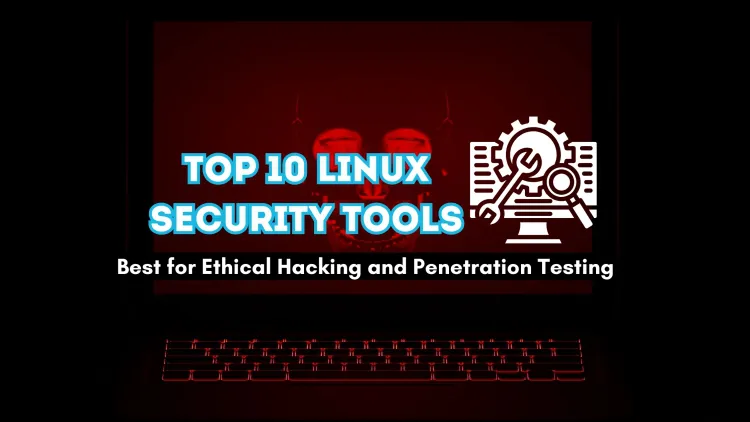
Quick answer: The Linux security tools every ethical hacker should know in 2026 are Nmap, Wireshark, Burp Suite, OWASP ZAP, sqlmap, Nikto, Hydra, John the Ripper, Aircrack-ng and Lynis. Each one maps to a stage of an assessment, from mapping a network to auditing a host's defences. Learn them in a lab you own, with written authorisation, because using them against systems you do not control is an offence under India's IT Act.
Key takeaways
- Learn each tool's defender view too: know what Nmap scans, Hydra brute-force attempts or sqlmap requests look like in logs.
- Use the tools in a sensible order: Nmap for exposure, Wireshark for traffic, then web testing tools, and Lynis to harden afterwards.
- Run Hydra, John the Ripper and Aircrack-ng only on systems and Wi-Fi you own, since doing otherwise breaks the IT Act.
This guide explains what each tool does, where it fits in a real assessment, and, just as useful, how a defender spots it in their logs. Knowing both sides is what separates a professional tester from someone running commands they do not understand.
Before you start: authorisation and the law
Every tool below is legal to own and run on your own systems. Pointing them at a network, website or Wi-Fi you do not own or have written permission to test is not. Under the Information Technology Act, 2000, unauthorised access and related acts (sections such as 43 and 66) carry civil and criminal liability in India, even if you cause no damage and are "just learning".
So build a lab you fully control: a laptop running a Kali or Parrot virtual machine, plus deliberately vulnerable targets you host yourself. Legitimate practice targets include OWASP WebGoat and other intentionally vulnerable VMs you download and run offline. Treat a signed scope document as the first tool in your kit.
The 10 tools and where they fit
| Tool | Category | Used for (authorised testing) | How defenders detect it |
|---|---|---|---|
| Nmap | Discovery | Mapping hosts, ports and services | Bursts of connections across many ports; IDS signatures |
| Wireshark | Analysis | Inspecting captured traffic | Passive; detected mainly by promiscuous-mode checks |
| Burp Suite | Web testing | Intercepting and testing web requests | Unusual parameter values, proxy user-agents in web logs |
| OWASP ZAP | Web testing | Automated and manual web scans | Scanner fingerprints and high request volume in web logs |
| sqlmap | Web testing | Confirming SQL injection findings | Classic injection patterns in query strings and WAF alerts |
| Nikto | Web scanning | Checking servers for known issues | Noisy requests for default files; recognisable user-agent |
| Hydra | Credential testing | Testing login strength in a lab | Many failed logins from one source; lockouts |
| John the Ripper | Password audit | Offline password-hash strength audit | Offline; detected by policy, not network logs |
| Aircrack-ng | Wireless | Auditing your own Wi-Fi security | Monitor-mode cards, deauth floods, rogue capture |
| Lynis | Defensive audit | Hardening and auditing Linux hosts | Run by defenders themselves |
1. Nmap: see what is exposed
Nmap maps a network: which hosts are up, which ports are open, and often which service and version is listening. It is almost always the first step, because you cannot assess what you have not found. The Nmap Scripting Engine (NSE) adds checks for specific misconfigurations and known issues.
In a lab: a service-and-version scan of your own subnet shows you the attack surface a defender needs to shrink. Defender view: a scan is noisy. A single source touching many ports in seconds stands out in firewall and IDS logs, which is why real attackers scan slowly. For a deeper walkthrough, see our guide to using Nmap for vulnerability scanning.
2. Wireshark: understand the traffic
Wireshark captures and decodes network packets so you can see exactly what is on the wire. Testers use it to confirm whether data is encrypted, to understand a protocol, or to debug why an exploit attempt behaves oddly. Defenders and SOC analysts use the same tool to investigate suspicious traffic.
It is passive: it reads traffic, it does not attack. The security lesson it teaches quickly is that plaintext protocols such as HTTP, Telnet and FTP expose credentials to anyone on the path, which is the argument for TLS everywhere.
3 to 6. Burp Suite, OWASP ZAP, sqlmap and Nikto: testing web apps
Most assessments spend the majority of their time on web applications, so four of these tools focus there.
- Burp Suite sits as a proxy between your browser and the target, letting you inspect and modify requests to test for flaws such as broken access control, injection and insecure session handling. The Community edition is enough to learn on.
- OWASP ZAP is the free, open-source alternative to Burp, with both automated scanning and manual tools. Start here if budget matters; our step-by-step OWASP ZAP guide covers setup.
- sqlmap automates the confirmation and safe demonstration of SQL injection once you suspect it. Against your own lab app, it shows why unparameterised queries are dangerous. Against anything else, it is unlawful.
- Nikto checks a web server for known issues: default files, outdated components and risky configuration. It is deliberately noisy, so it is a lab and authorised-scan tool, not a stealth one.
The defensive takeaway from all four is the same: a web application firewall, input validation, parameterised queries and prompt patching remove most of what these tools find.
7 and 8. Hydra and John the Ripper: the case for strong authentication
These tools exist to prove how weak passwords fall. Hydra tests how a login service holds up against repeated guesses. John the Ripper works offline against password hashes you are authorised to audit, showing which ones crack quickly.
Use them to make a defensive point, not to break into anything. In your own lab, they demonstrate why defenders need rate limiting, account lockout, multi-factor authentication and strong hashing such as bcrypt or Argon2. A login that survives these tools is one configured correctly. For stolen-credential context, our overview of managing users and permissions in Linux covers the access-control side.
9. Aircrack-ng: auditing your own Wi-Fi
Aircrack-ng is a suite for testing wireless security. On a network you own, it shows whether your encryption and settings would resist an attacker. Its main lesson for 2026 is simple: WEP and WPA/WPA2 with weak passphrases are breakable, so use WPA3 (or WPA2 with a long, random passphrase) and a strong router configuration. Capturing or interfering with Wi-Fi you do not own, including deauthenticating other users, is illegal.
10. Lynis: the defensive tool in the kit
Lynis is the odd one out, and that is the point. It audits a Linux host from the inside and reports misconfigurations, missing hardening and compliance gaps, with specific recommendations. Every tester should run it, because understanding what good hardening looks like makes you better at finding where it is missing. See our dedicated guide on using Lynis for security auditing and hardening, and the wider picture in what system hardening involves.
How the tools fit together in an assessment
These are not ten unrelated utilities. In a real authorised test they form a sequence:
- Scope and authorise: written permission and agreed targets.
- Discover: Nmap maps hosts and services.
- Analyse: Wireshark and manual review reveal how systems talk.
- Test the apps: Burp or ZAP, with Nikto and sqlmap to confirm specific issues.
- Test authentication: Hydra and John the Ripper, within scope.
- Audit the host: Lynis shows what hardening is missing.
- Report: findings, business impact and clear remediation. The report is the deliverable, not the exploit.
Getting the tools
All ten ship with, or install easily on, Kali Linux and Parrot OS, the distributions built for this work. If you are new to Kali, start with our guide on learning Kali Linux for beginners before running anything. Keep tools updated, because scanners and signatures change often, and never download them from unofficial mirrors.
From tools to a career
Employers do not hire people who can run a scanner. They hire people who understand findings, judge real risk and explain fixes. Tools are the easy part; methodology and reporting are what get paid. Structured programmes such as vulnerability assessment and penetration testing (VAPT) training teach that process in a legal, supervised lab, which also keeps your practice on the right side of the law.
Next step
Set up a single Kali VM and one vulnerable target you host yourself, then learn Nmap and Wireshark properly before touching anything else. Depth on two tools beats a shallow tour of ten.
Related reading
Frequently Asked Questions
What's Your Reaction?
 Like
0
Like
0
 Dislike
0
Dislike
0
 Love
0
Love
0
 Funny
0
Funny
0
 Wow
0
Wow
0
 Sad
0
Sad
0
 Angry
0
Angry
0

Vaishnavi is a skilled tech professional at the Ethical Hacking Training Institute in Pune, responsible for managing and optimizing the technical infrastructure that supports advanced cybersecurity education. With deep expertise in network security, backend operations, and system performance, she ensures that practical labs, online modules, and assessments run smoothly and securely. Her behind-the-scenes contributions play a vital role in delivering a seamless and secure learning experience for aspiring ethical hackers.










![Top 10 Famous Ethical Hackers in India [Updated 2026]](https://www.webasha.com/blog/uploads/images/202608/image_140x98_da23f65c290cfbf1237d77aec58a2f0f.jpg)