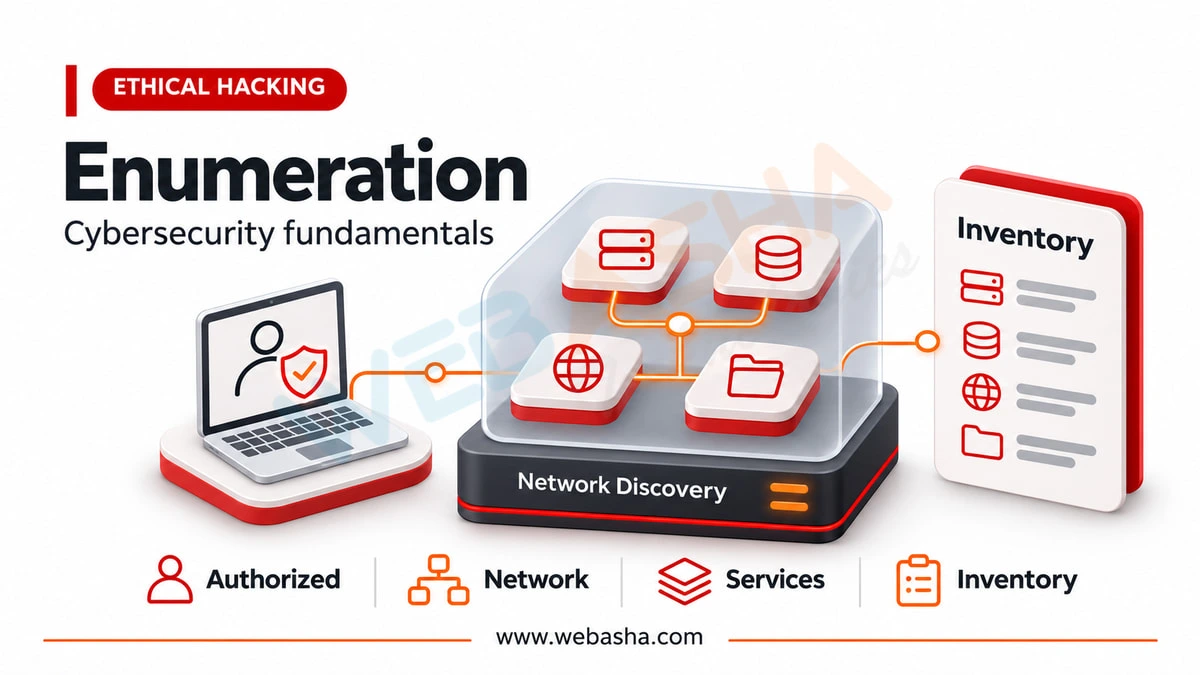
What Is Enumeration in Cybersecurity? SNMP, SMB, LDAP, NFS and BGP
Enumeration is the stage after scanning where someone connects to discovered services and asks them for details: user and group names, shares, device information, directory structure and routing data. Protocols such as SNMP, SMB, LDAP, NFS and BGP can reveal far more than intended when they are left on default settings.
Topic: Ethical Hacking in Cybersecurity & Ethical Hacking · Explainer
Also covers: Network Security
Quick answer: Enumeration is the stage after scanning where someone connects to discovered services and asks them for details: user and group names, shares, device information, directory structure and routing data. Protocols such as SNMP, SMB, LDAP, NFS and BGP can reveal far more than intended when they are left on default settings. Defenders should treat enumeration as an early warning sign, log it, and reduce what each service discloses through authentication, access lists, protocol upgrades and network segmentation. Any enumeration of systems you do not own requires written authorisation; unauthorised access is an offence under Sections 43 and 66 of India's IT Act 2000.
Key takeaways
- Enumeration turns a list of open ports into a map of accounts, shares and devices.
- Default SNMP communities, anonymous SMB and LDAP binds, and open NFS exports are the usual leaks.
- BGP data is public by design, so the risk is route hijacks and leaks, not secrecy.
- MITRE ATT&CK tracks this activity as discovery techniques you can detect.
- Most fixes are configuration changes, not new products.
Table of Contents
- What Is Enumeration and How Is It Different From Scanning?
- What Can Each Protocol Reveal?
- Why Do NFS Exports and SMB Shares Leak Data?
- What Does BGP Information Tell an Attacker?
- How Can You Detect Enumeration?
- How Do You Restrict Enumeration?
- When Is Enumeration Legal?
- References
What Is Enumeration and How Is It Different From Scanning?
Scanning answers which hosts are alive and which ports are open. Enumeration goes one step further: it opens a session with a service and collects whatever the service is willing to say. MITRE ATT&CK describes the related behaviours as Network Service Discovery (T1046), Account Discovery (T1087) and Network Share Discovery (T1135). Attackers use the results to choose targets for password guessing or privilege escalation. Penetration testers use the same information, with permission, to show what needs fixing.
What Can Each Protocol Reveal?
| Protocol | Typical port | What it can disclose | Main weakness |
|---|---|---|---|
| SNMP v1/v2c | UDP 161 | Interfaces, routes, running software, contact details | Plain-text community strings such as public |
| SMB | TCP 445 | Share names, host and domain names, sometimes users | Anonymous or guest sessions, SMBv1 |
| LDAP | TCP 389 | Users, groups, computers, directory structure | Anonymous binds, over-broad read rights |
| NFS | TCP/UDP 2049 | Exported directories and the clients allowed to mount them | Exports open to any host |
| BGP | TCP 179 | Prefixes, autonomous system paths, peering | Public routing data, unfiltered peers |
SNMP versions 1 and 2c send the community string in clear text. RFC 3414 defines the SNMPv3 user-based security model with authentication and encryption, which is the version to use. Our sibling guide on SNMP and LDAP enumeration covers those two protocols in more depth.
Why Do NFS Exports and SMB Shares Leak Data?
File-sharing services are often set up quickly and never reviewed. An NFS export written as a wildcard lets any host mount it. An SMB server that still allows guest access or SMBv1 lets unauthenticated users list shares. Microsoft's SMB security hardening guidance recommends SMB signing, encryption and removing SMBv1. You can review your own servers with safe, read-only commands:
# Windows: check SMBv1 and signing on your own file server
Get-SmbServerConfiguration | Select-Object EnableSMB1Protocol, RequireSecuritySignature

# Linux: list what your NFS server currently exports
sudo exportfs -v
For background on these protocols, see our guide to file-sharing protocols such as SMB and SFTP.
What Does BGP Information Tell an Attacker?
BGP, defined in RFC 4271, exchanges routing information between networks, and much of it is published in looking glasses and route collectors. Enumeration here means learning which prefixes an organisation announces and who its upstream providers are. The real risks are route hijacks, route leaks and attacks on BGP sessions. RFC 7454 recommends prefix filtering, maximum-prefix limits and protecting TCP 179 so only configured peers can connect.
How Can You Detect Enumeration?
| Signal | Where to look |
|---|---|
| Many SNMP requests with wrong community strings | Device logs, SNMP authentication traps |
| Anonymous or null SMB sessions | Windows Security logs, file server audit |
| Large LDAP queries for all users or groups | Domain controller diagnostics, identity threat tools |
| Mount requests from unknown hosts | NFS server logs, firewall logs |
| Connection attempts to TCP 179 from non-peers | Router logs, edge firewall |
Forward these logs to a SIEM and alert on spikes from a single source. CERT-In directions require Indian organisations to keep ICT logs for 180 days and report specified incidents within 6 hours, so retained logs also support reporting.
How Do You Restrict Enumeration?
- Move to SNMPv3 with authentication and privacy; disable SNMP where it is not needed.
- Disable SMBv1, guest access and anonymous enumeration of shares and accounts.
- Block anonymous LDAP binds and use LDAP signing and channel binding.
- Restrict NFS exports to named hosts and use root squashing.
- Filter BGP peers and prefixes as RFC 7454 describes.
- Block these ports at the internet edge; CISA's ransomware guide specifically advises against exposing SMB.
When Is Enumeration Legal?
Only with written permission from the system owner, a defined scope and agreed timing. Without that, connecting to services to extract information can count as unauthorised access under the IT Act 2000. If you want to practise these defensive skills in a lab, explore our ethical hacking and network defence training.
References
Frequently Asked Questions
What's Your Reaction?
 Like
0
 Dislike
0
 Love
0
 Funny
0
 Wow
0
 Sad
0
 Angry
0

Vaishnavi is a skilled tech professional at the Ethical Hacking Training Institute in Pune, responsible for managing and optimizing the technical infrastructure that supports advanced cybersecurity education. With deep expertise in network security, backend operations, and system performance, she ensures that practical labs, online modules, and assessments run smoothly and securely. Her behind-the-scenes contributions play a vital role in delivering a seamless and secure learning experience for aspiring ethical hackers.