Digital Forensics Training: Compare Labs, Feedback and Scope
Choose digital forensics training by the tasks it teaches and the feedback you receive, rather than a “best bootcamp” label. Check prerequisites, data sources, lab access, tool requirements and whether you submit a report for review. A Windows examination course, a tool workshop and an incident-response programme address different needs.
Topic: Incident Response & Digital Forensics in Cybersecurity & Ethical Hacking · Course information
Also covers: Cybersecurity Careers & Certifications
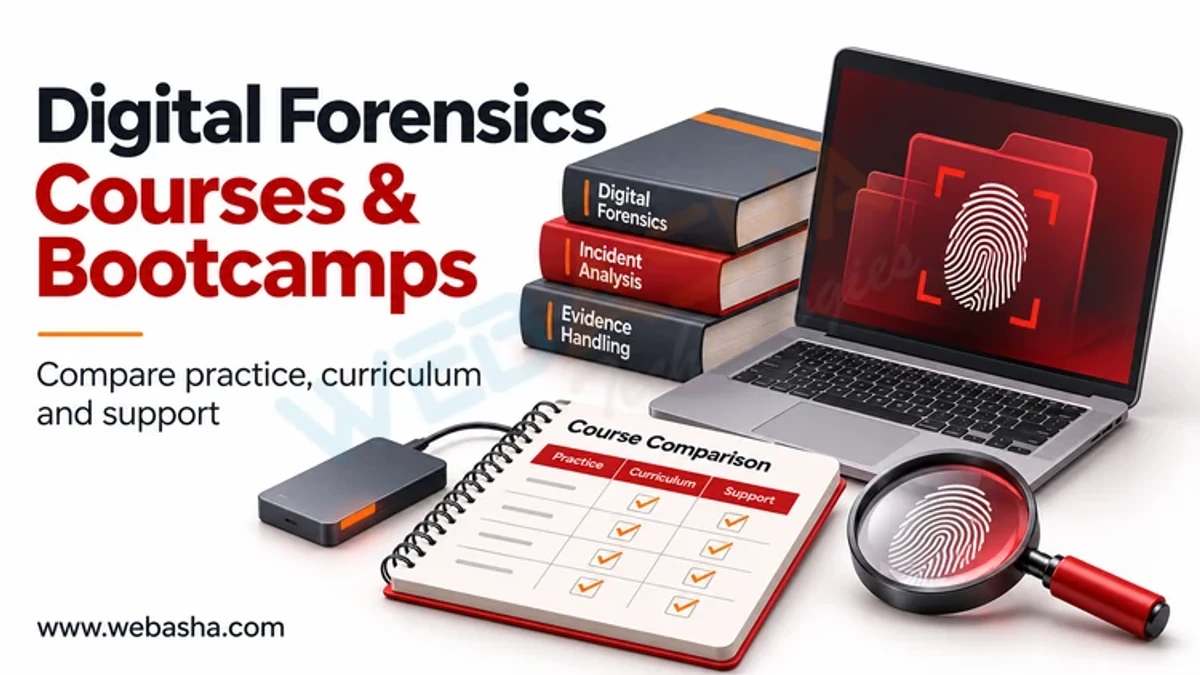
Quick answer: Choose digital forensics training by the tasks it teaches and the feedback you receive, rather than a “best bootcamp” label. Check prerequisites, data sources, lab access, tool requirements and whether you submit a report for review. A Windows examination course, a tool workshop and an incident-response programme address different needs. Confirm current details with the provider before enrolling, including what any assessment or certificate actually represents. Use a small sample lesson to test fit, and keep job or exam outcomes separate from training access.
Key takeaways
- Choose a specific forensic task before comparing course catalogues.
- Check whether the advertised level matches your operating-system foundations.
- Ask for a sample lab and the report-feedback process.
- Distinguish tool training, course completion and assessed certification.
- Get access, assessment and support terms in writing before enrolling.
Table of Contents
- What should you want to do after the course?
- How do course types differ?
- What should a sample lab reveal?
- How would you compare the two fictional offers?
- What should you ask about labs and instructor support?
- How do you distinguish learning completion from certification?
- How can you make a practical training decision?
- References
What should you want to do after the course?
A help-desk technician wants to move towards digital evidence work. They compare two fictional offers: one provides many recorded demonstrations, while another gives fewer exercises but reviews a written report. The useful question is which offer helps them perform the missing task, such as explaining a Windows artefact accurately.
Write a learning outcome in plain language: “I want to answer a bounded question from a supplied image and explain my method.” That is easier to evaluate than “master forensics.” NIST SP 800-86 offers IT-focused data-source context. Its broad categories can help you identify whether you need disk, network or application work, while current course documentation supplies the actual syllabus and prerequisites.
How do course types differ?
SANS FOR500 is a current Windows forensic analysis course example. Autopsy’s official training page describes tool-focused learning and assumes forensic foundations for its introductory tool course. IACIS’s CFCE programme includes peer review and a separate certification phase. These examples illustrate different structures rather than a universal ranking.
Read the current provider pages and ask about your own starting point. A course called introductory may introduce a particular tool to existing examiners rather than teach operating systems from zero. A programme that prepares for an exam is not necessarily the exam itself. Keep course content, support and credential requirements in separate rows when you compare offers.
| Training type | Potential use | Important fit question |
|---|---|---|
| Foundations course | Build handling and interpretation habits | Does it teach the operating-system concepts I lack? |
| Platform or tool workshop | Learn a specific supported workflow | What forensic knowledge is assumed already? |
| Windows examination course | Develop a particular artefact-analysis focus | Does this match the systems in my target work? |
| Structured certification pathway | Prepare for a defined assessment | Which training, review and assessment stages are separate? |
What should a sample lab reveal?
Ask for a permitted preview or description of one exercise. Look for an assigned question, a documented source, expected learning points and a way to discuss uncertainty. A demonstration in which the instructor clicks through menus can be useful, but it does not show whether you can complete the task independently.
NIST’s documented reference datasets illustrate the value of known contents for practice and checks. Ask whether the course uses lawful, appropriate material and whether you may retain or publish derived work. For the fictional technician, a suitable sample might ask them to explain a supplied artefact and its limits, then compare that explanation with feedback. The exercise need not claim to simulate every aspect of a real investigation.
How would you compare the two fictional offers?
Put the terms in writing instead of letting the largest content count decide. The worksheet below does not describe actual providers. It helps the technician see what remains unknown before paying. If one provider cannot explain its feedback process, record that as an unanswered question rather than fill the gap with an assumption.
NIST’s tool-testing programme can inform one quality question: are learners shown how to check a function against known material, or only told to trust the output? A good discussion should also cover incomplete data and incorrect interpretations. More examples are useful only when they help the learner reason through them.
| Comparison field | Fictional offer A | Fictional offer B |
|---|---|---|
| Practice format | Recorded demonstrations advertised | Independent exercises advertised |
| Report feedback | Ask whether individual review exists | Ask who reviews and whether revision is allowed |
| Lab access | Confirm dates, software and local requirements | Confirm dates, software and reset arrangements |
| Result checking | Ask how expected results are established | Ask how disagreements and errors are handled |
| Credential | Confirm what completion actually awards | Confirm whether any external exam is included |
What should you ask about labs and instructor support?
Ask whether labs run locally or remotely, what hardware and licences are needed, and whether the environment can be reset. Check the hours and channels for support, who answers technical questions and whether a student can resubmit a report after feedback. Flexible access is useful only if it matches the time you can actually study.
Ask how evidence handling and privacy are taught. NIST IR 8387 treats digital preservation as a specific concern, so a course should not present “open the image” as the whole process. Enquire about permitted data, notes, source identifiers and analysis copies. A short course may cover these at a limited level; that limit should be clear rather than hidden behind a comprehensive-sounding title.
How do you distinguish learning completion from certification?
A completion certificate may show attendance or completion of a provider's activities. An independently assessed credential has its own issuer, objectives and candidate rules. GIAC’s GCFE page describes a defined Windows-forensics certification; a course mentioning GCFE does not automatically award it or satisfy every exam requirement.
Before enrolling, check which exam, if any, is included, which conditions apply and how access dates relate to your study plan. Get the provider's written offer and verify uncertain issuer requirements directly. Avoid assuming that an assessment makes a learner qualified for every physical-science or legal evidence role. The relevant employer and professional context still determine what qualifications and supervised experience are needed.
How can you make a practical training decision?
For the fictional technician, the next action is to request the sample lab and ask how their report would be reviewed. If they cannot follow the operating-system material, they should close that foundation gap first. If the material fits, they can compare support and access terms before committing.
Keep a decision note with the task you want to learn, what the course provides and what remains outside its scope. Choose the course whose actual arrangements fit that need and your schedule. Ask any instructor or training provider for evidence of its syllabus and supervised practice, rather than relying on a promise of rapid expertise or guaranteed placement. Review your progress through a completed task you can explain, not simply the number of videos watched.
Related reading: choose a forensic credential by task; practise with a repeatable lab.
If you want instructor feedback, ask WebAsha for a syllabus, supervised lab arrangements and written access terms before enrolling.
References
- NIST SP 800-86: forensic techniques in incident response
- SANS FOR500: Windows Forensic Analysis
- Autopsy: official training scope
- IACIS Certified Forensic Computer Examiner
- NIST Computer Forensic Reference Data Sets
- NIST Computer Forensics Tool Testing program
- NIST IR 8387: digital evidence preservation
- GIAC Certified Forensic Examiner
Frequently Asked Questions
What's Your Reaction?
 Like
0
 Dislike
0
 Love
0
 Funny
0
 Wow
0
 Sad
0
 Angry
0

Vaishnavi is a skilled tech professional at the Ethical Hacking Training Institute in Pune, responsible for managing and optimizing the technical infrastructure that supports advanced cybersecurity education. With deep expertise in network security, backend operations, and system performance, she ensures that practical labs, online modules, and assessments run smoothly and securely. Her behind-the-scenes contributions play a vital role in delivering a seamless and secure learning experience for aspiring ethical hackers.