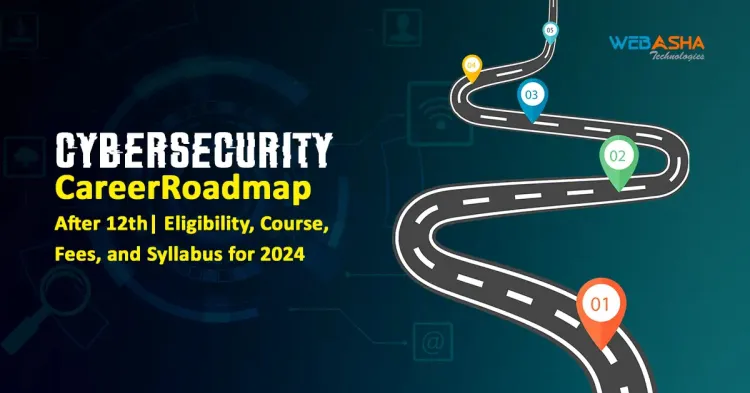
Cybersecurity After 12th: Eligibility, Courses and Roadmap
After Class 12, build cybersecurity foundations in a sequence you can demonstrate: computer use, networks, identities, safe evidence review and clear reporting. Check formal admission requirements for the exact programme while treating private-course entry, credential eligibility and employer selection separately.
Topic: Cybersecurity Careers & Certifications in Cybersecurity & Ethical Hacking · Certification preparation
Quick answer: After Class 12, build cybersecurity foundations in a sequence you can demonstrate: computer use, networks, identities, safe evidence review and clear reporting. Check formal admission requirements for the exact programme while treating private-course entry, credential eligibility and employer selection separately. This guide uses a school-club project to turn the learning sequence into small outputs before specialisation. Compare a current syllabus and complete written quote with your available practice time. A course can support learning, but it cannot guarantee that every school-leaver is eligible for every qualification or immediately ready for a security role.
Key takeaways
- Check formal programme rules rather than a universal stream claim.
- Produce a small output at each learning stage.
- Use invented data and authorised training environments.
- Choose a specialisation after comparing tasks you have practised.
- Keep fees, access deadlines and examination arrangements explicit.
Table of Contents
- Which eligibility rules should you check first?
- How can a school-club project organise the roadmap?
- Which topics should come before specialisation?
- When should you choose a cybersecurity specialisation?
- How should you compare courses, syllabus, fees and duration?
- What should you do before seeking an internship or junior role?
- How do you check progress when the project requirement changes?
- References
Which eligibility rules should you check first?
Choose the actual programme before asking whether your stream qualifies. An engineering degree, a computing degree and a private short course may have different subject and selection conditions. Verify the intended admission session directly with the institution.
For one specific computing example, IGNOU’s BCA_NEW page lists 10+2 or equivalent, or a pass in a Diploma in Commercial Practice or equivalent. It does not establish admission to every cybersecurity degree. The UGC precautions notice explains recognition and session checks for ODL or online higher education.
Alongside those decisions, you can start foundation exercises. Keep the education application plan and the learning plan separate so a pending admission does not become a claim about professional readiness.
How can a school-club project organise the roadmap?
In this illustrative case, Class 12 graduate Tara wants to help a fictional reading club manage its membership list. She uses invented members and works on supplied diagrams and records. She does not administer a real club system or collect classmates' information.
Her tutor asks for a sequence of outputs. First, she identifies files and their purpose. Next, she explains how a browser reaches the application. Then she separates who can log in from who can edit membership data. Finally, she writes a short note about an unexpected record.
| Learning stage | Tara’s output | Ready to move on when |
|---|---|---|
| Computer foundations | File and purpose inventory | She can explain which record is authoritative |
| Networking | Client-to-service diagram | She can distinguish name, address and response |
| Identity | Member and administrator role table | She separates login from permitted actions |
| Evidence | Observation and escalation note | She states what is known and what is missing |
The sequence gives her a way to measure progress without pretending that finishing a video playlist establishes all these skills.
Which topics should come before specialisation?
Start with operating-system use, files, basic command behaviour and safe handling of data. Then study network communication, identity, permissions and common security concepts. Cisco CCST Cybersecurity training is an example of a foundation-oriented syllabus to compare with your gaps.
Tara initially calls every unexpected login record an attack. Her tutor gives her an approved-maintenance note and asks her to revise the conclusion. She learns to compare context before assigning intent. This is a reading exercise with invented evidence, not a security operation.
Include communication from the beginning. Explain an observation in ordinary language, identify its source and name the person who should review it. Technical terms are useful only when they make that explanation more precise.
When should you choose a cybersecurity specialisation?
Use the NIST NICE Framework to compare work through tasks, knowledge and skills. Try small examples before choosing: interpret supplied alerts, review an access request or explain a web application's expected behaviour. These outputs help you see which work interests you and which foundations need attention.
PortSwigger Web Security Academy offers web-security learning and purpose-built labs. Follow the rules of any platform and keep all practice within authorised scope. A lab account does not authorise unrelated public testing.
Tara prefers writing evidence notes to investigating application behaviour at first. She continues defensive foundations while learning enough web concepts to communicate with developers. That is a current learning choice, not a permanent restriction on her career.
How should you compare courses, syllabus, fees and duration?
A foundation credential such as ISC2 Certified in Cybersecurity has its own published outline and conditions, including no work-experience requirement on the current page. Treat it separately from formal admission and any provider's completion certificate. Advanced credentials may have different experience requirements.
Request an itemised course quote and a sample assessment. Ask how learners revise mistakes, how long lab access lasts and which issuer examination, if any, is included. Keep the cost of a degree separate from short-course training.
| Decision | Written detail to compare | Question for Tara |
|---|---|---|
| Syllabus | Prerequisites and assessed tasks | Does it start where I am? |
| Duration | Teaching, practice and deadlines | Can I complete the work around study? |
| Lab | Device needs and access period | Can I repeat the permitted tasks? |
| Full cost | Tuition, exam, taxes and extensions | Can I afford the whole commitment? |
Choose a manageable sequence rather than buying all specialisations together. Revisit the next step after completing the current outputs and receiving feedback.
What should you do before seeking an internship or junior role?
Organise Tara's diagram, role table and revised evidence note into a small portfolio. Label the records as fictional, identify the feedback received and state what was not tested. Do not publish protected solutions or real account details.
Read each opportunity's actual education, age, experience and supervision conditions. A training provider's admission decision cannot waive an employer's selection rules. Ask what access a learner would receive, who supervises the work and which changes need approval.
Prepare to explain one mistake and its correction. Tara's improved login note shows that she can revise a conclusion when new context appears. As she completes authorised practical work, she can add verified results and gradually choose a more specialised learning target.
How do you check progress when the project requirement changes?
Revisit earlier outputs
Tara’s tutor adds a new condition: the reading club now has two coordinators, and the previous coordinator has left. Tara first updates the role table. She then notices that the support contact still names the former coordinator and the evidence note has no current owner. Changing one account entry would leave the rest of the handover inconsistent.
She marks each affected output and asks the exercise owner to confirm the intended replacement. This is a useful foundation checkpoint because it requires her to connect files, identities and communication. She can complete it using supplied records without accessing a real membership system.
Use the result to choose the next lesson
| Observed gap | Next learning task |
|---|---|
| Confuses login with editing rights | Explain authentication and authorisation with the role table |
| Updates a record without its source | Record where the change requirement came from |
| Cannot name the decision owner | Write a bounded question for the responsible person |
A reviewer should be able to explain why each correction follows from the new requirement. If Tara cannot yet connect the outputs, she repeats the foundation task before buying another specialist course. Her learning log records the gap and revised explanation, giving her a concrete reason for the next step.
Related reading: networking foundations after Class 12; Linux learning after Class 12.
References
Frequently Asked Questions
What's Your Reaction?
 Like
0
 Dislike
0
 Love
0
 Funny
0
 Wow
0
 Sad
0
 Angry
0

I am passionate about technology, invention and big challenging tasks on my to- do list. In terms of the work I am doing also at Bunnyshell, I am most passionate about the technologies that we are using., I'm devoted to delivering content that not only informs but also inspires. Whether you need in- depth analysis pieces, educational attendants, or study- provoking opinion pieces, I draft content that resonates with tech suckers and professionals likewise.