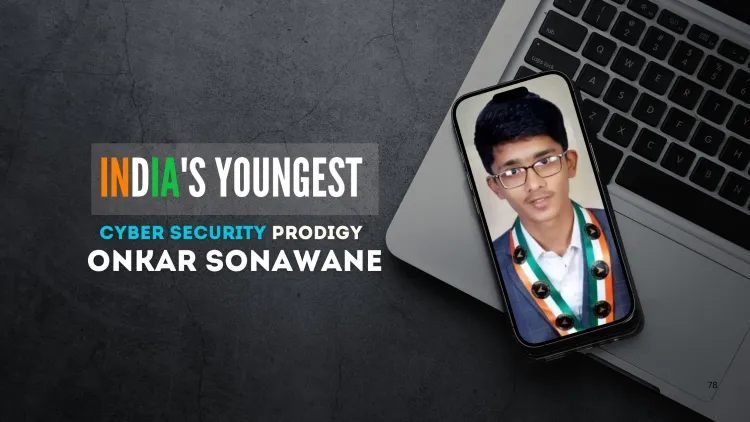
Onkar Sonawane: Public Security Credits and Learning Lessons
Onkar Sonawane is India's youngest ethical hacker, known for his impressive skills in cybersecurity. Starting his journey at the age of 15, Onkar has conducted workshops, written articles, and earned certifications that have established him as a respected figure in the cybersecurity community. His work continues to inspire the younger generation to pursue ethical hacking and cybersecurity as a career, positioning him as one of India’s brightest cybersecurity talents.
Topic: Cybersecurity Foundations in Cybersecurity & Ethical Hacking · Explainer
Also covers: Ethical Hacking, Cybersecurity Careers & Certifications
Quick answer: Onkar Sonawane appears in Mozilla's public security acknowledgement records. Its Web and Services Bug Bounty Hall of Fame lists the name in dated periods including the third quarter of 2019 and first quarter of 2020. These vendor records support a concrete account of public recognition. They do not independently establish every biographical, age, certification or ranking claim repeated online. For learners, the useful lesson is to connect an achievement to its original record and build similarly clear evidence of authorised work.
Key takeaways
- Mozilla provides primary public acknowledgement records for the name.
- Keep the programme, period and exact record attached to a credit.
- A vendor acknowledgement and a certification prove different things.
- Responsible research begins with the programme's current scope and rules.
- A clear report and a bounded lab project make learning evidence easier to assess.
Table of Contents
- What can be verified about Onkar Sonawane?
- What does a public acknowledgement tell a reader?
- What should a beginner learn about bug bounty programmes?
- What would a useful first lab report contain?
- Where can learners practise before live research?
- How can an acknowledgement inform a learning plan?
- What should readers check before repeating a profile claim?
- References
What can be verified about Onkar Sonawane?
Mozilla's Web and Services Bug Bounty Hall of Fame lists Onkar Sonawane under the third quarter of 2019 and first quarter of 2020, among other dated entries. Mozilla's Firefox bug bounty acknowledgement page also includes the name. These are records published by the vendor being discussed, which makes them more useful than an unattributed biography repeating the same superlative.
Describe the records narrowly: the name appears in those acknowledgement lists. A list alone does not disclose every underlying report, payment or technical detail, and it should not be expanded into a claim about every product or organisation. This profile therefore focuses on documented credits and the research habits a learner can take from them. It does not repeat an unverified youngest-person label, current age or global ranking.
What does a public acknowledgement tell a reader?
A public credit gives a reader an original organisation, a programme context and sometimes a date or link. Start by retaining those fields. Check whether the entry is in a web programme, browser programme or a separate recognition scheme. Do not silently combine entries into a new total without explaining whether the same contribution appears more than once.
For an illustrative student research note, record the page title, the exact listed name, the quarter heading and the date checked. Write a one-sentence conclusion that stays within the record. If a report is private, mark the technical details as unavailable in that public source. That preserves the positive acknowledgement without inventing its vulnerability class or impact. No private report or personal account was accessed for this article.
| Record type | Supported statement | Additional evidence needed |
|---|---|---|
| Vendor acknowledgement | The vendor lists the named contributor | Details not included in the entry |
| Certification record | The issuer confirms a particular credential | Identity, status and credential scope |
| Speaker programme | The organiser lists a session or speaker | Claims about later employment or expertise |
| Personal biography | The person makes the stated claim | Independent confirmation where needed |
What should a beginner learn about bug bounty programmes?
Mozilla's security bug bounty programme sets eligibility conditions for submissions. Its programme FAQ answers questions about covered software and reporting. Read the current programme documentation before any research. Scope and eligibility can change, so an old acknowledgement does not establish today's testing permission or reward terms.
A learner can first practise reading a programme policy without sending traffic anywhere. Identify the permitted assets, excluded behaviour, reporting route and handling requirements for sensitive information. Write down where the policy leaves a question unresolved. If testing authority is unclear, obtain clarification through the authorised process before proceeding. Participation in a programme requires compliance with its rules; recognising someone's past contribution does not authorise copying an approach against unrelated systems.
What would a useful first lab report contain?
Use an intentionally provided lab and state that context at the start. A concise report identifies the affected lab component, expected behaviour, observed behaviour and evidence sufficient for another authorised reviewer to understand the issue. Keep secrets and unrelated information out of the report. If the observation has several possible causes, record the uncertainty and the next permitted check.
For a fictional access-control lab, the student receives two test roles and an instructor-supplied observation. The exercise is to explain why a response differs between the roles, which result was expected and what evidence is still missing. It does not require contacting a real organisation. A report that distinguishes the observed response from a proposed impact gives the reviewer something specific to validate and avoids exaggerated conclusions.
| Report field | Fictional exercise entry | Reason to include it |
|---|---|---|
| Scope | Instructor-provided access-control lab | Shows the authorised environment |
| Expected behaviour | Each supplied role follows its stated permissions | Defines the comparison |
| Observation | Prepared response differs from that expectation | Separates evidence from explanation |
| Limit | No production system or customer data reviewed | Bounds the conclusion |
Where can learners practise before live research?
The PortSwigger Web Security Academy offers learning material and interactive labs. Use a platform's designated exercise environment and follow its terms. Start with the prerequisite web concepts so that an unexpected response can be explained in terms of requests, sessions, roles and application behaviour.
Keep a short notebook for each exercise: the question, permitted environment, observations, your explanation and any correction after reading the solution. Revisit an exercise later and see whether you can explain it without a memorised sequence. When sharing a portfolio, label a lab solution as a lab solution. That is useful evidence of learning and gives a prospective reviewer a fair account of what you actually did.
How can an acknowledgement inform a learning plan?
The NIST NICE Framework describes cybersecurity work through tasks, knowledge and skills. It provides a vocabulary for turning general interest into a practical objective. It does not rank individuals or convert a public credit into a complete assessment of every cybersecurity role.
Choose one task you want to perform well, such as explaining an application access-control finding. Identify the knowledge needed, practise in a provided lab and ask for feedback on the report. A browser security researcher, incident responder and network administrator have different daily work. Respecting that difference helps a learner choose relevant practice and helps readers appreciate a specific contribution without attaching an unsupported universal expert label to the contributor.
What should readers check before repeating a profile claim?
Use a simple evidence note: the claim, original source, date and conclusion. For this profile, Mozilla's acknowledgement pages support public security credits. Claims about exact age, schooling, certificates, employer relationships or national rankings require their own records. Absence of those records in this review is a limit on the article, not a finding that a person lacks an achievement.
When considering paid training or professional services from any person, ask for a syllabus or scope, practical deliverables and the terms relevant to your goal. Assess the proposed work on those details. A recognised contribution can be a useful starting point for interest, while a concrete sample and a defined engagement help determine whether a particular offering fits the reader's needs.
Related reading: authorisation and ethical boundaries; planning cybersecurity practice.
References
Frequently Asked Questions
What's Your Reaction?
 Like
0
 Dislike
0
 Love
0
 Funny
0
 Wow
0
 Sad
0
 Angry
0

Vaishnavi is a skilled tech professional at the Ethical Hacking Training Institute in Pune, responsible for managing and optimizing the technical infrastructure that supports advanced cybersecurity education. With deep expertise in network security, backend operations, and system performance, she ensures that practical labs, online modules, and assessments run smoothly and securely. Her behind-the-scenes contributions play a vital role in delivering a seamless and secure learning experience for aspiring ethical hackers.