What Is Hybrid Cloud? Definition, Examples, Connectivity and Security
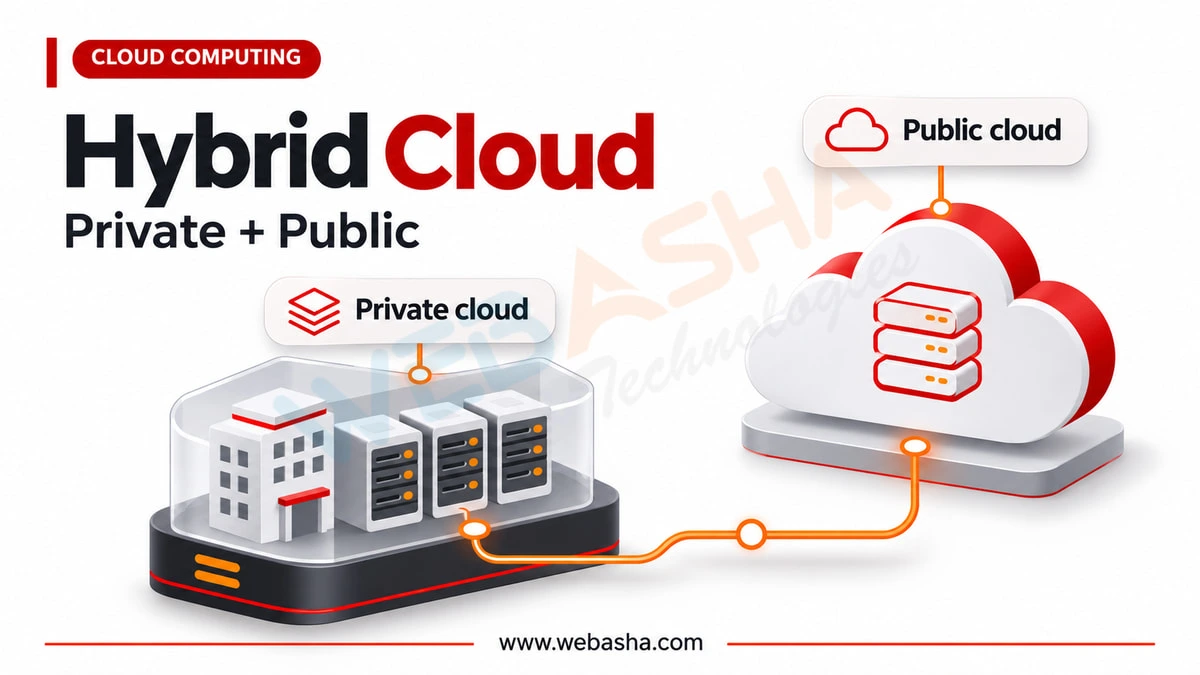
A hybrid cloud combines two or more distinct cloud environments, typically a private cloud or on-premises data centre with a public cloud such as AWS, Azure or Google Cloud, connected so that data and applications can move between them. Organisations use it to keep sensitive or latency-critical systems close while using public cloud for scale and new services.
Topic: Cloud Computing: AWS, Azure & GCP in IT Infrastructure · Explainer
Quick answer: A hybrid cloud combines two or more distinct cloud environments, typically a private cloud or on-premises data centre with a public cloud such as AWS, Azure or Google Cloud, connected so that data and applications can move between them. Organisations use it to keep sensitive or latency-critical systems close while using public cloud for scale and new services. It works when the connection, identity, security policy and operations span both sides. Without that, it is just two separate estates.
Key takeaways
- NIST defines hybrid cloud as distinct cloud infrastructures bound together by technology that enables data and application portability.
- Hybrid is about connecting private and public; multi-cloud is about using several public providers.
- The network link, VPN or dedicated connection, is the foundation, and the most common point of failure.
- One identity system and one security policy across both sides matter more than any single tool.
- Place each workload deliberately, by data sensitivity, latency, cost and how often it changes.
Table of Contents
- What Is a Hybrid Cloud?
- Hybrid Cloud vs Multi-Cloud: What Is the Difference?
- Why Do Organisations Use Hybrid Cloud?
- How Do You Connect Private and Public Environments?
- How Do You Check the Connection Is Working?
- How Do You Decide Which Workloads Go Where?
- What Are the Main Challenges?
- How Is Hybrid Cloud Secured?
- What Skills Do Hybrid Environments Require?
- References
What Is a Hybrid Cloud?
NIST SP 800-145, the definition most courses and exams use, lists four deployment models: private, community, public and hybrid. It describes hybrid cloud as a composition of two or more distinct cloud infrastructures that remain unique entities but are bound together by technology enabling data and application portability, with cloud bursting for load balancing between clouds as its example.
In practice in India, a typical hybrid set-up is a company data centre or a private cloud running core banking, ERP or regulated data, connected to a public cloud region in Mumbai or Hyderabad that runs customer-facing applications, analytics and new development.
Hybrid Cloud vs Multi-Cloud: What Is the Difference?
| Hybrid cloud | Multi-cloud | |
|---|---|---|
| Combines | Private or on-premises with public cloud | Two or more public cloud providers |
| Main reason | Keep some systems private while using public cloud | Best service per provider, avoiding lock-in |
| Key challenge | Connecting and operating across very different environments | Different tools, skills and billing per provider |
| Can both apply? | Yes: private plus several public clouds is both | Yes |
Why Do Organisations Use Hybrid Cloud?
- Regulation and data control: some data must stay in specific places or under the organisation's direct control.
- Existing investment: data centres and systems that work and are not worth moving yet.
- Latency: factory, hospital or trading systems that need to be physically close.
- Elastic capacity: bursting to public cloud for peaks instead of buying hardware for them.
- Gradual migration: moving to public cloud in stages, which makes almost every migration hybrid for a while.
How Do You Connect Private and Public Environments?
Two main options, often used together with one as a backup for the other:
- Site-to-site VPN: encrypted IPsec tunnels over the internet. Quick to set up and inexpensive, with variable performance. See AWS Site-to-Site VPN and Azure VPN Gateway.
- Dedicated private connections, such as AWS Direct Connect, Azure ExpressRoute and Google Cloud Interconnect: private circuits through a provider or colocation facility, with more consistent performance and bandwidth.
Above the network, platforms such as Kubernetes, described in the Kubernetes documentation, and products built on it let the same application run in both places, which is what makes workloads portable in the sense NIST describes.
How Do You Check the Connection Is Working?
When an application in the cloud cannot reach a database on-premises, start with the tunnel and the route.
AWS: each Site-to-Site VPN connection has two tunnels; both should normally be up.
aws ec2 describe-vpn-connections \
  --query 'VpnConnections[].VgwTelemetry[].[OutsideIpAddress,Status,StatusMessage]' \
--output tableAzure: check the connection status on the virtual network gateway.
az network vpn-connection show --name onprem-link --resource-group rg-network \
  --query '{status:connectionStatus, egress:egressBytesTransferred}'
From a Linux server on either side: confirm the route to the other side uses the tunnel, and test the port the application needs.
ip route get 10.20.0.15          # which interface and gateway reach the cloud host
traceroute -n 10.20.0.15
nc -vz 10.20.0.15 5432           # can we reach the database port?
A tunnel that shows up while traffic fails usually means a missing route on one side, a security group or firewall rule, or overlapping address ranges. Overlapping private ranges between the data centre and the cloud network is a classic hybrid mistake that is painful to fix later, so plan addressing first.
How Do You Decide Which Workloads Go Where?
| Factor | Points to private or on-premises | Points to public cloud |
|---|---|---|
| Data sensitivity and regulation | Strict control or residency rules | Data allowed in the provider's region |
| Demand pattern | Steady and predictable | Spiky or seasonal |
| Latency | Must be close to equipment or users on site | Users spread out, internet access |
| Rate of change | Stable legacy systems | New applications and experiments |
| Dependencies | Tightly coupled to other on-premises systems | Self-contained or cloud-native |
What Are the Main Challenges?
- Complexity: two sets of tools, skills and failure modes.
- Network cost and performance: data transfer out of public clouds is charged, and chatty applications split across the link slow down.
- Inconsistent security: policies that differ between sides leave gaps.
- Visibility: monitoring and logs in separate places make incidents slow to investigate.
- Skills: teams strong in one environment and weak in the other.
How Is Hybrid Cloud Secured?
- One identity system with single sign-on and multi-factor authentication across both sides.
- Least privilege for people and for workloads, with cloud roles kept as narrow as on-premises accounts.
- Encrypted links and segmentation, so the connection does not become a flat path between everything.
- Central logging from both sides into one place, kept long enough to investigate. Indian organisations covered by CERT-In's directions must retain logs for 180 days.
- Consistent configuration through infrastructure as code and policy checks.
- Understanding the shared responsibility model: the provider secures the cloud, you secure what you put in it. Our guide to AWS and who secures what explains it.
What Skills Do Hybrid Environments Require?
Networking above all: routing, VPNs, DNS and firewalls, because most hybrid problems are network problems. Then Linux and Windows administration, one public cloud in depth, infrastructure as code, containers and Kubernetes, identity, and monitoring. Our guides to cloud networking architecture and troubleshooting cloud network issues go deeper.
Talk to a WebAsha training advisor about cloud courses, batches and current fees.
References
- NIST SP 800-145, The NIST Definition of Cloud Computing
- AWS Site-to-Site VPN documentation
- Microsoft Learn, Azure VPN Gateway
- Kubernetes documentation, concepts
Related reading
Frequently Asked Questions
What's Your Reaction?
 Like
0
 Dislike
0
 Love
0
 Funny
0
 Wow
0
 Sad
0
 Angry
0

Vaishnavi is a skilled tech professional at the Ethical Hacking Training Institute in Pune, responsible for managing and optimizing the technical infrastructure that supports advanced cybersecurity education. With deep expertise in network security, backend operations, and system performance, she ensures that practical labs, online modules, and assessments run smoothly and securely. Her behind-the-scenes contributions play a vital role in delivering a seamless and secure learning experience for aspiring ethical hackers.