Welcome!

Unlock your personalized experience.
Sign Up
Interview Q & A

Ethical Hacking Interview Q & A

Ethical Hacking Interview Questions and Answers

78 posts Page 2 / 5

CCNA Security Protocol Interview Questions and Answers

Security protocol interview answers should identify what is protected, where protection starts and ends, and which peer or identity is trusted. SSH, TLS, IPsec, AAA and SNMPv3 solve different problems. An algorithm name such as AES is not itself a complete security protocol. The questions here follow a fictional administrator reviewing remote management and monitoring for a branch router.

CCNA IPv6 Interview Questions and Practical Answers

IPv6 interview answers need more than expanding an address. Explain how a host discovers neighbours and routers, obtains an address, learns a default route and handles packet size. These are related but separate processes. The worked case below concerns a fictional laptop that receives an IPv6 address and DNS information yet cannot reach an off-link service.

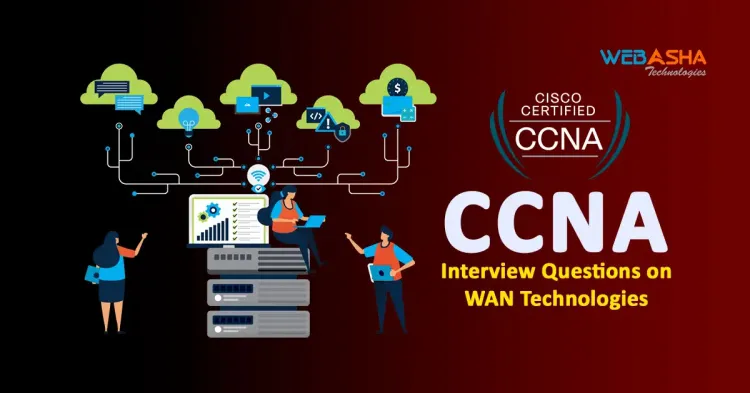
CCNA WAN Interview Questions and Practical Answers

WAN interview answers should identify the service, its handoff and the boundary where evidence changes ownership. A working local Ethernet link does not prove that a remote application or provider service is healthy. The questions below compare leased connectivity, Internet VPNs, MPLS, PPP and software-defined overlays through a fictional branch incident.

CCNA QoS Interview Questions and Practical Answers

QoS interview questions test how traffic is identified, marked and handled when resources are constrained. Explain the bottleneck and policy before naming a queue. Classification and policing can operate without congestion, while scheduling becomes especially important when traffic competes for an output resource.

CCNA DHCP Interview Questions and Practical Answers

DHCP interview answers should distinguish finding a server, receiving an offer, completing an allocation and maintaining a lease. An offer is not proof that a client finished configuration, and a link-local address does not identify the exact failure. The questions below follow an invented new classroom VLAN whose clients cannot obtain the intended addresses.

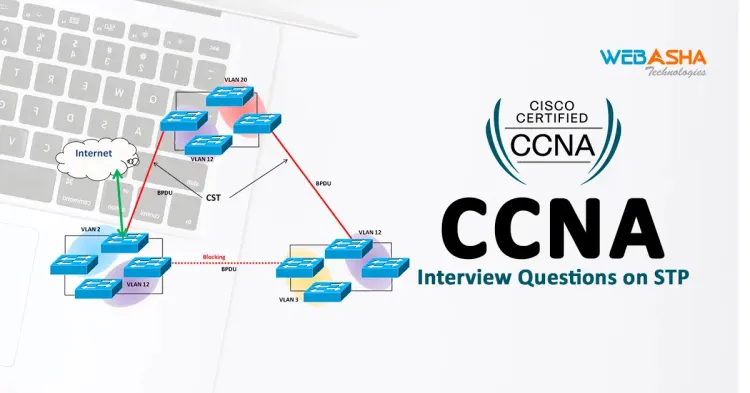
CCNA STP Interview Questions and Practical Answers

Spanning-tree interview answers should explain why a redundant Layer 2 network needs loop prevention, how a root and port roles are selected, and what the operational state actually means. Do not treat every non-forwarding link as a fault. The eight core questions below follow a fictional access switch added beside an existing distribution pair.

BGP Interview Questions for CCNA Learners and Beyond

BGP interview answers should connect reachability with routing policy. A shorter AS path is not automatically the chosen path when an earlier applicable policy attribute differs. The questions below use two supplied upstream routes to show why eligibility, local preference and next-hop reachability must be checked before blaming the protocol. They also cover iBGP, eBGP, communities and route reflection.

CCNA ACL Interview Questions and Practical Answers

ACL interview answers should identify the traffic being matched, the interface and direction where it is evaluated, and what an unmatched packet does in that context. A wildcard mask is a bit-matching rule, not always the inverse of a contiguous subnet mask. The questions below use an invented branch filter review and a checked offline wildcard example.

CCNA EIGRP Interview Questions and Practical Answers

EIGRP interview answers should distinguish the selected successor, a feasible successor and the route computation that happens when an immediately usable replacement is unavailable. The feasibility condition is strict: a neighbour’s reported distance must be less than the applicable feasible distance, not equal to it. The worked example checks that comparison for three supplied candidates without implementing DUAL.

CCNA NAT Interview Questions and Practical Answers

NAT interview questions should separate address translation, port mapping, packet filtering and return-path routing. A translation entry is not permission for every incoming packet, and a working outbound request does not prove that its reply can find the same stateful device. The worked case below interprets supplied dynamic mappings for two protocols sharing an outside port number.

CCNA OSPF Interview Questions and Practical Answers

OSPF interview answers should separate neighbour discovery, adjacency formation, database synchronisation and route selection. A neighbour at 2-Way is not always broken, and a full adjacency does not prove every expected prefix is installed.

CCNA VLAN Interview Questions and Practical Answers

VLAN interview answers should connect endpoint membership, tagging, trunk eligibility and Layer3 forwarding. A VLAN is not encryption, and a trunk does not itself route between VLANs. The worked case below follows a fictional payroll workstation whose VLAN exists on both switches but is absent from one trunk’s allowed list.

CCNA IP Addressing Interview Questions and Answers

IP addressing interview answers should explain what a prefix tells a host about local destinations and when it must use a next hop. Avoid relying on historical address classes or applying one host-count formula to every prefix. The worked case below checks a supplied workstation and two proposed gateway addresses offline. It establishes prefix membership, not whether a gateway is alive or authorised.

CCNA Interview Questions for Experienced Network Engineers

Experienced network interview answers should show technical reasoning, bounded responsibility and the evidence behind a change. Knowing a protocol definition is useful, but the interviewer may also ask how you detect a failed assumption and recover without creating another outage.

Sample CCNA Interview Questions with Practical Answer Cues

A useful sample CCNA interview should test definitions and then change a detail to see whether the explanation still holds. The questions below cover switching, addressing, routing, transport, services and security. Their answer cues distinguish facts that are often blurred together, such as a successful name lookup and working application access.

Eight CCNA Troubleshooting Scenarios with Interview Answers

A troubleshooting interview answer should turn a symptom into a testable hypothesis and request the evidence that could distinguish it from another cause. These eight scenarios use supplied fictional facts about VLANs, routing, DHCP, protective disabling, duplex and default routes. Each answer identifies the next check and a bounded correction, rather than presenting an unverified command as a universal fix.