AI for Threat Detection and Response: How It Works in a SOC
In a security operations centre (SOC), AI helps at each step of handling an alert. Machine learning models flag unusual logins, traffic and process behaviour that fixed rules miss. Scoring and correlation group related alerts into one incident so analysts see fewer, richer cases. Generative AI summarises evidence and drafts investigation notes.
Topic: AI in Cybersecurity in Cybersecurity & Ethical Hacking · Explainer
Also covers: SOC & Blue Team
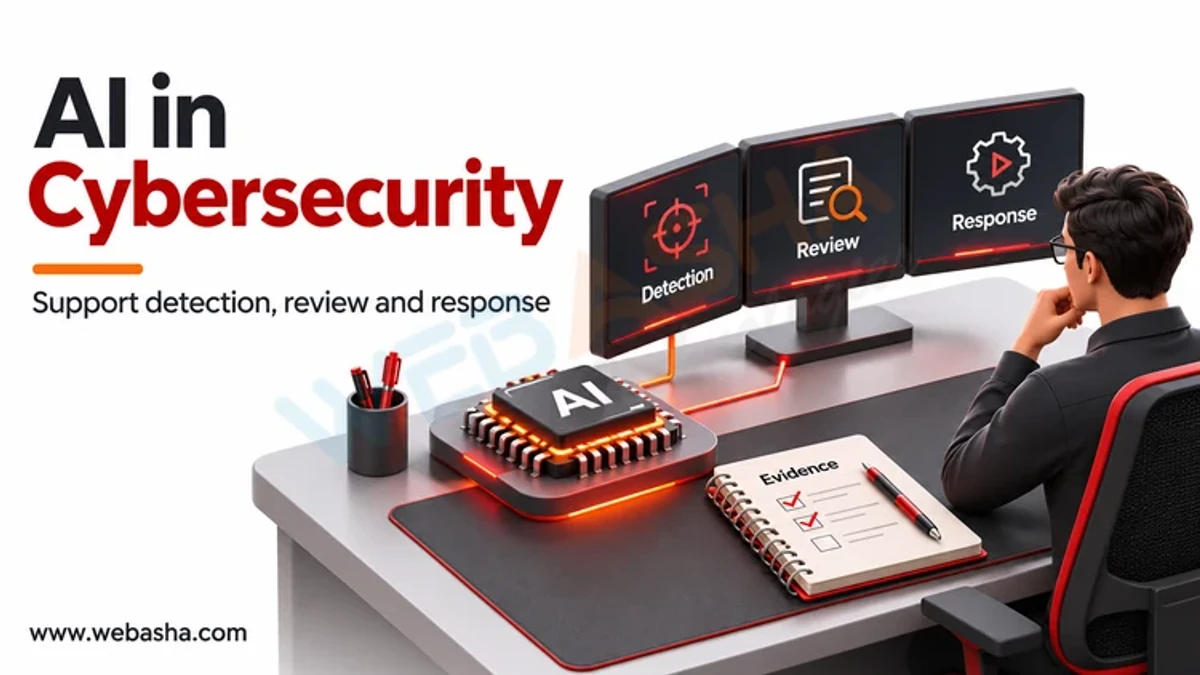
Quick answer: In a security operations centre (SOC), AI helps at each step of handling an alert. Machine learning models flag unusual logins, traffic and process behaviour that fixed rules miss. Scoring and correlation group related alerts into one incident so analysts see fewer, richer cases. Generative AI summarises evidence and drafts investigation notes. Automation playbooks then contain threats, for example by isolating a laptop, usually after an analyst approves. AI reduces noise and speeds up triage, but it produces false positives, can be evaded, and needs human oversight and regular tuning.
Key takeaways
- AI is most useful for triage and correlation, where alert volume overwhelms people.
- Anomaly detection finds unusual behaviour but needs a clean baseline and tuning.
- High impact response actions should keep a human approval step.
- Track metrics such as time to detect and false positive rate before and after adoption.
- Attackers can poison or evade detection models, so models need protection too.
Table of Contents
- How Does an Alert Move Through an AI-Assisted SOC?
- What Kinds of AI Detect Threats?
- How Does AI Help Triage and Investigation?
- Should AI Respond to Threats Automatically?
- How Do You Measure Whether AI Is Helping?
- What Are the Risks of AI-Based Detection?
- What Do Indian Organisations Need to Consider?
- References
How Does an Alert Move Through an AI-Assisted SOC?
NIST SP 800-61 Rev. 3, published in April 2025, ties incident response to the Detect, Respond and Recover functions of NIST CSF 2.0. The table shows where AI fits in that flow.
| Stage | What happens | Where AI helps |
|---|---|---|
| Collect | Logs from endpoints, network, cloud and identity | Parsing and normalising messy log formats |
| Detect | Rules and models raise alerts | Anomaly detection and behaviour models |
| Triage | Analyst decides if an alert matters | Risk scoring and grouping related alerts |
| Investigate | Build a timeline of what happened | Summaries, query suggestions, ATT&CK mapping |
| Respond | Contain, remove and recover | Playbook automation with approval |
| Learn | Review and improve detections | Feedback labels retrain models |
What Kinds of AI Detect Threats?
- Supervised models learn from labelled examples of malicious and benign activity, such as known malware behaviour.
- Unsupervised anomaly detection learns what normal looks like for a user or host and flags departures, such as a login from a new country at 3 a.m.
- User and entity behaviour analytics combine many weak signals into a risk score per account.
- Generative AI assistants do not detect much on their own; they explain alerts and help analysts write queries.
How Does AI Help Triage and Investigation?
Triage is where most analyst time goes. AI correlation can merge a phishing click, a new mailbox rule and an unusual file download into one incident instead of three alerts. Mapping each step to MITRE ATT&CK techniques helps analysts see the stage of an attack and what to look for next.
Generative assistants can draft a timeline from raw events. Analysts must still check each event against the source logs, because summaries can drop or invent details.
Should AI Respond to Threats Automatically?
| Action | Typical automation level |
|---|---|
| Enrich alert with threat intelligence | Fully automatic |
| Block a known malicious hash or domain | Automatic with logging |
| Isolate a workstation | Automatic for high confidence, else analyst approval |
| Disable an executive account | Analyst approval |
| Shut down a production server | Senior approval and change process |
The rule of thumb is simple: the more business impact an action has, the more human review it needs.
How Do You Measure Whether AI Is Helping?
- Mean time to detect and mean time to respond.
- False positive rate per detection rule or model.
- Alerts per analyst per shift.
- Percentage of incidents found by AI that rules missed.
- Coverage of ATT&CK techniques relevant to your environment.
Measure a baseline before adopting a tool. Without one, vendor claims cannot be checked.
What Are the Risks of AI-Based Detection?
Models drift as your environment changes. Attackers can evade models or poison training data, attack classes described in NIST AI 100-2 E2025. Generative assistants connected to SOC tools can be targeted with prompt injection hidden in log data. Govern these tools with the NIST AI RMF and follow CISA guidance on AI for secure deployment.
What Do Indian Organisations Need to Consider?
CERT-In directions require reporting of specified incidents within six hours and keeping ICT system logs for 180 days within India. Good logging is also what AI detection depends on, so meeting the rule helps the SOC too. Personal data in logs is covered by the DPDP Act 2023.
Read more on what a SOC does and how SIEM works. For hands-on practice with alert triage, ask about SOC analyst training.
References
Frequently Asked Questions
What's Your Reaction?
 Like
0
 Dislike
0
 Love
0
 Funny
0
 Wow
0
 Sad
0
 Angry
0

Vaishnavi is a skilled tech professional at the Ethical Hacking Training Institute in Pune, responsible for managing and optimizing the technical infrastructure that supports advanced cybersecurity education. With deep expertise in network security, backend operations, and system performance, she ensures that practical labs, online modules, and assessments run smoothly and securely. Her behind-the-scenes contributions play a vital role in delivering a seamless and secure learning experience for aspiring ethical hackers.