AI and Machine Learning Roles in India and the Skills Each Needs
AI and machine learning work in India spans several distinct roles.
Topic: Machine Learning in AI & Data · Career guidance
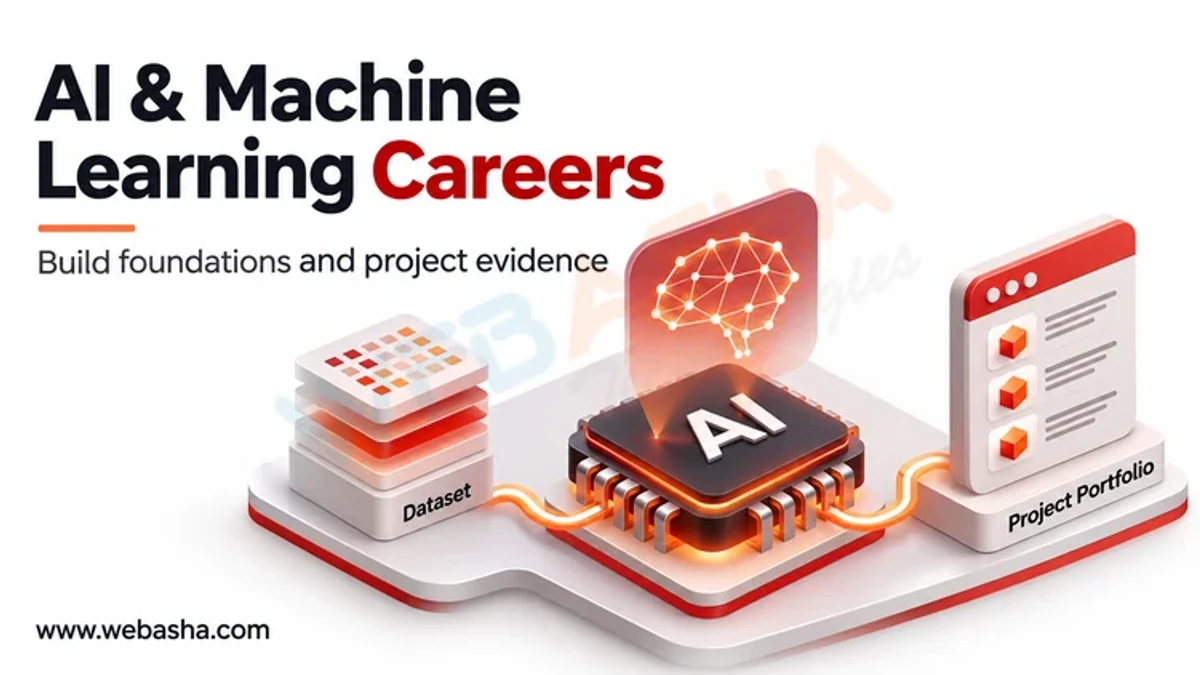
Quick answer: AI and machine learning work in India spans several distinct roles. Machine learning engineers build and deploy models; data scientists explore data and design models; MLOps engineers run the pipelines that train, release and monitor them; LLM application engineers build products on large language models; computer vision and NLP engineers specialise in images or text; research scientists create new methods; AI product managers decide what to build; and AI security specialists protect models and data. All share Python, data handling and basic statistics, but each adds its own depth in maths, software engineering, infrastructure, domain knowledge or security.
Key takeaways
- AI work is a group of roles with different skill mixes, not one job.
- Python, data handling and statistics are the shared base.
- Production roles need software engineering as much as maths.
- AI security is a growing specialty with its own frameworks.
- Nasscom expects new AI-native roles to grow faster than the overall digital workforce.
Table of Contents
- Which AI and ML Roles Exist Today?
- Which Skills Does Each Role Need Most?
- What Separates an ML Engineer From a Data Scientist?
- What Does an LLM Application Engineer Need?
- Where Does AI Security Fit?
- Which New AI Roles Are Emerging in India?
- How Do You Pick the Right AI Role?
- References
Which AI and ML Roles Exist Today?
| Role | Main work |
|---|---|
| Machine learning engineer | Builds, tests and deploys models as software |
| Data scientist | Explores data, designs experiments and models |
| MLOps engineer | Automates training, release, monitoring and rollback |
| LLM application engineer | Builds chat, search and agent features on language models |
| Computer vision or NLP engineer | Specialises in image, video, speech or text models |
| AI research scientist | Develops new methods, usually after advanced study |
| AI product manager | Defines use cases, success measures and risks |
| AI security specialist | Tests and protects models, data and AI pipelines |
Which Skills Does Each Role Need Most?
| Role | Maths depth | Software engineering | Infrastructure | Distinctive skill |
|---|---|---|---|---|
| ML engineer | Medium | High | Medium | Model serving and testing |
| Data scientist | High | Medium | Low | Experiment design and statistics |
| MLOps engineer | Low | High | High | CI/CD, containers, monitoring |
| LLM application engineer | Low to medium | High | Medium | Retrieval, evaluation, prompt security |
| Research scientist | Very high | Medium | Low | Reading and writing papers |
| AI product manager | Low | Low | Low | User research and risk judgement |
| AI security specialist | Medium | Medium | Medium | Threat modelling of AI systems |
What Separates an ML Engineer From a Data Scientist?
A data scientist asks whether a model can answer a question well. An ML engineer makes that model work every day for real users: packaging it, versioning data and models, setting latency targets and watching for drift. Certifications such as the Google Professional Machine Learning Engineer focus on this production side, including monitoring and responsible AI practices.
What Does an LLM Application Engineer Need?
This role combines software development with language model behaviour. Core skills include API integration, retrieval-augmented generation, evaluation datasets, cost and latency control, and guarding against prompt injection and data leakage. The OWASP Top 10 for LLM Applications lists the main risks, and the NIST AI Risk Management Framework gives a structure for managing AI risk across a product's life.
Where Does AI Security Fit?
AI security specialists study how models can be attacked or misused and how to defend them. MITRE ATLAS catalogues adversary tactics against AI systems, and the NICE Framework v2.2.0 includes an Artificial Intelligence Security competency area. Demand is visible in workforce research: in ISC2's India findings from its 2025 workforce study, AI was the most cited skills need, at 52% of respondents.
Which New AI Roles Are Emerging in India?
Nasscom's Strategic Review 2026 says AI-native roles are set to expand faster than the overall digital workforce. It names new positions such as AI reliability engineers, orchestrators, human-AI managers, process architects and trainers, alongside traditional AI and ML roles. The government's IndiaAI Mission is also funding compute, datasets and skilling programmes.
How Do You Pick the Right AI Role?
Match the role to what you already do well. Developers move most easily into ML engineering or LLM application work. Statistics graduates suit data science. System administrators and DevOps staff fit MLOps. Security professionals can specialise in AI security. Business analysts can grow into AI product roles. The WEF Future of Jobs Report 2025 lists AI and machine learning specialists among the fastest-growing roles globally and in India, but research roles usually expect postgraduate study. For a step-by-step plan, see our AI and machine learning starter roadmap, and compare with data science roles compared. WebAsha Technologies offers AI and machine learning training.
References
- World Economic Forum: Future of Jobs Report 2025
- Nasscom Strategic Review 2026, executive summary
- NIST AI Risk Management Framework
- OWASP Top 10 for LLM Applications
- MITRE ATLAS
- NIST NICE Framework, current version
- ISC2: India cybersecurity workforce research
- Google Cloud Professional Machine Learning Engineer
- IndiaAI Mission
Frequently Asked Questions
What's Your Reaction?
 Like
0
 Dislike
0
 Love
0
 Funny
0
 Wow
0
 Sad
0
 Angry
0

Vaishnavi is a skilled tech professional at the Ethical Hacking Training Institute in Pune, responsible for managing and optimizing the technical infrastructure that supports advanced cybersecurity education. With deep expertise in network security, backend operations, and system performance, she ensures that practical labs, online modules, and assessments run smoothly and securely. Her behind-the-scenes contributions play a vital role in delivering a seamless and secure learning experience for aspiring ethical hackers.