EX280 Preparation: Practical Tasks and Readiness Checks
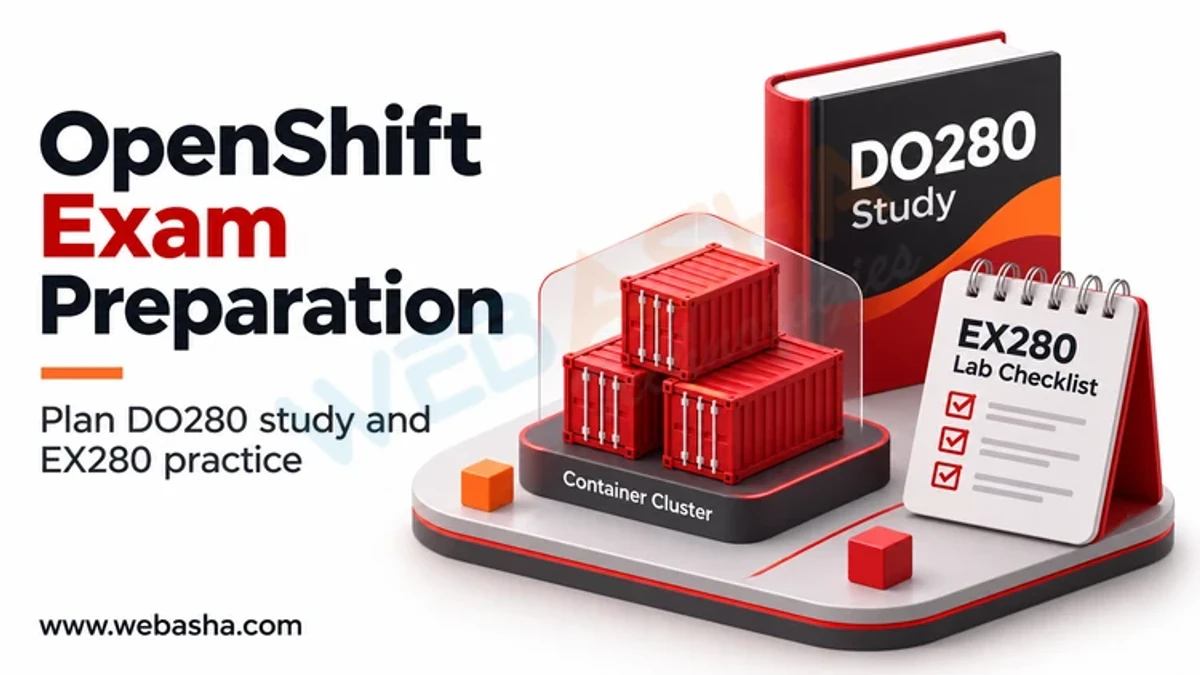
Prepare for EX280 by matching your assigned exam version to the published objectives, then practicing complete tasks with independent validation. Build skill before adding time pressure. This guide uses an original scheduling exercise in which a required placement rule prevents a second replica from running, despite an accepted configuration update.
Topic: OpenShift in IT Infrastructure · Certification preparation
Learning path: OpenShift Administrator, lesson 10 of 13

Quick answer: Prepare for EX280 by matching your assigned exam version to the published objectives, then practicing complete tasks with independent validation. Build skill before adding time pressure. This guide uses an original scheduling exercise in which a required placement rule prevents a second replica from running, despite an accepted configuration update. It also shows how to organize access, quotas, networking and troubleshooting practice without relying on protected exam questions or a first-attempt guarantee.
Key takeaways
- Confirm the version assigned to your intended EX280 booking.
- Practice the required state and its verification together.
- Distinguish API acceptance from workload availability.
- Keep required placement constraints separate from preferences.
- Read the purchase and delivery terms for your actual product.
Table of Contents
- Which EX280 version and award should you prepare for?
- What preparation should come before timed practice?
- Why might the second replica remain Pending after a successful apply?
- How should you organize the published skills into practice blocks?
- What does useful task validation look like?
- How can you practice under time pressure without rushing?
- What should you check before booking the first attempt?
- References
Which EX280 version and award should you prepare for?
Start with the official EX280 page and the version assigned to your intended exam. As checked on 15 November 2026, the public page describes OpenShift Container Platform 4.22 and the Red Hat Certified System Administrator in OpenShift award. It also explicitly says multiple exam versions are in use and directs candidates to their designated objectives.
Do not assume an old course recording matches your booking. Save a dated objective checklist and confirm the applicable environment through the issuer's scheduling and learning systems. Exam preparation should use original exercises that test the published skills, rather than recalled or protected examination items.
A first attempt is a planning constraint, not something a trainer can guarantee. Read each task carefully and preserve time for validation.
What preparation should come before timed practice?
You should be comfortable navigating Linux, reading YAML, identifying container images and interpreting Kubernetes resources. Practice checking the selected project, resource names and identity before changing anything in an approved lab.
The DO280 course page describes administration, multitenancy, security and declarative workflows. Use its recommended preparation to identify gaps; course attendance and demonstrated skill are different evidence.
Make a simple baseline review. Can you explain a desired replica count, distinguish a Service from a workload, and locate the reason a pod is not scheduled? If you cannot, work through those concepts slowly before adding a timer. Memorized command fragments are fragile when the resource name or constraint changes.
Why might the second replica remain Pending after a successful apply?
In this original paper exercise, a workload requests two replicas. Its required pod anti-affinity rule separates matching application pods by node hostname. Only one node is eligible for either pod, the relevant labels and selector are correct, and the first replica already runs there. Assume other scheduling requirements are satisfied.
The second replica cannot share that hostname while meeting the required rule. A successful API update establishes that the requested configuration was accepted, not that both replicas can be scheduled. The scheduling guide distinguishes required constraints from preferences.
Inspect the supplied scheduling events and eligibility facts before proposing a fix. Do not weaken the requirement merely to make a status indicator green. Ask whether another eligible node should be provided or whether the owner intended a softer placement preference.
| Supplied fact | Meaning | Next review |
|---|---|---|
| Two requested replicas | Desired workload count is two | Check actual pod states separately |
| Required hostname separation | Matching pods cannot share the relevant node domain | Review the intended availability requirement |
| One eligible node, first pod present | No second eligible hostname is available | Check why other nodes are excluded |
| Apply accepted | API request succeeded | Inspect scheduling and application acceptance |
This is constraint reasoning from supplied facts, with no cluster, scheduler or command execution. In a real approved lab, events may reveal additional blockers such as taints, capacity or storage topology; keep those possibilities separate from this simplified case.
How should you organize the published skills into practice blocks?
Pair each objective with an action and a verification step. For access control, check the intended user's permitted operations rather than testing only as an administrator. The RBAC reference explains additive permissions; one narrow role does not cancel a grant from another binding.
For quotas, distinguish an API admission rejection from a later scheduling problem. Resource-quota documentation explains that a quota violation can prevent resource creation. For network isolation, account for the cluster's enforcement implementation as well as policy selectors; the NetworkPolicy guide describes those dependencies.
| Practice block | Original task idea | Acceptance evidence |
|---|---|---|
| Declarative management | Change a supplied workload requirement | Intended resource fields and observed workload state |
| Identity and access | Delegate a bounded project operation | Relevant action checked as the intended subject |
| Quotas and limits | Explain a supplied admission rejection | Correct scope, resource use and rejection reason |
| Networking | Express an approved communication requirement | Relevant allowed and blocked paths checked in the lab |
| Troubleshooting | Resolve an explicitly supplied placement conflict | Owner requirement preserved and workload rechecked |
What does useful task validation look like?
Check more than object existence. A workload may exist while pods are Pending; a Service may exist while the intended application is unavailable; a permission change may work for an administrator but fail for the target identity.
Use the documentation for the actual platform version. The OpenShift 4.22 documentation set provides product-specific context, while upstream Kubernetes pages explain underlying concepts. Avoid treating every upstream feature as supported identically in every OpenShift release.
In the anti-affinity exercise, acceptance includes both the intended separation and the required replica availability. If the owner changes the requirement, record that decision before changing configuration. Otherwise you may solve a different task from the one assigned.
How can you practice under time pressure without rushing?
Start untimed and record why each task failed. Common gaps include wrong project context, misunderstood selectors, missing verification and applying a remembered solution before reading the requirement.
Then repeat a fresh variant with different resource names or constraints. Keep a short decision log: observation, interpretation, proposed change and result. Add timing only after the workflow is repeatable.
During a timed session, read all requirements, identify dependencies and complete a bounded task before moving on. Reserve a final review for the exact requested state. Repeatedly rebuilding the same broken setup without understanding it is less useful than one carefully explained correction.
What should you check before booking the first attempt?
Confirm your exam version, identity-verification arrangements, delivery requirements and purchase validity. Red Hat Training Policies distinguish scheduling, rescheduling, no-show consequences and product-specific retake arrangements. Do not assume every subscription and standalone purchase has identical terms.
Use an independent practice review as a readiness decision. Ask someone to change one supplied fact and explain how your answer changes. For the placement case, replacing a required rule with a preference changes the constraint, but does not remove other scheduling requirements.
Book when you can complete representative tasks, diagnose common failures and verify the intended state within the available time. A pass promise adds no evidence to that decision.
Related reading: OpenShift original practice questions; RHCSA practical readiness.
References
- Red Hat EX280: System Administrator in OpenShift exam
- Red Hat DO280: Configuring a Production Cluster
- Kubernetes scheduling constraints
- Kubernetes role-based access control
- Kubernetes resource quotas
- Kubernetes network policies
- OpenShift Container Platform 4.22 documentation
- Red Hat Training Policies
Frequently Asked Questions
What's Your Reaction?
 Like
0
 Dislike
0
 Love
0
 Funny
0
 Wow
0
 Sad
0
 Angry
0

With a passion for staying on the cutting edge of technology trends, I am dedicated to delivering content that not only informs but also inspires. Whether you need in-depth analysis pieces, informative guides, or thought-provoking opinion pieces, I craft content that resonates with tech enthusiasts and professionals alike.